Akhilesh Yadav: Only those who fight for public good will rise

Synopsis
Samajwadi Party president Akhilesh Yadav posted a sharp Hindi declaration on 7 July 2026 — 'Only the one who struggles for public welfare will rise' — signalling ideological mobilisation ahead of the 2027 Uttar Pradesh assembly elections.
Key Takeaways
Akhilesh Yadav posted on 7 July 2026 : 'Jo jan hit ke liye sangharsh karega, vahi badhega!' — 'Only the one who fights for public welfare will rise.' The post, accompanied by a video, targets Samajwadi Party cadre and the Uttar Pradesh electorate ahead of the 2027 assembly elections .
The message reflects the party's founding socialist ideology, rooted in welfare for OBCs, minorities, and youth .
As Chief Minister (2012–2017) , Akhilesh Yadav backed welfare schemes including free laptops and bicycles for students.
The statement implicitly positions SP as the authentic public-interest alternative to the ruling BJP in Uttar Pradesh.
Such motivational messaging typically precedes formal organisational drives and booth-level outreach campaigns.
Samajwadi Party president Akhilesh Yadav on Tuesday, 7 July 2026, posted a pointed message on X, declaring that only those who struggle for the welfare of the people will ultimately prevail — a statement that encapsulates the party's long-standing socialist ethos ahead of a politically charged period in Uttar Pradesh.
Context
The post, written in Hindi, reads: 'Jo jan hit ke liye sangharsh karega, vahi badhega!' — 'Only the one who struggles for the welfare of the people will rise!' The brevity of the message is characteristic of Akhilesh Yadav's social media style: a short, ideologically loaded phrase aimed at both party cadre and the broader electorate. The statement carries an implicit contrast with political rivals, positioning the Samajwadi Party as the authentic champion of public interest.
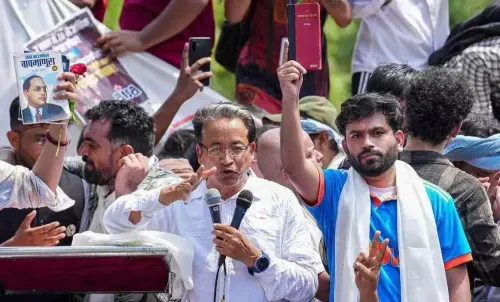
The post accompanies a video, the contents of which are consistent with the party's tradition of sharing speeches or rally footage to amplify such messaging across its support base. No specific event or occasion was cited in the post itself.
Policy Backdrop
The Samajwadi Party, founded by Mulayam Singh Yadav, has historically anchored its identity in welfare politics targeting Other Backward Classes (OBCs), minorities, and youth. During Akhilesh Yadav's tenure as Chief Minister of Uttar Pradesh from 2012 to 2017, the government launched flagship schemes including free laptops and bicycles for students, framing governance explicitly as service to the common person.
That welfare-centric lineage makes the July 2026 message a direct continuation of the party's ideological branding. Socialist rhetoric of this kind has been a consistent tool for maintaining cadre enthusiasm and public identification with the party between election cycles.
Stakeholders and Impact
The primary audience for such messaging is the party's vast network of workers across Uttar Pradesh, India's most populous state and the decisive battleground for any national political ambition. By framing political success as inseparable from public service, Akhilesh Yadav reinforces a moral hierarchy within the organisation — rewarding those who engage in grassroots welfare work.
The broader UP electorate, particularly voters from OBC communities, minorities, and youth demographics, receives a signal about the party's priorities. In a state where the Bharatiya Janata Party has held power since 2017, such statements serve as a counter-narrative, asserting that genuine public welfare remains the Samajwadi Party's defining mission.
What's Next
The 2027 Uttar Pradesh assembly elections are the most significant political event on the horizon for the Samajwadi Party, and organisational groundwork is expected to intensify through the coming months. Statements of this nature are typically precursors to formal mobilisation drives, booth-level outreach, and the announcement of welfare-focused policy planks.
Observers will watch whether this message is followed by concrete programmatic announcements or organisational meetings that translate the rhetoric of public struggle into an electoral platform capable of challenging the incumbent government.
Point of View
A distinction that matters for cadre retention in the long inter-election stretch. Placed against the backdrop of the 2027 UP assembly contest, the post reads as an early mobilisation cue, reminding workers that grassroots welfare work is the currency of advancement within the party. The consistency of this messaging across decades suggests it is less improvisation than institutional doctrine.
NationPress
7 Jul 2026
Frequently Asked Questions
What did Akhilesh Yadav post on 7 July 2026?
Akhilesh Yadav posted a Hindi message stating 'Jo jan hit ke liye sangharsh karega, vahi badhega!' — meaning 'Only the one who struggles for public welfare will rise!' — along with a video on X.
Why did Akhilesh Yadav post this message?
The post reflects the Samajwadi Party's long-standing socialist ideology and is consistent with the pattern of motivational messaging directed at party cadre during periods of political mobilisation ahead of elections.
What are the Samajwadi Party's welfare credentials in Uttar Pradesh?
During Akhilesh Yadav's tenure as Chief Minister from 2012 to 2017, the SP government launched welfare schemes such as free laptops and bicycles for students, positioning public service as central to its governance model.
How does this post relate to the 2027 UP elections?
Political observers see such welfare-centric rhetoric as an early signal of pre-poll mobilisation, with the Samajwadi Party expected to intensify organisational activity and policy positioning ahead of the 2027 Uttar Pradesh assembly elections.
What is the Samajwadi Party's ideological base?
The Samajwadi Party, founded by Mulayam Singh Yadav, is a socialist party primarily active in Uttar Pradesh, with its core support among OBC communities, minorities, and youth.