Akhilesh Yadav slams BJP over Ayodhya waterlogging
Synopsis
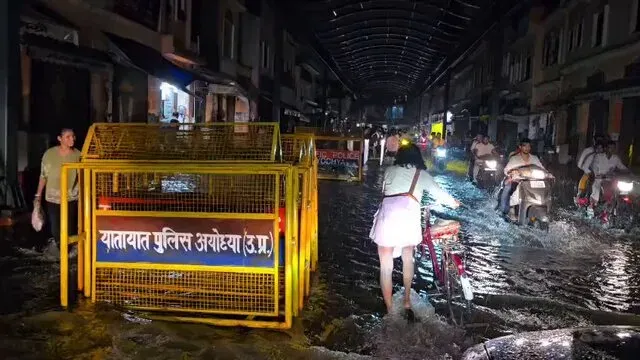
Samajwadi Party president Akhilesh Yadav on 15 July 2026 attacked the BJP government over waterlogging in Ayodhya, calling it a mockery of the ruling party's claims of international-level development in the historic city.
Key Takeaways
Samajwadi Party president Akhilesh Yadav posted on X on 15 July 2026 attacking the BJP over conditions in Ayodhya .
Yadav alleged Ayodhya has been left waterlogged due to BJP's misdeeds and the state government's administrative disorder.
The post included a video and was framed as a rebuttal to BJP's claims of delivering international-level development in Ayodhya.
The Ram Temple was inaugurated in Ayodhya on 22 January 2024 , after which the UP government launched multiple infrastructure projects to promote the city as a global pilgrimage hub.
Opposition parties including the Samajwadi Party have consistently highlighted gaps between project announcements and civic service delivery in Ayodhya.
Samajwadi Party president Akhilesh Yadav on Wednesday, 15 July 2026 launched a sharp attack on the Bharatiya Janata Party, alleging that Ayodhya — projected by the ruling party as an international-class development showcase — has been reduced to a waterlogged city due to BJP's misdeeds and administrative failure.
In his post on X, Yadav wrote: 'Pehle BJP ke kukrityon se Ayodhya paani-paani ho gaya aur ab BJP sarkar ki avyavastha ke kaaran' ('First, Ayodhya was drowned by BJP's misdeeds, and now because of the BJP government's disorder'). He added sarcastically that this is what the BJP's claim of international-level development in Ayodhya amounts to.
Context
The post, which was accompanied by a video, follows recurring concerns about the state of civic infrastructure in Ayodhya — a city the Uttar Pradesh government has aggressively promoted as a global pilgrimage and tourism destination. Yadav, a former Chief Minister of Uttar Pradesh and current Lok Sabha MP, has consistently raised questions about the gap between official development claims and on-ground realities in the state.
The reference to Ayodhya being 'paani-paani' (submerged in water) points to waterlogging or flooding conditions in the city, which Yadav attributes directly to the BJP government's administrative failures.
Policy Backdrop
The Ram Temple in Ayodhya was inaugurated on 22 January 2024 by Prime Minister Narendra Modi, marking the centrepiece of the BJP's cultural and tourism development agenda. In the months that followed, the Uttar Pradesh government accelerated a range of infrastructure projects — including the Maharishi Valmiki International Airport, expanded road networks, and urban renewal schemes — to position Ayodhya as a world-class pilgrimage hub.
BJP governments at both the Centre and in Uttar Pradesh have framed religious-site redevelopment at locations such as Ayodhya and Varanasi as a core economic and cultural policy plank. Critics, including the Samajwadi Party, have repeatedly argued that headline infrastructure announcements have outpaced delivery on basic civic services such as drainage, sanitation, and land management.
Stakeholders and Impact
Ayodhya's residents, pilgrims, and the tourism economy that has grown significantly since January 2024 are directly affected by the city's civic infrastructure performance. Waterlogging during the monsoon season can disrupt access to the Ram Temple complex, deter pilgrim footfall, and damage the international tourism image the state government has invested heavily in building.
For the Samajwadi Party, Ayodhya represents a politically sensitive battleground. The party has sought to shift the conversation from BJP's temple-centric narrative to questions of governance quality and service delivery for ordinary citizens and visitors alike.
What's Next
Official post-monsoon assessments of Ayodhya's drainage and civic works are expected to be closely watched, as are any questions raised in the Uttar Pradesh Legislative Assembly or Parliament regarding infrastructure spending and outcomes in the city. Yadav's post is likely to intensify political pressure on the state government to provide a formal account of the situation on the ground.
With Uttar Pradesh remaining a key electoral battleground, the BJP-SP contest over Ayodhya's development story — whether it is a symbol of resurgent India or of governance failure — is set to sharpen through the remainder of 2026.
Point of View
The Samajwadi Party is targeting a perception gap that tends to resonate with residents and small traders who live with the city's infrastructure daily. This fits a broader opposition pattern of using monsoon-season civic failures — flooding, potholes, power outages — as evidence that headline projects mask neglected basics. The exchange signals that Ayodhya will remain a fiercely contested symbol in Uttar Pradesh politics well into the next electoral cycle.
NationPress
15 Jul 2026
Frequently Asked Questions
Why is Akhilesh Yadav criticising the BJP over Ayodhya?
Akhilesh Yadav alleged on 15 July 2026 that Ayodhya has been left waterlogged due to the BJP government's misdeeds and administrative failure, calling it a contradiction of the ruling party's claims of international-level development in the city.
What development projects has the BJP undertaken in Ayodhya?
After the Ram Temple inauguration on 22 January 2024, the Uttar Pradesh government accelerated projects including the Maharishi Valmiki International Airport, road network expansion, and urban renewal schemes to position Ayodhya as a global pilgrimage hub.
When was the Ram Temple in Ayodhya inaugurated?
The Ram Temple in Ayodhya was inaugurated on 22 January 2024 by Prime Minister Narendra Modi.
What does 'paani-paani ho gaya' mean in Akhilesh Yadav's post?
The Hindi phrase 'paani-paani ho gaya' literally means 'submerged in water' or 'flooded,' and Yadav used it to allege that Ayodhya is experiencing waterlogging due to the BJP government's poor infrastructure management.
How has the Samajwadi Party responded to BJP's Ayodhya development claims before?
The Samajwadi Party has consistently argued that BJP's infrastructure announcements for Ayodhya have not translated into adequate civic services, including drainage and sanitation, for residents and visitors.