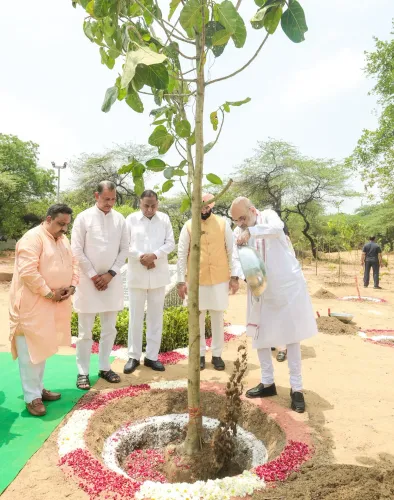
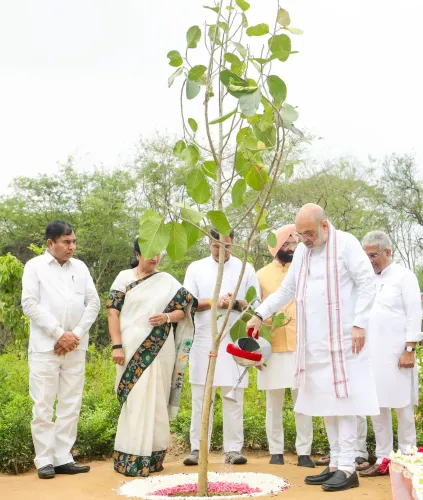
Amit Shah announces 8 themed forests for Delhi Ridge

Synopsis
Union Home Minister Amit Shah announced plans to develop eight culturally themed forests — including Panchavati Van, Nakshatra Van, and Tirthankara Van — across the Delhi Ridge, combining ecological restoration with India's civilisational heritage.
Key Takeaways
Eight themed forests — Panchavati Van, Nakshatra Van, Bel Van, Ritu Van, Rishi Van, Tirthankara Van, Vaman Vriksha Van, and Purani Vatika — are proposed for the Delhi Ridge .
The announcement was made by Union Home Minister Amit Shah on 7 July 2026 via his official X account.
The Delhi Ridge is a reserved forest and the capital's primary biodiversity corridor, protected since the 1980s–1990s .
The themed-forest concept draws on Hindu, Jain, astronomical, and seasonal traditions, reflecting a policy preference for culturally framed urban greening.
The Delhi Forest Department and DDA are the likely implementing agencies, with alignment expected under the Delhi Master Plan 2041 .
The model could serve as a replicable blueprint for culturally grounded urban forest projects in other Indian cities.
Union Home Minister Amit Shah on Tuesday, 7 July 2026, announced plans to develop eight specially themed forests across the Delhi Ridge, outlining a vision that blends ecological restoration with India's cultural and civilisational heritage.
Context
Shah's post listed eight distinct forest themes to be developed in the Ridge area: Panchavati Van, Nakshatra Van, Bel Van, Ritu Van, Rishi Van, Tirthankara Van, Vaman Vriksha Van, and Purani Vatika (Old Garden). Each theme draws from a specific strand of Indian tradition — ranging from the sacred grove concept of Panchavati to astronomical-botanical grids inspired by Nakshatra (star-constellation) systems, and groves dedicated to sages, Jain Tirthankaras, and seasonal cycles.
The announcement was accompanied by a video and posted on Shah's official X account, signalling a formal policy direction rather than a routine ceremonial statement.
Policy Backdrop
The Delhi Ridge is the northern extension of the ancient Aravalli Range, running through the heart of the national capital and notified as a reserved forest in successive phases during the 1980s and 1990s. It functions as Delhi's primary green lung and biodiversity corridor.
Urban forest development on the Ridge has featured in every Delhi Master Plan since 1962, with plantation drives intensifying after reserved-forest notifications. The current proposal follows a broader administrative pattern of framing urban greening through cultural motifs — an approach mirrored in similar Nakshatra and Ritu Van projects undertaken at the state level across India.
The Ministry of Home Affairs, headed by Shah, exercises administrative oversight over the National Capital Territory of Delhi, giving the Union government a direct role in land-use and environmental decisions affecting the Ridge.
Stakeholders and Impact
The primary beneficiaries are Delhi's approximately 3.3 crore residents, who stand to gain expanded green cover, improved air quality, and accessible public forest spaces. Urban foresters, ecologists, and heritage conservationists are also key stakeholders, as the themed-forest model requires both botanical expertise and cultural curation.
The inclusion of a Tirthankara Van and Rishi Van signals outreach to Jain and Hindu communities for whom these groves carry devotional significance. A Vaman Vriksha Van — a forest of dwarf or miniature trees — adds a horticultural dimension that could serve educational and research purposes.
Civil society groups and environmental advocates who have historically opposed commercial encroachment on the Ridge may broadly welcome the greening intent, though the pace and implementing agencies remain to be confirmed.
What's Next
Attention will now turn to the Delhi Forest Department and the Delhi Development Authority (DDA) for progress reports on zoning, plantation schedules, and budget allocations for the eight themed forests. Any revisions to the Delhi Master Plan 2041 that earmark specific Ridge compartments for these projects will be a key indicator of how quickly the announcement translates into ground-level action.
If implemented as outlined, the themed-forest grid could set a replicable model for other Indian cities seeking to combine biodiversity goals with cultural identity in urban green-space planning.
Point of View
Rishi, and Tirthankara vocabularies, the initiative simultaneously advances a green-cover agenda and a broader civilisational-identity narrative — a dual-register that has become a consistent feature of BJP-led environmental communication. The Ridge, long contested between developers and conservationists, gains renewed political salience as a site of cultural as well as ecological assertion. Whether the eight themed forests move from announcement to plantation will ultimately test the coordination between Union oversight and Delhi's on-ground agencies.
NationPress
7 Jul 2026
Frequently Asked Questions
What are the eight themed forests planned for the Delhi Ridge?
The eight themed forests announced for the Delhi Ridge are Panchavati Van, Nakshatra Van, Bel Van, Ritu Van, Rishi Van, Tirthankara Van, Vaman Vriksha Van, and Purani Vatika (Old Garden), each drawing on a distinct strand of Indian cultural or natural heritage.
What is the Delhi Ridge and why is it important?
The Delhi Ridge is the northern extension of the Aravalli Range running through the national capital. Notified as a reserved forest in the 1980s and 1990s, it serves as Delhi's primary green lung and biodiversity corridor.
Who announced the themed forests on the Delhi Ridge?
Union Home Minister Amit Shah announced the plan on 7 July 2026 through a post on his official X account.
Which agencies will implement the Delhi Ridge forest project?
The Delhi Forest Department and the Delhi Development Authority (DDA) are the most likely implementing agencies, though specific timelines and responsibilities had not been officially confirmed at the time of the announcement.
What is a Nakshatra Van?
A Nakshatra Van is a forest or garden where trees and plants are mapped to the 27 lunar constellations (Nakshatras) of Indian astronomy, with each species traditionally associated with a specific star cluster. Several Indian states have developed such botanical grids on public land.