Amit Shah: Cabinet Clears NIPU-2026 for Urea Self-Reliance
Synopsis
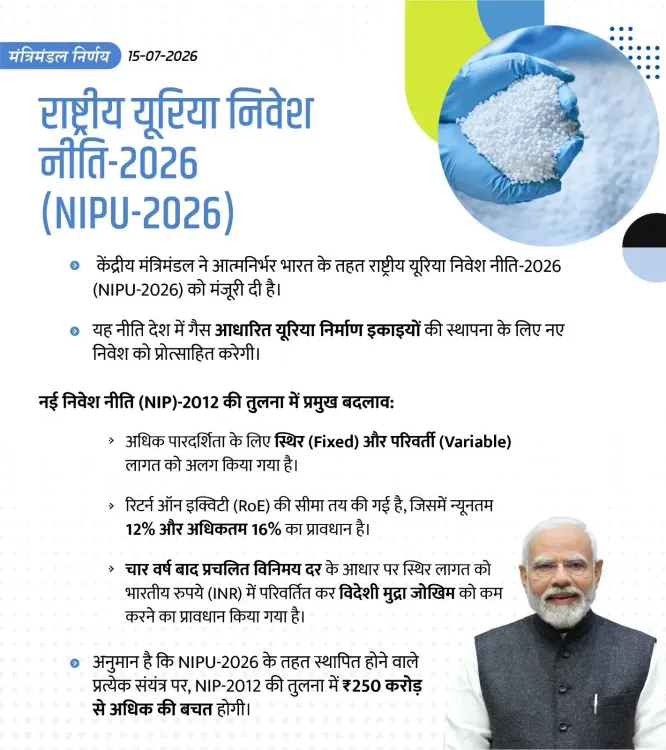
The Union Cabinet on 15 July 2026 approved NIPU-2026, a policy guaranteeing 12–16% assured returns for gas-based urea manufacturers and switching transactions to rupees, projecting savings of over ₹250 crore per new plant as India pushes for urea self-reliance.
Key Takeaways
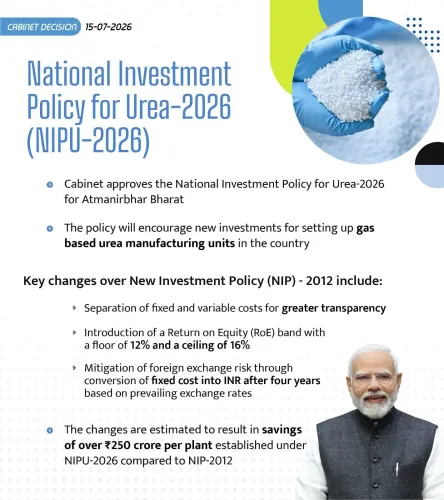
The Union Cabinet approved the National Urea Investment Policy-2026 (NIPU-2026) on 15 July 2026 .
The policy targets fresh investment in gas-based urea manufacturing to reduce import dependence.
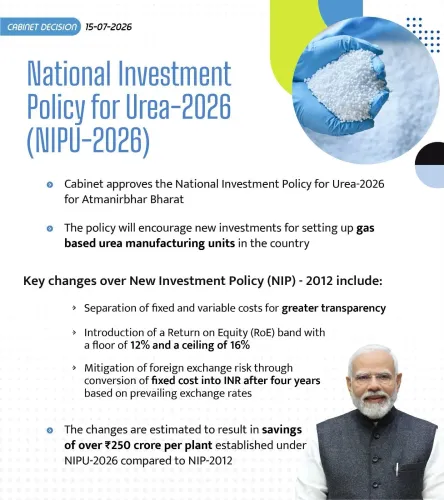
Companies investing under the policy are guaranteed a fixed return of 12–16 per cent .
Transactions will shift from dollars to rupees , cutting foreign-exchange risk.
Each new plant is projected to save more than ₹250 crore under the new framework.
The move builds on earlier policies including the New Urea Policy 2015 and the Atmanirbhar Bharat Abhiyan .
Union Home Minister Amit Shah on Wednesday, 15 July 2026 announced that the Union Cabinet, under the leadership of Prime Minister Narendra Modi, has approved the National Urea Investment Policy-2026 (NIPU-2026), a framework aimed at boosting domestic gas-based urea manufacturing and reducing India's dependence on imports.
Context
Posting on X, Shah described the cabinet decision as 'aatmanirbharta ko badhawa dene ki disha mein aham qadam' — 'an important step towards promoting self-reliance' in the urea sector. The policy is designed to attract fresh investment into gas-based urea plants, make the fertiliser sector 'more transparent and competitive', and reduce India's foreign-exchange exposure by shifting transactions from dollars to rupees.
According to Shah's post, the new policy guarantees companies a fixed return of 12–16 per cent, a provision intended to de-risk private capital entering the sector. The rupee-denominated transaction mechanism is projected to save more than ₹250 crore per new plant, strengthening the economics of greenfield capacity addition.
Policy Backdrop
India has long grappled with a structural gap between domestic urea production and farm-sector demand, bridged each year by costly imports that strain foreign-exchange reserves. The New Urea Policy 2015 had earlier revised subsidy norms and encouraged brownfield expansion of existing units, while the Atmanirbhar Bharat Abhiyan of 2020 identified fertilisers as a priority sector for domestic manufacturing.
Parallel efforts under the current government have included the revival of shuttered public-sector fertiliser units and the negotiation of long-term liquefied natural gas supply agreements to ensure feedstock security for gas-based plants. NIPU-2026 builds on this lineage by providing a clearer, more predictable returns framework that investors had long demanded before committing to capital-intensive urea projects.
The shift to rupee-denominated settlements also aligns with a broader government push to de-risk payments across critical import-dependent sectors, reducing vulnerability to dollar volatility in global commodity markets.
Stakeholders and Impact
Fertiliser companies stand to benefit most immediately, gaining assured returns and a more transparent pricing environment that reduces project-level financial uncertainty. For Indian farmers, the long-term promise is greater domestic availability of urea, which could help stabilise supply chains and insulate farm-input costs from global price swings.
The government's subsidy outlay on urea — one of the largest line items in the fertiliser budget — could also see structural relief over time as domestic capacity displaces high-cost imports. The Department of Fertilizers is expected to issue plant-wise approvals and commissioning timelines under the new policy framework.
What's Next
Detailed notifications from the Department of Fertilizers outlining eligibility criteria, application procedures, and gas-linkage arrangements for new plants under NIPU-2026 are anticipated in the coming weeks. Parliamentary scrutiny of revised subsidy projections linked to the policy is likely during the next budget session.
The pace at which private and public-sector players file investment proposals under the new framework will be a key indicator of whether the assured-return model succeeds in unlocking the large-scale capacity addition that successive administrations have sought. India's trajectory toward urea self-sufficiency will depend heavily on how quickly these plants move from approval to commissioning.
Point of View
By resolving the returns-certainty problem that had stalled investment under earlier frameworks. The rupee-settlement provision is notable: it mirrors steps taken in oil and defence procurement and signals a systematic effort to reduce dollar dependency across strategic sectors. For the BJP government, a credible path to urea self-sufficiency carries both economic and political weight — lower import bills ease the fiscal burden of farm subsidies, while visible action on Atmanirbhar Bharat reinforces a core campaign narrative ahead of state elections. The real test will be whether the assured-return model translates into ground-breaking of new plants within a policy cycle.
NationPress
15 Jul 2026
Frequently Asked Questions
What return is guaranteed to companies under NIPU-2026?
Under NIPU-2026, companies investing in new gas-based urea plants are guaranteed a fixed return of 12 to 16 per cent, providing greater financial certainty for capital-intensive projects.
How does NIPU-2026 reduce foreign-exchange risk?
The policy shifts urea-related transactions from US dollars to Indian rupees, insulating investors and the government from dollar volatility and reducing the foreign-exchange exposure associated with fertiliser imports and feedstock procurement.
How much can India save per urea plant under the new policy?
According to the cabinet announcement shared by Home Minister Amit Shah, the rupee-transaction mechanism and revised investment norms are projected to save more than ₹250 crore for each new urea plant set up under NIPU-2026.
How does NIPU-2026 relate to Atmanirbhar Bharat?
Fertilisers were identified as a priority sector under the Atmanirbhar Bharat Abhiyan launched in 2020. NIPU-2026 is the latest in a series of policy steps — following the New Urea Policy 2015 and revival of closed public-sector units — aimed at building domestic urea capacity and reducing India's reliance on imports.