Cabinet Clears 43-km Elevated Corridor Along Varuna River in Varanasi
Synopsis
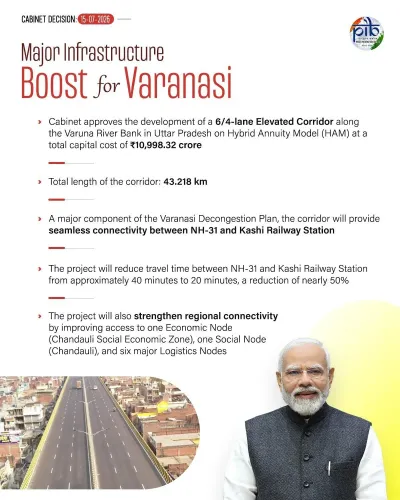
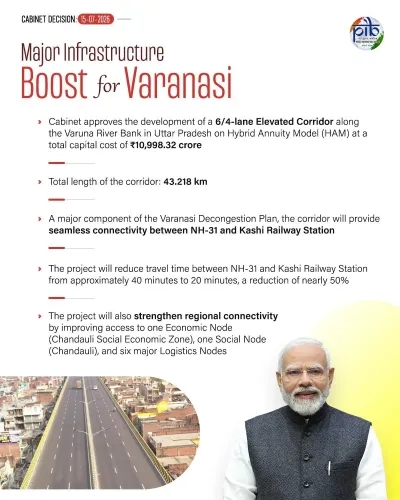
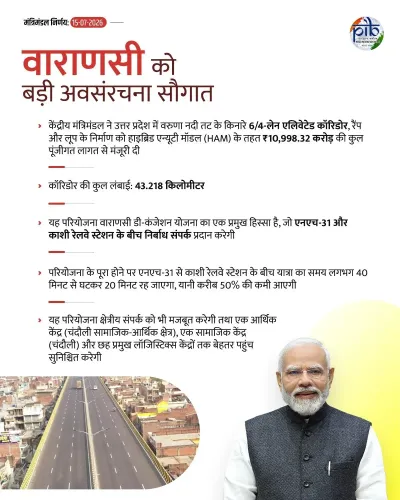
The Union Cabinet has approved a 43.218-km six- and four-lane elevated corridor along the Varuna River in Varanasi, a move Union Jal Shakti Minister C. R. Paatil says will boost connectivity, cut travel time, and strengthen the logistics network across Purvanchal in eastern Uttar Pradesh.
Key Takeaways
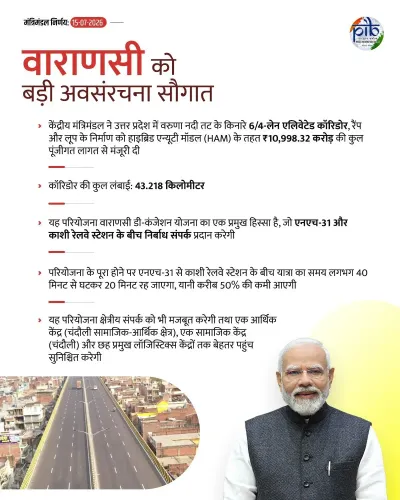
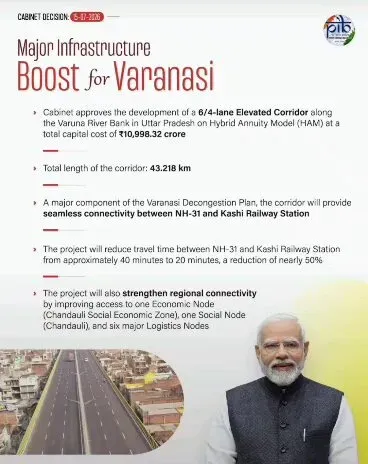
The Union Cabinet has approved a 43.218-km elevated corridor in Varanasi , aligned along the Varuna River .
The corridor will be built as a 6/4-lane elevated road, designed to ease traffic in a densely built heritage city.
Union Jal Shakti Minister C.
Paatil announced the approval on 15 July 2026 , framing it as a milestone for Purvanchal 's economic and social development.
The project is positioned within the government's ' Viksit Bharat ' vision of a developed India by 2047 .
Key next steps include land acquisition, environmental clearances, and integration with other Varanasi infrastructure projects such as airport expansion and waterway terminals.
Beneficiaries include daily commuters, Purvanchal traders, and logistics operators dependent on eastern Uttar Pradesh supply chains.
Union Jal Shakti Minister C. R. Paatil on Wednesday, 15 July 2026, welcomed the Union Cabinet's approval of a 43.218-kilometre six- and four-lane elevated corridor along the Varuna River in Varanasi, calling it a new chapter in the city's development and connectivity. The project is among the largest road-infrastructure approvals for the Purvanchal region in recent years.
Context
Paatil shared the news on X, writing: 'काशी के विकास को नई गति, कनेक्टिविटी को नई शक्ति' ('New momentum for Kashi's development, new strength for connectivity'). He described the corridor as a project that will make traffic 'more convenient, safer and faster' while giving 'a new direction to the economic and social development of Purvanchal.' The post underscores the Centre's continued political and infrastructural focus on Varanasi, the parliamentary constituency of Prime Minister Narendra Modi.
Policy Backdrop
The approval fits within two overlapping central frameworks. Bharatmala Pariyojana, launched in 2015, set out to develop national highways and elevated corridors across states including Uttar Pradesh. The PM Gati Shakti National Master Plan, announced in 2021, added a multimodal integration layer, aiming to synchronise road, rail, port and logistics planning under a single digital platform.
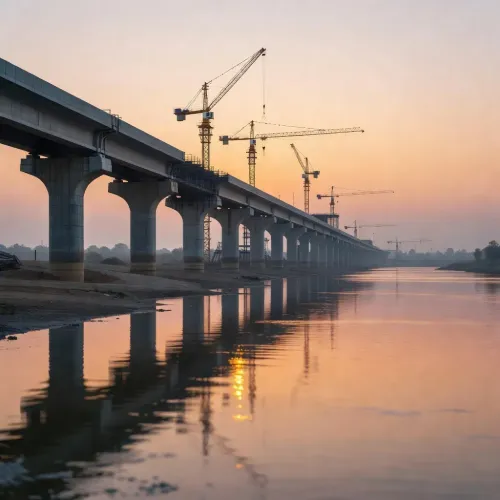
Elevated corridors along river alignments have become a preferred design choice in recent central and state projects because they reduce the need for large-scale land acquisition while delivering higher travel speeds. The Varuna River alignment in this case follows that logic, threading through a densely built heritage city where ground-level widening is not feasible.
Paatil also framed the corridor as reinforcing the government's 'Viksit Bharat' vision — a policy goal of making India a developed nation by 2047 — noting that better road infrastructure, reduced travel time, and a stronger logistics network would advance that commitment.
Stakeholders and Impact
Daily commuters in Varanasi stand to benefit most immediately, as the corridor is expected to ease the chronic congestion that affects movement between the city's core and its outer districts. Purvanchal traders and logistics operators are also key beneficiaries: faster freight movement along the corridor could reduce supply-chain costs for goods moving between eastern Uttar Pradesh and national markets.
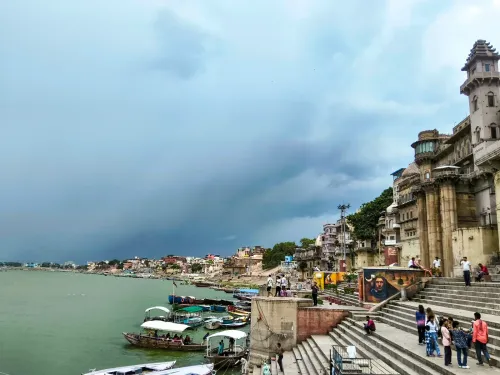
The project also has a heritage dimension. Varanasi attracts millions of pilgrims and tourists annually, and traffic bottlenecks around the ghats and the old city have long been a pressure point. An elevated bypass along the Varuna could divert through-traffic away from the most congested zones without requiring demolition of historic structures.
What's Next
Following Cabinet approval, the standard sequence involves land acquisition notifications, environmental and forest clearances, and the tendering of construction contracts. Observers will watch for the official project timeline and whether the corridor is integrated with other ongoing Varanasi infrastructure upgrades, including the city's airport expansion and inland waterway terminal development on the Ganga. The pace of clearances will determine whether the project advances within the current political cycle or stretches into the next.
Point of View
Reinforcing the BJP's 'Kashi model' of development as a template for Purvanchal. The choice of a river-aligned elevated design reflects a maturing approach to heritage-city infrastructure — bypassing the land-acquisition battles that have stalled earlier urban road projects. Framing a single corridor approval within the Viksit Bharat 2047 narrative has become standard practice, but it also raises the accountability bar: each such project now carries the weight of a national promise, making delayed clearances politically costly. Stakeholders in eastern Uttar Pradesh will watch whether this approval translates into ground-breaking within the current term or remains a headline without a construction timeline.
NationPress
14 Oct 2026
Frequently Asked Questions
What is the Varanasi elevated corridor project approved by the Union Cabinet?
The Union Cabinet has approved a 43.218-kilometre, six- and four-lane elevated road corridor aligned along the Varuna River in Varanasi, aimed at easing traffic congestion and improving connectivity across Purvanchal in eastern Uttar Pradesh.
Who announced the Varanasi Varuna River corridor approval?
Union Jal Shakti Minister C. R. Paatil announced the Cabinet approval on 15 July 2026 via a post on X, describing it as a boost to Kashi's development and Purvanchal's economic growth.
How does the Varanasi elevated corridor connect to Viksit Bharat?
The government has framed the corridor as a step toward the 'Viksit Bharat' goal of making India a developed nation by 2047, arguing that better road infrastructure and logistics networks are essential enablers of that vision.
Why is the corridor built along the Varuna River?
Aligning an elevated corridor along the Varuna River minimises land acquisition in a densely built heritage city like Varanasi, a design approach that has become common in central and state infrastructure projects to reduce displacement and speed up approvals.
What are the next steps after Cabinet approval of the Varanasi corridor?
After Cabinet approval, the project moves to land acquisition notifications, environmental and forest clearances, and tendering of construction contracts. Integration with other Varanasi projects — including airport expansion and inland waterway terminals — will also be closely watched.