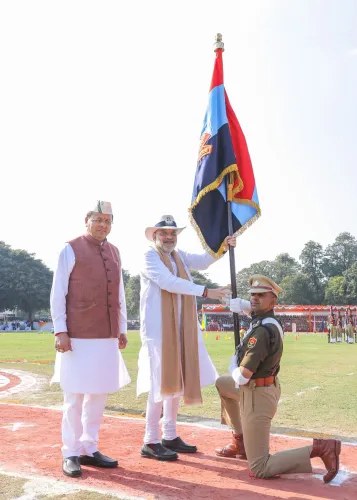
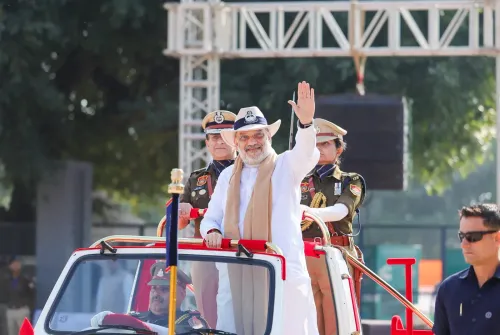
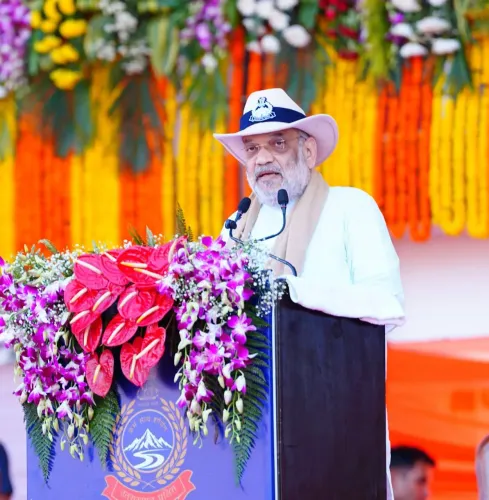
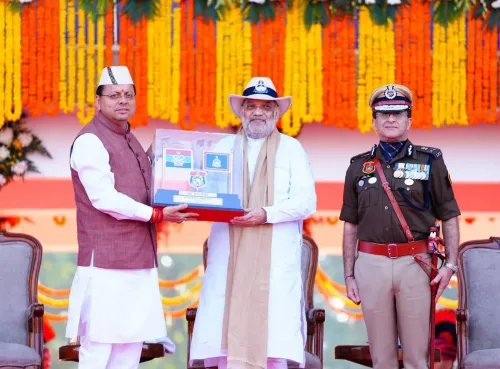
Amit Shah Confers President's Colour on Uttarakhand Police
Synopsis
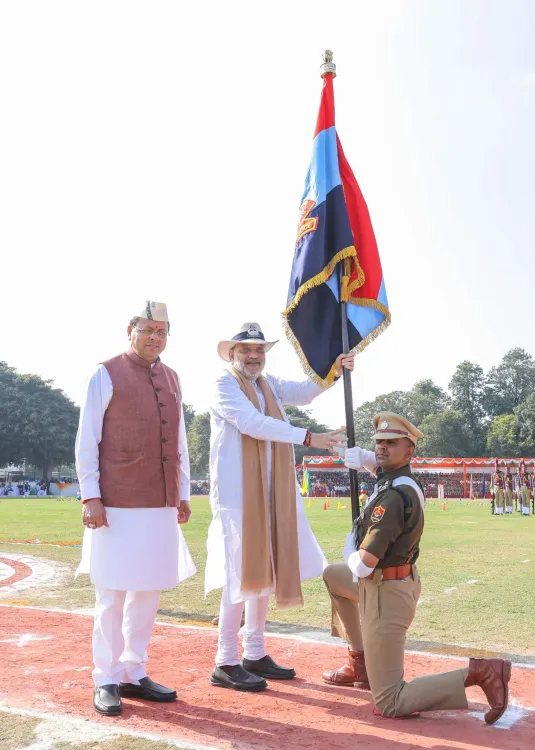
Union Home Minister Amit Shah conferred the President's Colour on Uttarakhand Police in Dehradun on 6 November 2026, honouring 26 years of service in disaster relief, Char Dham pilgrim safety, Vibrant Village Programme implementation, and rollout of India's new criminal codes.
Key Takeaways
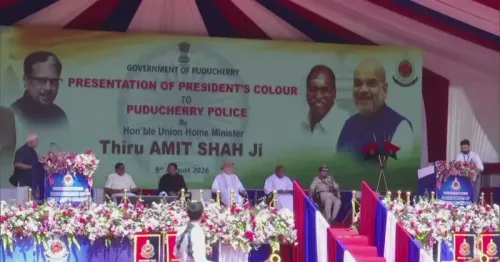
Union Home Minister Amit Shah presented the President's Colour — one of India's highest police honours — to Uttarakhand Police in Dehradun on 6 November 2026 .
Uttarakhand Police was constituted in November 2000 when the state was carved out of Uttar Pradesh, making the force just 26 years old .
The force was recognised for disaster relief, Char Dham pilgrim facilitation, border-area work under the Vibrant Village Programme , and implementing India's three new criminal laws enacted in December 2023 .
The Vibrant Village Programme targets infrastructure and livelihood development in strategic villages along India's northern land borders.
Three new criminal codes — replacing the IPC, CrPC, and Evidence Act — were passed by Parliament in December 2023 ; Uttarakhand Police's field-level rollout was specifically cited as a distinction.
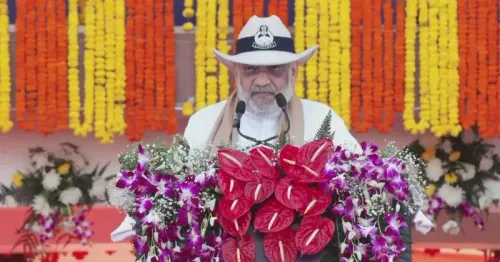
Twenty-six years after Uttarakhand was carved out of Uttar Pradesh, its police force earned one of the highest ceremonial distinctions the Indian state can bestow. Union Home Minister Amit Shah conferred the President's Colour on Uttarakhand Police at a ceremony in Dehradun on Friday, 6 November 2026 — recognising a force that has had to be everything at once: disaster responder, pilgrim guardian, border-area administrator, and law-reform pioneer.
Posting on X in Hindi, Shah wrote: 'Uttarakhand Police bete 26 varshon se pradesh ko surakshit banane ke saath seva, samarpan va kartavyanishtha ka pratik bani hai' — 'For the past 26 years, Uttarakhand Police has been a symbol of service, dedication, and devotion to duty, alongside keeping the state safe.' The tribute was not ceremonial flattery; it was a checklist of hard, specific work.
What the President's Colour actually means
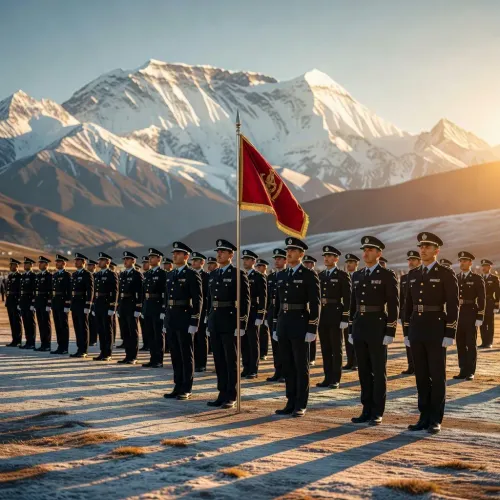
The President's Colour is among the most prestigious honours conferred on police and paramilitary units in India. It is awarded to organisations that have rendered exceptional service to the nation — in peacetime as much as in crisis. For a state police force, earning it is rare; for one barely a quarter-century old, it is remarkable.
Uttarakhand Police was constituted when the state itself was born in November 2000, separated from Uttar Pradesh. It inherited the terrain's demands immediately: a Himalayan state with remote valleys, a volatile monsoon, international borders, and among the world's highest pilgrimage footfalls at the Char Dham shrines.
From Char Dham yatras to Vibrant Village beats
Shah's post specifically named four areas of distinction. First, rapid relief during natural disasters — Uttarakhand's cloud-burst and landslide seasons have repeatedly tested every agency in the state. Second, smooth facilitation of Char Dham pilgrims, whose numbers have swelled into the millions annually, requiring crowd management, medical coordination, and route security across high-altitude passes.
Third — and notably geopolitical — was the force's role in implementing the Vibrant Village Programme, the Central government's scheme to develop infrastructure and livelihoods in border villages along India's northern frontier. Deploying police presence in these strategic hamlets is as much about deterrence and state visibility as it is about law and order.
Fourth, Shah credited the force with grounding India's new criminal laws. Parliament enacted three codes in December 2023 — replacing the Indian Penal Code, the Code of Criminal Procedure, and the Evidence Act — and translating those statutes from Delhi's legislative halls to Uttarakhand's mountain police stations has been a live administrative challenge. Shah flagged it as a point of pride.
A template Central leaders want other states to follow
The timing and framing of this recognition is deliberate. Central leaders have used similar honours to signal what good policing looks like — especially in states that straddle disaster vulnerability, religious tourism, and sensitive borders simultaneously. Uttarakhand checks all three.
The state now joins a short list of police forces that have been formally acknowledged at presidential level. For a force that began with zero institutional memory in 2000, that is not a small thing. The question now is whether the momentum on new-law implementation and border-village policing holds when the cameras leave Dehradun.
Point of View
Shah ties state police performance to two of the BJP-led government's signature policy agendas. The recognition also reinforces the Centre's sustained focus on border-area governance, where police presence doubles as a soft-power instrument against demographic drift in frontier villages. Watch whether this triggers accelerated rollout of the new codes and expanded Vibrant Village Police posts in other border states.
NationPress
7 Nov 2026
Frequently Asked Questions
What is the President's Colour award for police?
The President's Colour is a prestigious ceremonial honour conferred by the President of India on select police and paramilitary forces in recognition of exceptional service to the nation over a sustained period.
When was Uttarakhand Police established?
Uttarakhand Police was established in November 2000 when Uttarakhand was carved out as a separate state from Uttar Pradesh.
What is the Vibrant Village Programme?
The Vibrant Village Programme is a Central government scheme aimed at developing infrastructure and livelihoods in villages along India's northern land borders, with Uttarakhand being one of the key beneficiary states.
What are the new criminal laws Amit Shah referred to?
Shah referred to three new criminal codes enacted by Parliament in December 2023 — replacing the Indian Penal Code, the Code of Criminal Procedure, and the Indian Evidence Act — whose ground-level implementation Uttarakhand Police has been credited with advancing.
Why is Char Dham security significant for Uttarakhand Police?
The Char Dham pilgrimage circuit attracts millions of devotees annually to high-altitude Himalayan shrines, requiring Uttarakhand Police to manage crowd safety, medical emergencies, and route security across challenging mountain terrain every season.