Amit Shah launches Sahakar Nav-Kranti in Mumbai, shifts cooperative apex body to Maharashtra

Synopsis
Union Minister Amit Shah launched the Sahakar Nav-Kranti programme in Mumbai on 8 August 2026, announcing the relocation of the NUCFDC headquarters to Maharashtra, mandatory Umbrella Organisation membership for all 1,400 urban cooperative banks, and a doubling of the collateral-free lending limit to ₹5 lakh — the Centre's most sweeping cooperative banking reform push yet.
Key Takeaways
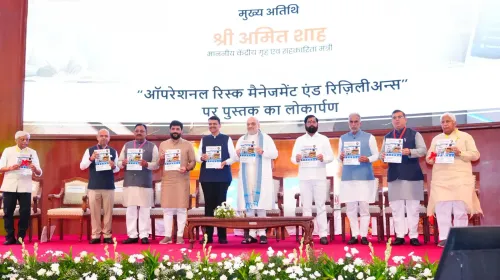
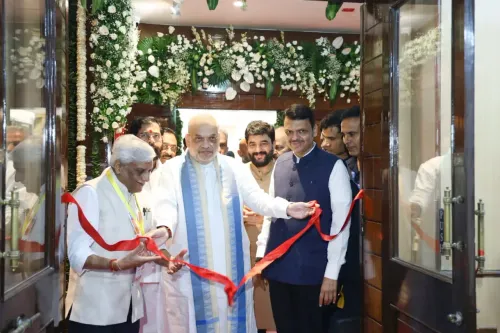
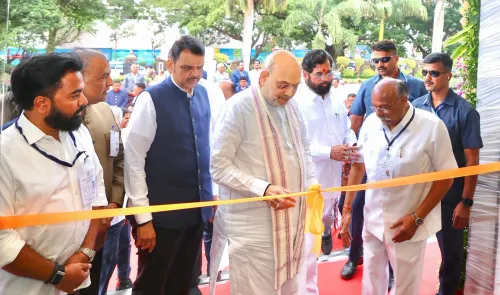
The Sahakar Nav-Kranti programme was inaugurated in Mumbai on 8 August 2026 by Union Minister Amit Shah , with CM Devendra Fadnavis as principal host.
The NUCFDC headquarters will relocate from Delhi to Maharashtra , recognising the state's outsized role in cooperative banking with 449 cooperative banks .
All 1,400 urban cooperative banks holding approximately ₹6 lakh crore in deposits are urged to join the Umbrella Organisation and connect to a Security Operations Centre .
The ceiling for collateral-free loans has been doubled from ₹2.5 lakh to ₹5 lakh .
A repayment rate of 99.78 per cent on existing small loans was cited as evidence of the creditworthiness of small and micro borrowers.
The initiative is framed within PM Narendra Modi 's Viksit Bharat 2047 vision for inclusive economic growth.
Six lakh crore rupees in deposits. Fourteen hundred banks. And, until now, no single modern spine holding them together. That changed on Saturday, 8 August 2026, when Union Home and Cooperation Minister Amit Shah inaugurated the Sahakar Nav-Kranti programme in Mumbai — firing the starting gun on what the Centre is billing as the most consequential overhaul of India's urban cooperative banking sector in a generation.
The NUCFDC moves to Maharashtra — and why it matters
The headline announcement from the event: the headquarters of the National Urban Cooperative Finance and Development Corporation (NUCFDC) will shift from Delhi to Maharashtra. Shah's reasoning was blunt and data-driven — Maharashtra alone hosts 449 cooperative banks, and the states of Maharashtra, Gujarat, Goa and Karnataka together account for the overwhelming bulk of urban cooperative banking activity in the country. Placing the apex body at the centre of gravity of the sector, rather than in the national capital, is a deliberate pivot toward regional anchoring for national scale.
Chief Minister Devendra Fadnavis presided as the principal host, with Deputy Chief Minister Eknath Shinde, Union Ministers of State Krishnapal Gurjar and Murlidhar Mohol, state ministers Babasaheb Patil and Jaykumar Rawal, and NUCFDC chairman Jyotindra Mehta also present.
The Umbrella Organisation: one security net for 1,400 banks
At the structural heart of the programme is the 'Umbrella Organisation' — a shared technology and security architecture that Shah wants every urban cooperative bank in the country to join, down to the smallest single-branch institution. Once enrolled, each bank connects to a Security Operations Centre (SOC) designed to harden the sector against the cyber and governance failures that have historically eroded depositor trust. The move is a direct policy response to high-profile collapses — most notably the PMC Bank crisis of 2019 — that exposed the vulnerability of under-supervised cooperative lenders.
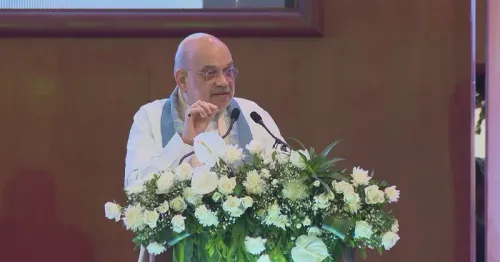
Shah's pitch to the sector was unambiguous: membership in the Umbrella Organisation is not optional in spirit, even if not yet mandated in law. 'Every urban cooperative bank, even a single-branch bank, should join,' he said at the event.
Collateral-free lending limit doubled to ₹5 lakh
Beyond architecture, Shah announced a concrete credit-access expansion: the ceiling for loans extended without any collateral or guarantee has been doubled from ₹2.5 lakh to ₹5 lakh. The rationale is anchored in a striking repayment statistic Shah cited — 99.78 per cent of loans under the existing scheme have been repaid with interest, demonstrating that small borrowers are, in fact, reliable credit risks that large commercial banks routinely overlook.
The beneficiaries are precisely those the formal banking system struggles to reach: छोटे दुकानदार, व्यापारी, कुटीर उद्योग (small shopkeepers, traders, cottage industries), MSMEs, local professionals, and women's self-help groups. At the taluka level, urban cooperative banks can move faster and with more local knowledge than any commercial lender — and the doubled ceiling is designed to let them do exactly that.
'Sahakar se Samriddhi' — prosperity through cooperation, not just for banks
Shah was careful to frame the programme's ambition beyond institutional reform. The slogan 'सहकारातून समृद्धी' — 'prosperity through cooperation' — means enriching the bank's customer, not just the bank's balance sheet, he said. The Sahakar Nav-Kranti sits explicitly within Prime Minister Narendra Modi's Viksit Bharat 2047 vision, positioning cooperative modernisation as a route to last-mile financial inclusion rather than a narrow sectoral upgrade.
The Ministry of Cooperation, created in July 2021 to give the cooperative sector its first dedicated central ministry, has been the institutional vehicle for this entire arc of reform. Saturday's Mumbai event is its most operationally dense announcement yet — a headquarters relocation, a technology mandate, a credit-limit expansion, and a national enrolment drive, all in a single programme launch.
Whether 1,400 banks can be wired into a single security and technology spine on schedule will be the real test. The kicker is this: with ₹6 lakh crore in deposits and nearly a billion potential last-mile borrowers in its orbit, India's urban cooperative banking sector is too large to fail quietly — and, after Saturday, too visible to reform slowly.
Point of View
A technology mandate, and a credit-access expansion in a single announcement. Relocating the NUCFDC to Maharashtra is a strategic signal that the Centre is willing to decentralise apex cooperative infrastructure to where the density of the sector actually lies, rather than retaining it in Delhi for administrative convenience. The doubling of the collateral-free lending ceiling, backed by a near-perfect repayment record, also reframes cooperative banks not as legacy institutions requiring rescue but as high-performing last-mile lenders deserving expansion. The programme's success will ultimately hinge on whether voluntary Umbrella Organisation enrolment translates into genuine cyber resilience — or remains a ceremonial affiliation for the sector's smallest players.
NationPress
8 Aug 2026
Frequently Asked Questions
What is the Sahakar Nav-Kranti programme launched in Mumbai?
Sahakar Nav-Kranti is a central government initiative inaugurated on 8 August 2026 in Mumbai by Union Minister Amit Shah to modernise India's urban cooperative banking sector through a shared technology and security framework called the Umbrella Organisation, alongside a relocation of the apex financing body to Maharashtra.
Why is the NUCFDC headquarters being moved to Maharashtra?
The National Urban Cooperative Finance and Development Corporation (NUCFDC) headquarters is being shifted from Delhi to Maharashtra because the state hosts 449 cooperative banks — the largest concentration in the country — making it a more operationally relevant base for the apex body.
What is the new collateral-free loan limit for urban cooperative banks?
The ceiling for loans extended without any collateral or guarantee has been doubled from ₹2.5 lakh to ₹5 lakh as announced at the Sahakar Nav-Kranti event.
What is the Umbrella Organisation for urban cooperative banks?
The Umbrella Organisation is a shared technology, governance, and security architecture that all 1,400 urban cooperative banks in India are being urged to join. Member banks connect to a Security Operations Centre (SOC) to improve cyber security and depositor confidence.
How much money is held in urban cooperative banks in India?
India's approximately 1,400 urban cooperative banks collectively hold around ₹6 lakh crore in deposits, serving small traders, MSMEs, women's self-help groups, and middle-class borrowers.