Amit Shah calls for mother tongue learning and AI-ready Indian languages
Synopsis
Union Home Minister Amit Shah on 19 July 2026 outlined a four-point language resolution: family as first school, universities as centres of original thought, AI-enabled Indian languages, and every youth learning their mother tongue plus one other Indian language — reinforcing the NEP 2020 multilingualism agenda.
Key Takeaways
Amit Shah posted a four-point language resolution on 19 July 2026 , calling for families, universities, digital tools and multilingual learning to anchor India's linguistic future.
He called for every Indian language to be made digitally and AI-enabled , aligning with the government's ongoing Bhashini initiative for AI-powered language tools.
Every young Indian should learn their mother tongue plus at least one other Indian language , reinforcing the three-language formula under NEP 2020 .
Universities are urged to become centres of original, foundational thinking ( maulik chintan ), signalling a push for research in Indian languages.
The statement strengthens political backing for NEP 2020 implementation, particularly state-level adoption of mother-tongue instruction in early schooling.
Regional language speakers and students in rural and semi-urban India are the primary beneficiaries of the proposed digital localisation push.
Union Home Minister Amit Shah on Sunday, 19 July 2026, outlined a four-point resolution for the future of India's languages, calling for families to become the first classroom, universities to become centres of original thought, every language to be made digitally and AI-enabled, and every young Indian to learn their mother tongue alongside at least one other Indian language.
Context
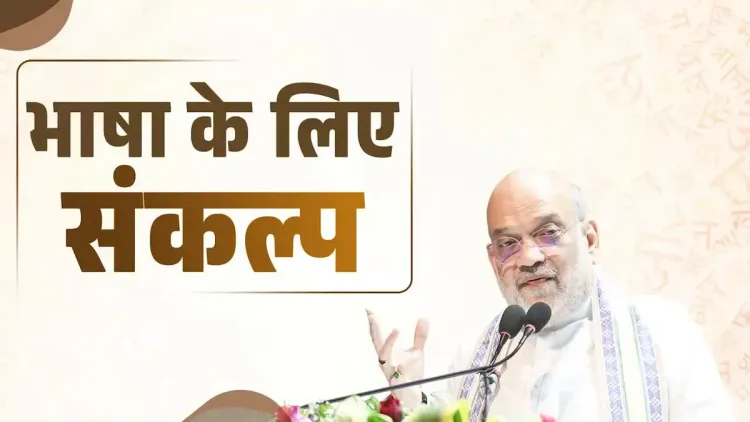
Shah's post, shared on X in Hindi, carries a compact but sweeping vision for linguistic policy. Translated, it reads: 'Sankalp ke liye bhasha' — 'A resolution for language: let the family be the first school, let universities become centres of original thinking, let every language become digitally and AI-enabled, and let every young person learn their mother tongue along with at least one other Indian language.'
The statement comes as India continues to debate the role of regional languages in education, governance and technology. It reflects a growing consensus across political and academic circles that mother-tongue instruction and multilingualism are foundational to equitable development.
Policy Backdrop
The resolution echoes the framework laid out in the National Education Policy (NEP) 2020, which directed states to adopt mother-tongue instruction in early schooling and formalised the three-language formula at the secondary level. NEP 2020 also called for expanding digital resources across Indian languages to reduce dependence on English in classrooms and governance.
Complementing this, the government's Bhashini initiative has sought to build AI-powered translation and language tools for India's scheduled languages, aiming to make digital services accessible to citizens regardless of linguistic background. Shah's call for every language to be 'digitally and AI-enabled' aligns directly with this ongoing programme.
The emphasis on universities as centres of 'original thinking' (maulik chintan) signals a push to move higher education away from rote learning and towards research conducted in Indian languages — a reform that NEP 2020 also explicitly encourages.
Stakeholders and Impact
The most immediate audience is India's vast student population, particularly the hundreds of millions of learners in rural and semi-urban areas who study in regional-language medium schools. For them, a stronger policy commitment to mother-tongue instruction and AI-enabled language tools could mean better access to quality content and reduced dropout rates.
Regional language speakers — from Tamil and Telugu to Odia, Marathi, Punjabi and beyond — stand to benefit from accelerated digital localisation. Technology companies and start-ups working on natural language processing for Indian languages are also likely to see this as a signal of continued government support for the sector.
The call for every young Indian to learn 'at least one other Indian language' beyond their mother tongue has implications for national integration, reinforcing the idea that multilingualism — rather than a single dominant language — is the preferred model for a diverse federal republic.
What's Next
Attention will now turn to state governments and their pace of adopting mother-tongue curricula under NEP 2020, particularly in states that have been slower to implement the three-language formula. The rollout of AI language models for scheduled languages in official services is also a key milestone to watch.
Shah's statement, while a post on social media rather than a formal policy announcement, carries weight given his seniority in the Union Cabinet and his role in shaping national legislative priorities. It is likely to reinforce momentum behind both the NEP implementation drive and the expansion of India's AI-for-languages ecosystem in the months ahead.
Point of View
He is bridging cultural nationalism with technological modernism, a combination the BJP has used effectively to build broad coalitions. The call for every youth to learn a second Indian language is also a subtle counter to the perception that the three-language formula disproportionately burdens non-Hindi speakers, since it frames multilingualism as a universal civic duty rather than a Hindi imposition. Watch whether this post precedes a formal announcement — a cabinet decision on Bhashini expansion or a NEP compliance review — in the coming weeks.
NationPress
19 Oct 2026
Frequently Asked Questions
What did Amit Shah say about Indian languages on 19 July 2026?
Amit Shah posted a four-point resolution stating that families should be the first school for language learning, universities should become centres of original thinking, every Indian language should be digitally and AI-enabled, and every youth should learn their mother tongue plus at least one other Indian language.
What is the NEP 2020 three-language formula?
The National Education Policy 2020 requires students to learn three languages — typically their mother tongue, Hindi, and English or another Indian language — with the goal of promoting multilingualism and reducing barriers to education for non-English speakers.
What is Bhashini and how does it relate to AI-enabled Indian languages?
Bhashini is a government initiative to build AI-powered translation and natural language processing tools for India's scheduled languages, making digital services accessible to citizens in their own languages without requiring English proficiency.
Why is Amit Shah emphasising mother-tongue education?
Mother-tongue instruction has been shown to improve learning outcomes, reduce dropout rates and support cognitive development in early childhood. It is also a core pillar of NEP 2020, which the central government has been pushing states to implement since 2020.
Which Indian languages could benefit from an AI-enablement push?
All of India's 22 scheduled languages — including Tamil, Telugu, Kannada, Malayalam, Odia, Marathi, Punjabi, Bengali, Gujarati, and others — stand to benefit from AI tools such as machine translation, speech recognition and digital content creation in those languages.