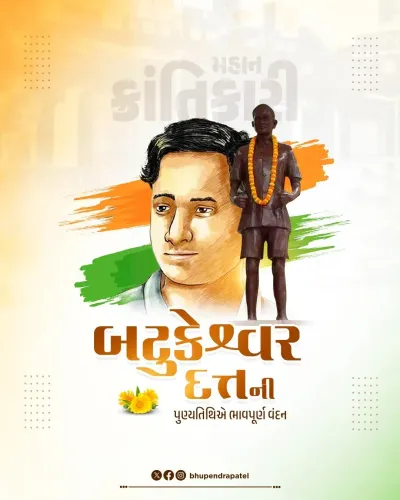
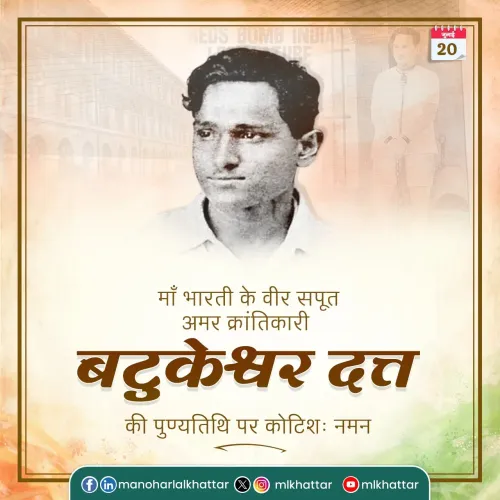
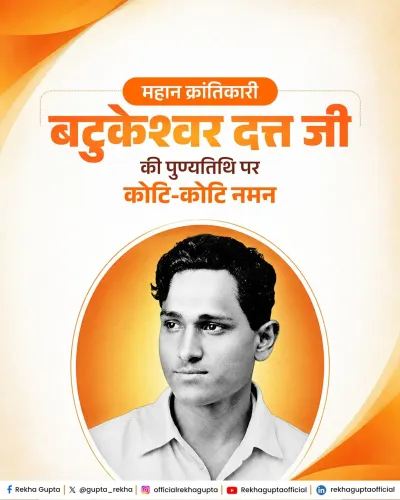
Amit Shah Pays Tribute to Revolutionary Batukeshwar Dutt on Birth Anniversary
Synopsis
Union Home Minister Amit Shah honoured revolutionary Batukeshwar Dutt on his birth anniversary, highlighting the HSRA leader's role in the 1929 Central Assembly bombing alongside Bhagat Singh and his fearless resistance inside Cellular Jail.
Key Takeaways
Union Home Minister Amit Shah paid tribute to revolutionary Batukeshwar Dutt on his birth anniversary on 18 November 2026 .
Dutt, a member of the Hindustan Socialist Republican Association (HSRA) , threw smoke bombs in the Central Legislative Assembly alongside Bhagat Singh on 8 April 1929 .
The bombing was a deliberate act of protest — not to cause casualties but to force the colonial administration to 'hear the deaf,' as the revolutionaries declared.
Dutt was sentenced to transportation for life and held at the Andaman Cellular Jail (Kala Pani) , where he led hunger strikes against unjust treatment of political prisoners.
Shah's tribute is part of a consistent BJP practice of formally honouring revolutionary nationalists alongside figures from the non-violent independence movement.
A bomb in the Central Assembly in 1929, the stench of Cellular Jail, and a hunger strike behind bars — the life of Batukeshwar Dutt compressed an entire revolution into a few searing years. On his birth anniversary, Union Home Minister Amit Shah paid solemn tribute to the revolutionary, calling his courage an emblem of India's freedom struggle.
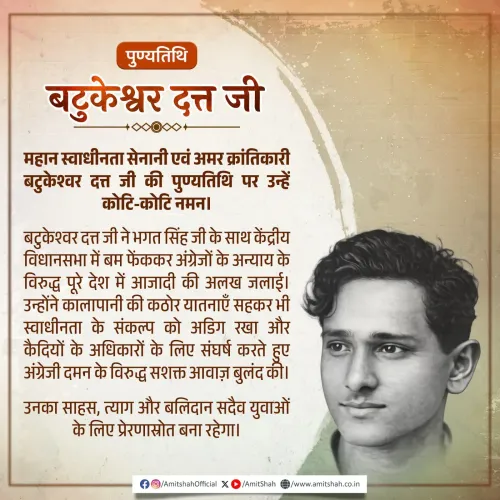
Shah's post, shared on Wednesday, 18 November 2026, invoked Dutt's role in the Hindustan Socialist Republican Association (HSRA), the clandestine network that organised armed resistance against British colonial rule in the late 1920s and early 1930s. The minister wrote: 'Jab bhi shaurya, sahas aur dridh sankalp ki baat hoti hai, Batukeshwar Dutt ji ka naam garv se liya jata hai' — 'Whenever courage, bravery and firm resolve are spoken of, Batukeshwar Dutt's name is taken with pride.'
The Central Assembly Bombing That Shook Colonial Delhi
On 8 April 1929, Batukeshwar Dutt and Bhagat Singh threw two smoke bombs into the Central Legislative Assembly chamber in Delhi — deliberately aimed to avoid casualties — to protest the Public Safety Bill and Trade Disputes Bill that the British administration was pushing through. The act was not intended to kill; it was intended to be heard. The two men then scattered leaflets and allowed themselves to be arrested, turning a courtroom into a stage for their ideology.
Shah's tribute recalled that moment precisely — that Dutt and Bhagat Singh struck terror into British authority and delivered the message, in his words, that 'this country belongs only to its people.' The deliberate surrender that followed transformed a bombing into a political trial, and both men into symbols.
Kala Pani and the Hunger Strike That Would Not Break
Sentenced to transportation for life, Batukeshwar Dutt was sent to the dreaded Andaman Cellular Jail — Kala Pani — where the British held political prisoners under conditions designed to break the will. Dutt refused to be broken. He joined fellow freedom fighters in hunger strikes protesting the brutal treatment of political detainees, enduring force-feeding and isolation.
Shah's post specifically noted that 'even the tortures of Kala Pani could not shake his resolve,' and that Dutt 'raised his voice against the injustice meted out to freedom fighters in jail.' It is a detail that separates Dutt from many in the pantheon — his resistance did not end at the moment of arrest; it continued, defiantly, in the cells meant to silence it.
HSRA's Place in India's Revolutionary Nationalism
The Hindustan Socialist Republican Association, through which Dutt channelled his activism, was one of the most consequential armed-resistance organisations of the late colonial period. Founded in the mid-1920s and drawing on socialist as well as nationalist ideology, the HSRA recruited young men radicalised by the perceived limitations of constitutional protest. Its actions — from the Lahore Conspiracy Case to the Assembly bombing — forced the question of violence versus non-violence into the centre of the independence debate.
BJP leaders have consistently honoured HSRA members and other revolutionary nationalists on their birth and death anniversaries, weaving their stories into a broader national narrative that sits alongside — and in conversation with — the dominant Gandhian account of independence. The pattern has been visible in official statements and commemorations since at least 2014, presenting figures like Bhagat Singh, Chandrashekhar Azad, and Dutt as co-architects of freedom alongside non-violent leaders.
Batukeshwar Dutt outlived most of his comrades, witnessing independence in 1947, but spent his later years in relative obscurity. His birth anniversary is a corrective — a moment to retrieve a name that history occasionally lets drift to the margins.
Point of View
Decade-long effort by the BJP to expand India's official freedom-fighter pantheon beyond the Gandhian mainstream, reclaiming socialist revolutionaries like the HSRA cadre for a broader nationalist narrative. By emphasising Dutt's armed defiance and his suffering in Kala Pani, the tribute implicitly argues that multiple strands of resistance — constitutional, non-violent, and armed — built the nation together. Politically, it also allows the ruling party to speak to a younger, history-curious demographic that has grown up romanticising Bhagat Singh. The consistency of these commemorations since 2014 signals institutionalisation, not improvisation.
NationPress
18 Nov 2026
Frequently Asked Questions
Who was Batukeshwar Dutt?
Batukeshwar Dutt was an Indian revolutionary and member of the Hindustan Socialist Republican Association (HSRA) who, alongside Bhagat Singh , threw smoke bombs in the Central Legislative Assembly on 8 April 1929 to protest repressive British laws. He was subsequently sentenced to life imprisonment and transported to the Andaman Cellular Jail .
What was the Central Assembly bombing of 1929?
On 8 April 1929 , Bhagat Singh and Batukeshwar Dutt threw two low-intensity smoke bombs into the Central Legislative Assembly in Delhi, deliberately aiming to avoid casualties. The goal was to protest the Public Safety Bill and to draw attention to the demand for Indian self-rule, with the duo then surrendering to police to use the subsequent trial as a political platform.
What is Kala Pani or Cellular Jail?
Cellular Jail , known as Kala Pani , is a colonial-era prison in the Andaman Islands where the British transported political prisoners sentenced to life imprisonment. Batukeshwar Dutt was held there after the 1929 Assembly bombing case and participated in hunger strikes protesting the harsh treatment of fellow freedom fighters.
What was the Hindustan Socialist Republican Association?
The Hindustan Socialist Republican Association (HSRA) was a revolutionary organisation active in the late 1920s and early 1930s that combined socialist ideology with armed resistance against British colonial rule. Its members, including Bhagat Singh , Chandrashekhar Azad , and Batukeshwar Dutt , carried out several high-profile actions to challenge British authority.
Why does Amit Shah regularly tribute revolutionary freedom fighters?
Union Home Minister Amit Shah and other BJP leaders have consistently honoured revolutionary nationalists like HSRA members on their birth and death anniversaries since at least 2014 , as part of a broader effort to bring armed-resistance figures into the mainstream national narrative alongside leaders of the non-violent independence movement.