Shivraj Singh Chouhan Reviews Green Ammonia Tech at Punjab Village
Synopsis
Union Agriculture Minister Shivraj Singh Chouhan visited Badarpur village in Punjab to witness a solar-powered green ammonia fertilizer demonstration claiming 82% nitrogen content. The technology, still at trial stage with scientific assessment ongoing, aligns with India's National Green Hydrogen Mission and long-running efforts to cut farm input costs and restore soil health.
Key Takeaways
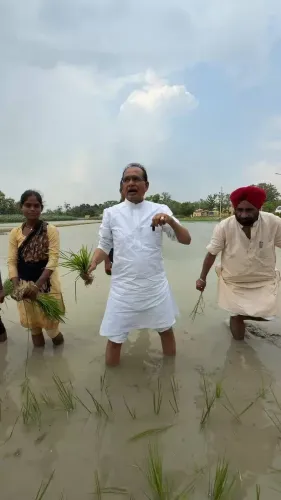
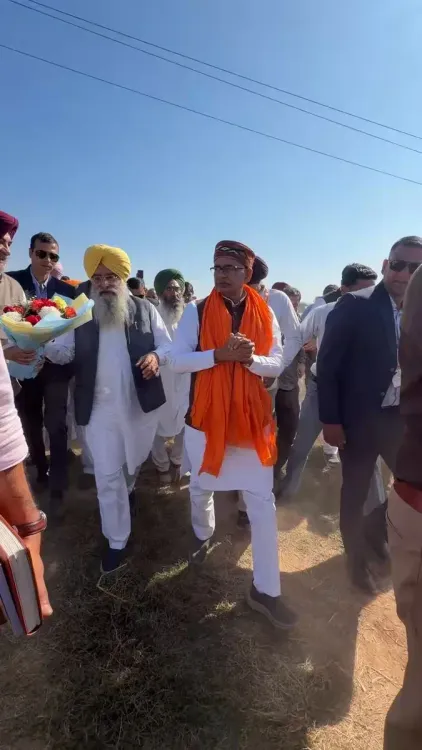
Union Agriculture Minister Shivraj Singh Chouhan observed a green ammonia-based fertilizer demonstration at Badarpur village, Punjab on November 18, 2026 .
The ammonia is synthesised using solar energy and reportedly carries approximately 82% nitrogen , delivered directly into soil via a specialised machine.
The minister confirmed the technology is currently at an experimental stage ; scientific assessment of results is in progress.
The initiative is linked to #KhetBachaoAbhiyan , a campaign for farmland protection and sustainable agriculture.
The demonstration fits within India's broader policy arc — Neem Coated Urea (2015) , Soil Health Card Scheme (2015) , and the National Green Hydrogen Mission (2023) .
Potential benefits include lower input costs for farmers and reduced soil degradation, but scaling to smallholder farmers remains the key challenge ahead.
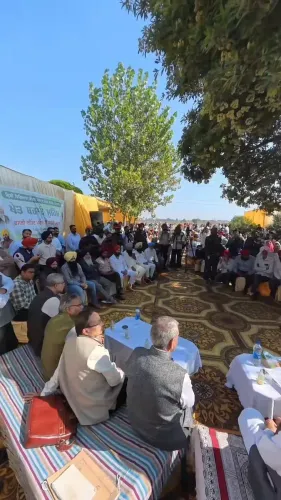
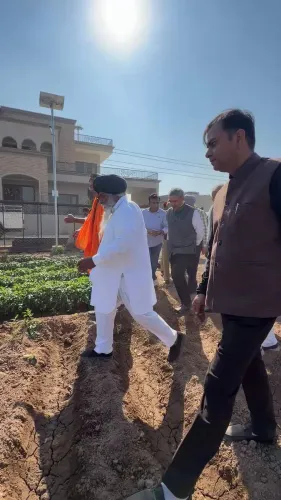
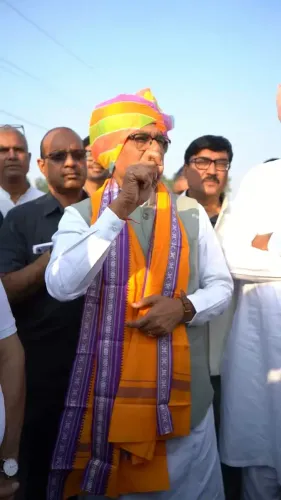
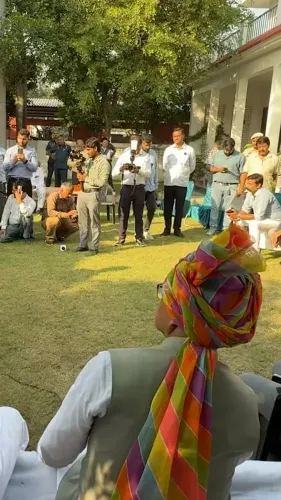
In a Punjab field that could signal the next chapter of Indian agriculture, Union Agriculture Minister Shivraj Singh Chouhan on Wednesday, November 18 witnessed a live demonstration of green ammonia-based fertilizer technology at Badarpur village in Punjab — a trial that places solar energy at the heart of the country's fertilizer future.
Posting on X, the minister described what he saw: ammonia synthesised from solar energy carrying approximately 82% nitrogen, delivered directly into the soil through a specialised machine. 'Our effort is that through modern technology in farming, fertilizers are used better, the cost for farmers comes down, and the health of the earth is preserved,' he wrote, tagging the initiative under #KhetBachaoAbhiyan.
The minister was careful to frame the moment in measured terms. The technology, he noted, is currently at an experimental stage, and a scientific assessment of its results is underway. No rollout has been announced. The visit was an observation, not a launch.
Why Punjab Is the Right — and Most Pressured — Stage
Punjab is ground zero for India's fertilizer paradox. Its wheat-rice rotation belt drives national food security, but decades of intensive cultivation have leaned heavily on chemical nitrogen inputs, degrading soil health and deepening import dependence on urea. The state is precisely where the case for smarter nitrogen delivery is most urgent — and most politically visible.
India has been building toward this moment across a decade of policy steps. The Neem Coated Urea mandate, rolled out from 2015, improved nitrogen use efficiency and curbed diversion of subsidised urea. The Soil Health Card Scheme, also launched in 2015, pushed farmers toward soil-test-based fertilizer applications. And the National Green Hydrogen Mission, approved in 2023, explicitly targeted green ammonia production using renewables to begin decarbonising the fertilizer supply chain. The Badarpur demonstration sits at the logical intersection of all three threads.
What Green Ammonia Actually Changes — If It Works
Conventional ammonia production is one of the most carbon-intensive industrial processes on earth, relying on natural gas through the century-old Haber-Bosch process. Green ammonia replaces that fossil-fuel feedstock with hydrogen produced via electrolysis powered by renewable electricity — in this case, solar. The result is a nitrogen source with a dramatically lower carbon footprint.
The claim of 82% nitrogen content — cited by the minister from the demonstration — would, if validated, place this formulation among the most nitrogen-dense fertilizer inputs available. The delivery mechanism matters equally: injecting ammonia directly into the soil minimises volatilisation losses that plague surface-applied urea, potentially improving the efficiency of every kilogram applied. For farmers, that translates into lower input costs for the same yield effect. For the soil, it means less chemical accumulation over time.
The Gap Between Promise and Scale
The honest word in the minister's post is 'experiment.' Green ammonia technology is capital-intensive, requires reliable renewable power infrastructure at the farm periphery, and demands specialised injection equipment that most smallholder farmers do not currently have access to. India's small and marginal farmers — who till the overwhelming majority of the country's agricultural land — represent both the most compelling beneficiaries and the hardest audience to reach.
The critical next marker is the scientific assessment Chouhan referenced. If that evaluation, once published, shows measurable yield parity or improvement alongside soil health gains, the pressure to scale — and to integrate green ammonia into existing fertilizer subsidy frameworks — will accelerate sharply. If the numbers disappoint, the experiment stays a footnote.
India's farming sector has seen no shortage of promising pilots that stalled at scale. What sets the current moment apart is the institutional scaffolding already in place — from the Green Hydrogen Mission's industrial targets to the Soil Health Card's field-testing infrastructure. The Badarpur visit puts a cabinet minister's name, and attention, on a technology that has so far lived mostly in policy documents. That visibility alone changes the speed of what comes next.
Point of View
The ministry frames it as a farmer-welfare story, not an industrial one — a framing designed to build rural political buy-in before any subsidy-integration decision is forced. The measured language around 'experiment' and 'scientific assessment' also insulates the government from premature expectations while keeping the pilot alive in the policy conversation. The real test arrives when that assessment is published: a positive verdict will immediately raise demands to bring green ammonia inside the fertilizer subsidy architecture, a move with enormous fiscal and geopolitical implications for India's urea import dependency.
NationPress
18 Nov 2026
Frequently Asked Questions
What is green ammonia and how is it different from regular fertilizer?
Green ammonia is produced using hydrogen generated by renewable electricity — in this case solar power — instead of natural gas, making it far less carbon-intensive than conventional ammonia. It delivers nitrogen to crops while significantly reducing the fossil-fuel footprint of fertilizer production.
What happened at Badarpur village in Punjab?
Union Agriculture Minister Shivraj Singh Chouhan visited Badarpur village in Punjab on November 18, 2026 to observe a live demonstration of green ammonia-based fertilizer technology that claims approximately 82% nitrogen content and is delivered directly into the soil using a specialised machine.
Is the green ammonia technology ready for use by Indian farmers?
No. The minister explicitly stated it is currently at an experimental stage and that a scientific assessment of its results is ongoing. No rollout or government adoption has been announced yet.
What is Khet Bachao Abhiyan?
Khet Bachao Abhiyan is a campaign promoting farmland protection and sustainable agricultural practices, under which the green ammonia demonstration was tagged by the minister.
How does this relate to India's National Green Hydrogen Mission?
The National Green Hydrogen Mission, approved in 2023, specifically targeted the use of green ammonia — produced via renewable-powered electrolysis — to decarbonise India's fertilizer supply chain. The Badarpur trial is an early field-level application of that policy direction.