Amit Shah hails Puducherry's spiritual and patriotic legacy
Synopsis
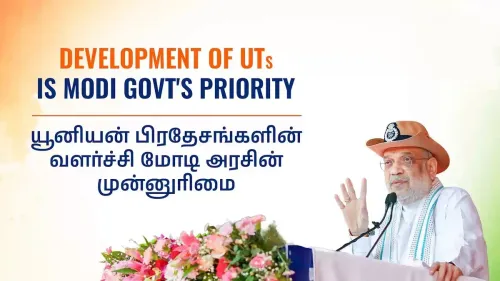
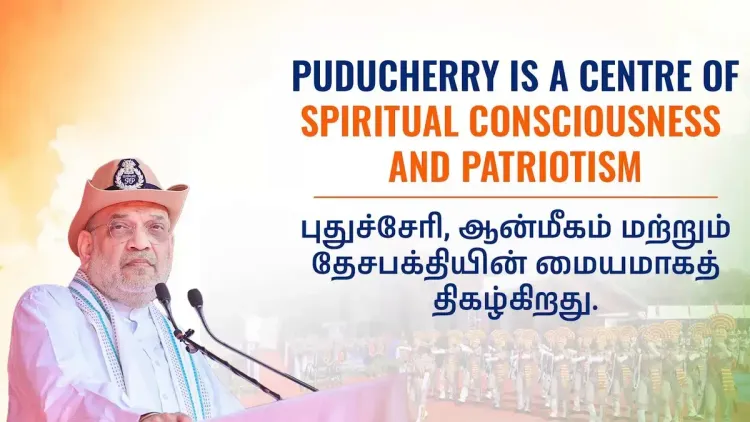
Home Minister Amit Shah, in a bilingual English-Tamil post, saluted Puducherry's twin pillars of identity: Sri Aurobindo and The Mother as founders of its spiritual consciousness, and Mahakavi Subramania Bharati as the architect of its patriotic soul.
Key Takeaways
Union Home Minister Amit Shah posted a tribute to Puducherry's spiritual and patriotic heritage on 9 August 2026 .
Sri Aurobindo arrived in Puducherry in 1910 and founded the Sri Aurobindo Ashram , a global centre of integral yoga.
The Mother (Mirra Alfassa) co-founded the Ashram and later established Auroville , an international township near Puducherry.
Mahakavi Subramania Bharati lived in Puducherry from 1911 to 1918 , producing seminal Tamil nationalist poetry during his exile.
The post was bilingual — English and Tamil — reflecting deliberate outreach to Tamil-speaking communities in southern India.
Puducherry's French colonial status until 1954 made it a sanctuary for both spiritual and political figures beyond British reach.
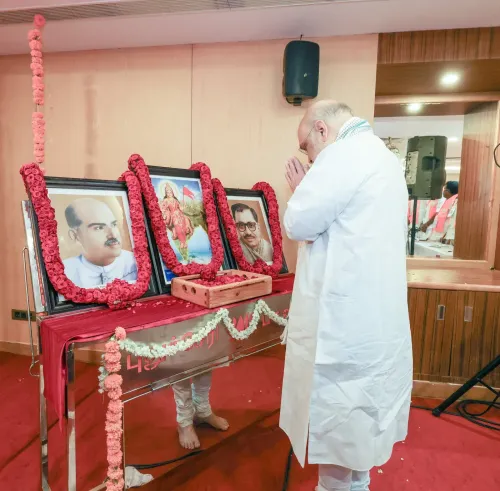
Where a philosopher-yogi chose exile and a poet turned his pain into anthems, Union Home Minister Amit Shah found the perfect frame for Puducherry — a city he described on Sunday, 9 August 2026 as both a cradle of spiritual consciousness and a beacon of patriotic fire.
In a bilingual post in English and Tamil, Shah paid tribute to the twin pillars of Puducherry's identity: Sri Aurobindo and The Mother (Mirra Alfassa), whose presence he said made the Union Territory 'the centre of spiritual consciousness', and Mahakavi Subramania Bharati, whose fierce nationalism gave the city 'a distinguished patriotic identity.'
The philosopher and the poet who shaped a city
Sri Aurobindo, the Bengali philosopher, yogi, and former revolutionary, arrived in Puducherry in 1910 after evading British surveillance, and never left. He founded the Sri Aurobindo Ashram, which became one of the most influential centres of integral yoga and spiritual philosophy in the world. His spiritual partner, The Mother — Mirra Alfassa, a French-born mystic, co-founded the Ashram and later established Auroville, the international township on the city's outskirts that today draws seekers from across the globe.
Barely a year after Aurobindo arrived, Mahakavi Subramania Bharati reached Puducherry in 1911, fleeing British India's repression of nationalist voices. He stayed until 1918, and the years in that French-administered enclave were among his most prolific — producing poetry that fused Tamil literary tradition with a burning call for swaraj (self-rule). His verses on freedom, womanhood, and national pride remain part of the Tamil cultural canon.
Why Puducherry holds a singular place in India's freedom story
Puducherry's French colonial status, which lasted until the de facto transfer of 1954 and formal merger with India in 1963, made it a refuge for figures the British Raj could not easily reach. That accident of geography turned the city into an unlikely incubator for both spiritual and political dissent — a duality Shah's post captures in two crisp sentences.
Central leaders have periodically acknowledged Puducherry's heritage as part of a broader emphasis on regional contributions to India's independence movement and cultural life. The choice of a bilingual English-Tamil format signals deliberate outreach to Tamil-speaking communities in the Union Territory and across southern India.
Point of View
Framing them as proof that India's civilisational and nationalist threads ran deeper than any foreign administration. The bilingual English-Tamil format is a deliberate signal of cultural respect toward Tamil voters and the Puducherry electorate, a Union Territory where the BJP has sought to expand its footprint. By pairing a spiritual giant with a freedom poet, the post bridges the party's dual emphasis on cultural nationalism and Hindutva-adjacent spiritual heritage without making either explicit. The timing in August — proximate to Independence Day — amplifies the resonance of both tributes.
NationPress
23 Sept 2026
Frequently Asked Questions
Why is Puducherry called a centre of spiritual consciousness?
Puducherry earned that description primarily because Sri Aurobindo settled there in 1910 and founded the Sri Aurobindo Ashram , which became a global hub of integral yoga and spiritual philosophy. The Mother (Mirra Alfassa) later co-founded the Ashram and established Auroville , deepening the city's spiritual identity.
Who was Mahakavi Subramania Bharati and what is his connection to Puducherry?
Subramania Bharati was a Tamil poet, journalist, and independence activist who lived in Puducherry from 1911 to 1918 to escape British repression. His years in the French-administered city were among his most creative, producing nationalist Tamil poetry that remains a cornerstone of Tamil literary heritage.
Why did Sri Aurobindo come to Puducherry?
Sri Aurobindo moved to Puducherry in 1910 to escape British surveillance after his involvement in the nationalist movement. Because Puducherry was under French administration, British authorities could not easily pursue him there, allowing him to pursue his spiritual and philosophical work freely.
What did Amit Shah say about Puducherry?
Amit Shah said that the presence of Sri Aurobindo and The Mother had made Puducherry 'the centre of spiritual consciousness,' and that the patriotism of Mahakavi Subramania Bharati had given it 'a distinguished patriotic identity.' He posted the tribute in both English and Tamil.
When did Puducherry merge with India?
Puducherry saw a de facto transfer from French administration in 1954 and was formally merged with India in 1963 . Its earlier status as a French territory is precisely what made it a refuge for figures like Aurobindo and Bharati during the British colonial era.