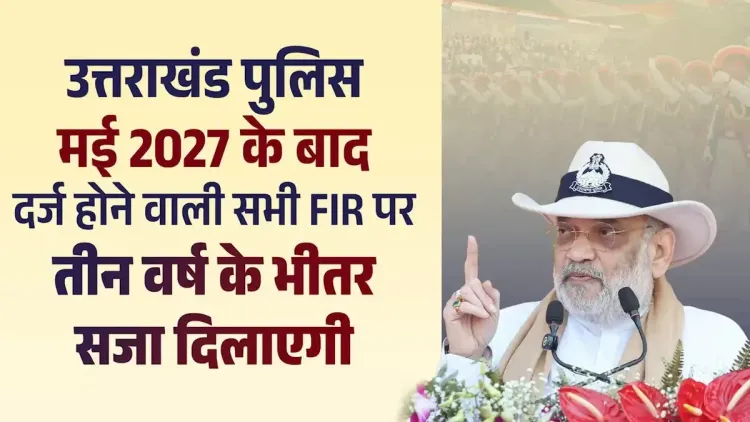
Amit Shah: Uttarakhand Police to deliver conviction within 3 years
Synopsis
Union Home Minister Amit Shah highlighted Uttarakhand Police's pledge to secure convictions within three years for every FIR registered after May 2027, showcasing the state as an early implementer of India's new criminal justice codes enacted in 2023.
Key Takeaways
Union Home Minister Amit Shah publicly praised Uttarakhand Police on 6 November 2026 for operationalising India's new criminal laws.
Uttarakhand has set May 2027 as the threshold after which every FIR must result in conviction within three years .
The three new criminal codes — replacing the IPC, CrPC, and Evidence Act — came into force on 1 July 2024 after Parliament passed them in December 2023 .
Shah was the principal architect of the legislative overhaul; the post signals Centre's intent to amplify Uttarakhand as a replication model.
State-level implementation remains uneven nationally; judicial bandwidth and forensic capacity are key bottlenecks to watch.
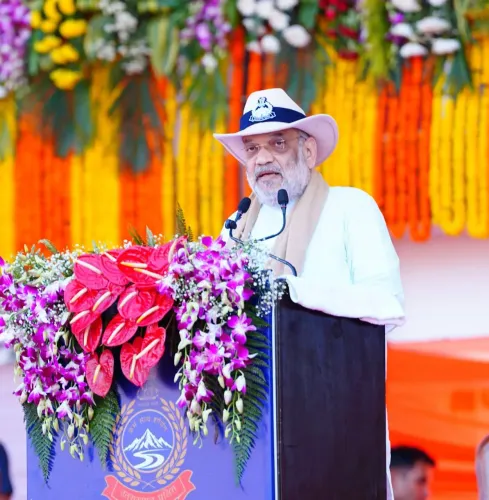
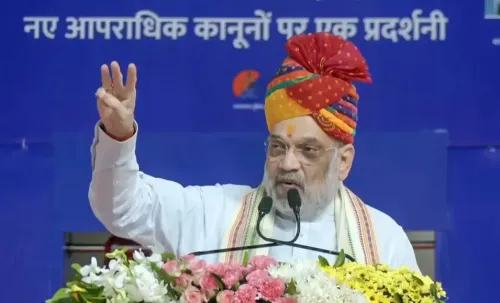
Every FIR filed after May 2027 in Uttarakhand will carry a promise attached to it — a conviction delivered within three years. Union Home Minister Amit Shah made that declaration on Friday, 6 November 2026, praising the Uttarakhand Police for translating the new criminal justice codes from statute into ground-level operational targets.
Posting in Hindi, Shah wrote: 'Nai nyaya samhitaon ko zameen par utar rahi Uttarakhand Police — May 2027 ke baad darj har FIR mein teen varsh ke bheetar saza dilaegi.' ('Uttarakhand Police is bringing the new justice codes down to the ground — every FIR registered after May 2027 will result in punishment within three years.')What the new criminal laws actually demand
The three new criminal laws — the Bharatiya Nyaya Sanhita, the Bharatiya Nagarik Suraksha Sanhita, and the Bharatiya Sakshya Adhiniyam — were passed by Parliament in December 2023 and came into force on 1 July 2024, replacing the colonial-era Indian Penal Code, Code of Criminal Procedure, and Indian Evidence Act respectively. Shah was the chief architect of that legislative overhaul, steering all three bills through both Houses.
The new codes embed time-bound mandates into the criminal process itself — from investigation deadlines to trial completion windows. The stated intent was to slash India's notorious case pendency and guarantee that victims see justice within a defined horizon, not decades later.
Uttarakhand's self-imposed deadline
Uttarakhand Police has now set May 2027 as the threshold: every FIR registered from that date onward will be tracked against a three-year conviction clock. That is a notably ambitious internal benchmark — court timelines in India have historically stretched far beyond three years even for straightforward cases. The state is effectively staking its own institutional credibility on the new framework delivering measurable outcomes.
Shah's post signals that the Centre views Uttarakhand as an early-mover model worth amplifying. By flagging the state's target publicly, the Home Ministry adds political accountability to what might otherwise remain a bureaucratic circular.
The wider race among states to implement the new codes
Since July 2024, states have been directed to align police training, digital FIR systems, forensic infrastructure, and prosecution capacity with the new codes. Progress has been uneven. Uttarakhand setting a hard, public, date-stamped conviction target raises the bar — and implicitly challenges other state forces to publish comparable commitments.
The real test, as legal observers have noted, sits not with the police but at the intersection of investigation quality, forensic capacity, and judicial bandwidth. Securing a conviction in three years requires every link in the chain — from the constable at the first scene to the prosecutor in court — to perform within tight windows that India's system has rarely managed at scale.
If Uttarakhand delivers on its May 2027 promise, it will hand the government its most concrete proof yet that the new criminal laws can move the justice needle where decades of reform rhetoric could not.Point of View
The Home Ministry converts a state-level administrative target into a national political benchmark. For a government that staked significant legislative capital on the 2023 criminal law overhaul, visible, time-stamped outcomes from a BJP-governed state serve as proof-of-concept ahead of potential electoral messaging. The three-year clock also quietly shifts the burden of proof from Parliament — which passed the laws — to states, courts, and prosecutors, whose infrastructure constraints remain the genuine obstacle to time-bound justice at scale.
NationPress
7 Nov 2026
Frequently Asked Questions
What did Amit Shah say about Uttarakhand Police and the new criminal laws?
Amit Shah stated that Uttarakhand Police is implementing India's new criminal justice codes on the ground and has set a target to secure convictions within three years for every FIR registered after May 2027.
What are the new criminal laws India introduced in 2023?
Parliament passed three new laws in December 2023 — the Bharatiya Nyaya Sanhita, Bharatiya Nagarik Suraksha Sanhita, and Bharatiya Sakshya Adhiniyam — replacing the colonial-era IPC, CrPC, and Indian Evidence Act respectively, with effect from 1 July 2024.
What is the May 2027 target Uttarakhand Police has set?
Uttarakhand Police aims to ensure that every FIR registered from May 2027 onward will result in punishment or conviction within three years, as part of implementing the new criminal procedure codes.
When did the Bharatiya Nyaya Sanhita come into effect?
The Bharatiya Nyaya Sanhita and the other two new criminal laws came into force on 1 July 2024, following their passage in Parliament in December 2023.
Will other states also adopt a three-year conviction timeline like Uttarakhand?
Uttarakhand is among the early movers in setting a hard public deadline. The Home Ministry's endorsement of the target signals that similar benchmarks could be encouraged or expected from other state police forces, though no uniform central mandate for a three-year target has been confirmed.