Amritsar Police Busts Two Cross-Border Drug & Arms Networks

Synopsis
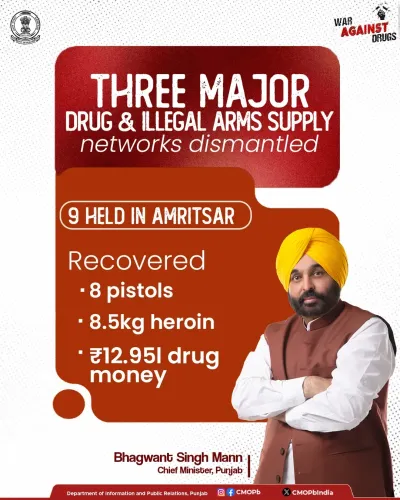
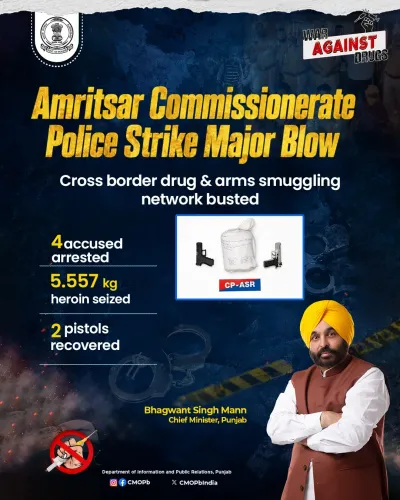
Amritsar Commissionerate Police dismantled two cross-border drug and arms networks on August 11, 2026, arresting seven people and seizing 10 illegal pistols, 1.054 kg of heroin, and a drone — a major step in CM Bhagwant Mann's drive to make Punjab a safe state.
Key Takeaways
Seven individuals arrested by Amritsar Commissionerate Police in a single coordinated operation on August 11, 2026 .
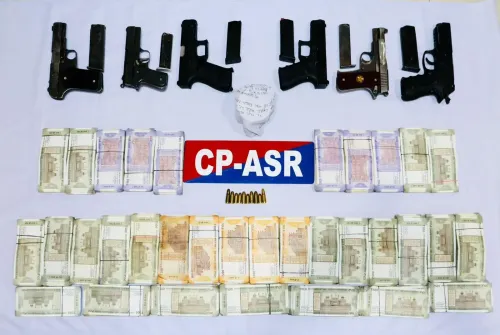
10 illegal pistols and 1.054 kg of heroin recovered from the accused.
A drone was also seized, indicating aerial smuggling routes were in use.
Two separate cross-border networks — one focused on narcotics, one on illegal arms — were dismantled simultaneously.
The operation was conducted under the policy direction of Chief Minister Bhagwant Singh Mann as part of Punjab's 'safe state' drive.
Investigations are ongoing; follow-up arrests and seizures in other border districts remain possible.
Ten illegal pistols, over a kilogram of heroin, and a drone — seized in a single operation. Amritsar Commissionerate Police has dismantled two major cross-border smuggling networks, arresting seven individuals in what the Chief Minister's Office of Punjab described on Tuesday, August 11, 2026 as a major breakthrough in the state's ongoing drive to curb narcotics and illegal arms flowing in from across the border.
What the Amritsar bust recovered — and why a drone changes the picture
Police recovered 10 illegal pistols, 1.054 kg of heroin, and a drone from the possession of the arrested individuals. The drone detail is significant: it signals that at least one of the two networks was using aerial smuggling routes — a method that has become increasingly common along the India-Pakistan border in recent years, allowing contraband to bypass ground-level checkpoints entirely.
The simultaneous dismantling of two separate networks in a single operation suggests coordinated intelligence work rather than a routine patrol intercept. Amritsar, as a border district, sits at the sharpest edge of Punjab's cross-border smuggling problem and has repeatedly featured in such busts.
Mann's anti-narcotics push since 2022
The operation falls squarely within the policy framework that Chief Minister Bhagwant Singh Mann has pursued since the Aam Aadmi Party came to power in Punjab in 2022. The government has consistently framed anti-narcotics operations as central to its promise of making Punjab a 'safe and secure state' — ਸੁਰੱਖਿਅਤ ਸੂਬਾ (a secure state) — with border districts and cross-border supply chains as the primary targets.
Punjab's heroin crisis has deep roots: the state's long, porous frontier with Pakistan has made it a preferred entry corridor for narcotics for decades. Successive governments have launched drives; the current administration's emphasis has been on targeting the supply chain at its source rather than only at the street level.
Investigations open into the two dismantled networks
With seven arrests made, investigators will now work to map the full architecture of both networks — identifying handlers, financiers, and any links to organised crime or militant outfits that have historically exploited the same smuggling corridors. Whether this bust triggers follow-up operations in other border districts of Punjab will be the immediate test of how deep the intelligence runs.
For border communities and Punjab's youth — the populations most exposed to the downstream consequences of cheap heroin and illegal weapons — the question is always whether a single high-profile seizure translates into sustained disruption, or whether the networks reconstitute quickly. The answer will come in the weeks ahead.
Point of View
Raising the stakes for sustained aerial monitoring along the border. For CM Mann, each such operation reinforces a governance narrative ahead of future electoral cycles, but the durability of that narrative depends on whether dismantled networks stay dismantled — a test Punjab has historically struggled to pass.
NationPress
25 Sept 2026
Frequently Asked Questions
What did Amritsar police seize in the August 2026 cross-border bust?
Amritsar Commissionerate Police seized 10 illegal pistols , 1.054 kg of heroin , and a drone while arresting seven individuals linked to two cross-border smuggling networks.
How are drones being used to smuggle drugs into Punjab?
Smugglers use drones to fly contraband — heroin, weapons, and cash — across the India-Pakistan border at night, bypassing ground checkpoints. The drone recovered in this Amritsar operation is consistent with that method.
What is CM Bhagwant Mann's 'safe state' drive in Punjab?
Since taking office in 2022 , Chief Minister Bhagwant Singh Mann has directed Punjab Police to prioritise anti-narcotics and anti-arms operations targeting cross-border supply chains, framing it as central to making Punjab a safe and secure state.
Why is Amritsar a hotspot for cross-border drug and arms smuggling?
Amritsar is a border district that shares proximity with the India-Pakistan frontier, making it a primary entry point for heroin and illegal weapons smuggled into Punjab for decades.
What happens after the two networks were dismantled in Amritsar?
Investigations are ongoing to map the full network — identifying financiers, handlers, and cross-district links. Follow-up arrests or seizures in other Punjab border districts are possible as the probe deepens.