Anurag Thakur Greets Doctors on National Doctors Day

Synopsis
BJP MP Anurag Thakur marked National Doctors Day on 1 July 2026 by honouring physicians for their service and connecting their dedication to India's expanding medical education infrastructure and the Viksit Bharat vision under PM Modi.
Key Takeaways
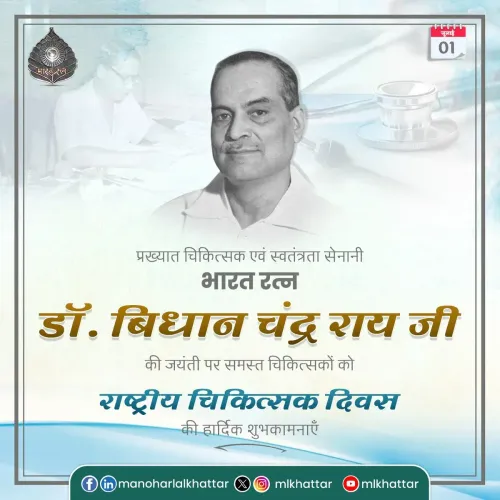
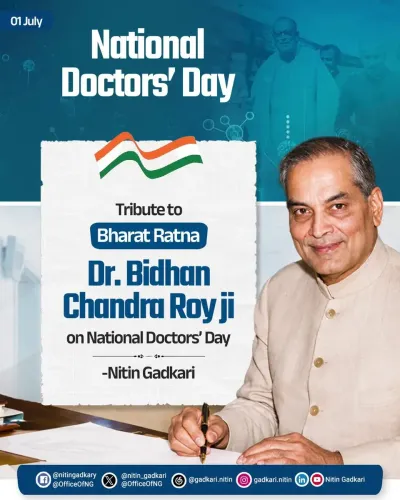
National Doctors Day is observed on 1 July every year in India, marking the birth and death anniversary of physician and former West Bengal CM Dr Bidhan Chandra Roy .
BJP MP Anurag Thakur extended greetings to the medical community and called doctors 'the closest thing to God on earth.' Thakur credited PM Narendra Modi 's leadership for a 'remarkable expansion of India's medical education and healthcare capacity.' Policy milestones underpinning this expansion include the National Health Policy 2017 , multiple new AIIMS campuses and government medical colleges approved since 2014 , and the Ayushman Bharat scheme launched in 2018 .
The tribute linked doctors' future contributions to the Viksit Bharat goal of a healthier, stronger India by 2047 .
Commissioning timelines for newly sanctioned medical colleges and their effect on rural doctor postings remain key policy watchpoints.
BJP MP Anurag Thakur on Wednesday, 1 July 2026, extended greetings to the medical community on National Doctors Day, honouring physicians for their role in protecting lives and linking their service to India's broader ambitions under Prime Minister Narendra Modi.
Context
National Doctors Day is observed every year on 1 July across India to honour the medical profession. The date marks the birth and death anniversary of Dr Bidhan Chandra Roy, the eminent physician and former Chief Minister of West Bengal who remains one of the most celebrated figures in Indian medicine. The occasion is used by public figures, institutions and citizens alike to express gratitude to the doctor community.
Thakur, a Lok Sabha MP from Hamirpur, Himachal Pradesh and former Union Minister of Information and Broadcasting as well as Youth Affairs and Sports, wrote on X: 'You stand beside people at their most vulnerable moments, bringing reassurance before recovery and hope before healing.' He added, 'A doctor is the closest thing to God on earth.'
Policy Backdrop
Thakur's tribute situated the medical profession within the government's record on healthcare expansion. The post noted that India, 'under the leadership of PM Shri Narendra Modi ji, has witnessed a remarkable expansion of India's medical education and healthcare capacity, creating a stronger foundation for the future.'
That expansion has a documented policy lineage. The National Health Policy 2017 set explicit targets for improving the doctor-to-population ratio and scaling up medical education infrastructure. Since 2014, multiple phases of new All India Institutes of Medical Sciences (AIIMS) and government medical colleges have been approved, substantially increasing both MBBS and postgraduate seats. The Ayushman Bharat scheme, launched in 2018, combined large-scale health insurance coverage with the rollout of Health and Wellness Centres at the grassroots level.
These measures are framed by the government as part of a long-term human-capital strategy aligned with the Viksit Bharat vision for 2047, which integrates health-system strengthening with goals of universal health coverage and the demographic dividend.
Stakeholders and Impact
The primary audience for such messaging is India's large and growing medical community — doctors, resident physicians, medical students and allied health workers. Thakur's post captured the emotional weight of the profession: 'Every patient who returns home because of your care carries back more than restored health. They carry home a family's happiness, a child's smile and the promise of tomorrow.'
For patients and families, particularly in rural and semi-urban areas, access to trained doctors remains a lived concern. The expansion of government medical colleges is intended in part to address shortages in such regions, with newly trained doctors expected to fill postings in underserved districts. Medical students and early-career physicians are the long-term beneficiaries of increased seat availability and institutional infrastructure.
What's Next
Parliamentary scrutiny of the health budget and evolving regulations under the National Medical Commission — the successor body to the Medical Council of India — will determine the pace at which newly sanctioned medical colleges become operational and begin placing graduates in the field. The commissioning timelines of these institutions, and their downstream effect on rural doctor postings, will be a key measure of whether the capacity expansion translates into equitable healthcare access. As India moves deeper into the Viksit Bharat roadmap, the health sector's ability to produce, deploy and retain skilled doctors will remain central to the nation's development narrative.
Point of View
The post reinforces the BJP's broader narrative of governance-as-capacity-building ahead of ongoing electoral cycles. The invocation of 'Viksit Bharat' is deliberate — it ties routine tribute messaging to the government's flagship long-term vision, keeping the policy frame alive in public discourse. For the opposition, the implicit challenge is to contest not the sentiment but the ground-level outcomes: whether seat expansion has translated into equitable doctor deployment, particularly in rural India.
NationPress
1 Jul 2026
Frequently Asked Questions
Why is National Doctors Day celebrated on 1 July in India?
National Doctors Day in India is observed on 1 July every year to honour the birth and death anniversary of Dr Bidhan Chandra Roy , a distinguished physician and former Chief Minister of West Bengal, who is regarded as one of the most eminent doctors in Indian history.
What did Anurag Thakur say on National Doctors Day 2026?
BJP MP Anurag Thakur posted a tribute on X calling doctors 'the closest thing to God on earth' and praised their role in standing beside patients 'at their most vulnerable moments,' while also highlighting India's expansion of medical education under PM Narendra Modi .
How has India expanded medical education under PM Modi?
Since 2014 , the government has approved multiple new AIIMS campuses and government medical colleges, significantly increasing MBBS and postgraduate seats. The National Health Policy 2017 set targets for improving the doctor-to-population ratio, and Ayushman Bharat was launched in 2018 to expand health insurance and grassroots health infrastructure.
What is Viksit Bharat and how does it relate to healthcare?
Viksit Bharat is the Indian government's vision for a developed India by 2047 . Healthcare system strengthening — including expanding the supply of trained doctors and achieving universal health coverage — is a core component of this long-term development framework.
Who is Anurag Thakur?
Anurag Thakur is a BJP Lok Sabha MP representing Hamirpur constituency in Himachal Pradesh . He has previously served as Union Minister of Information and Broadcasting and Union Minister of Youth Affairs and Sports.