Anurag Thakur invokes Maharana Pratap in Karnataka speech
Synopsis
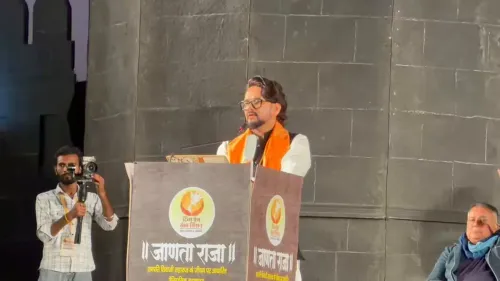
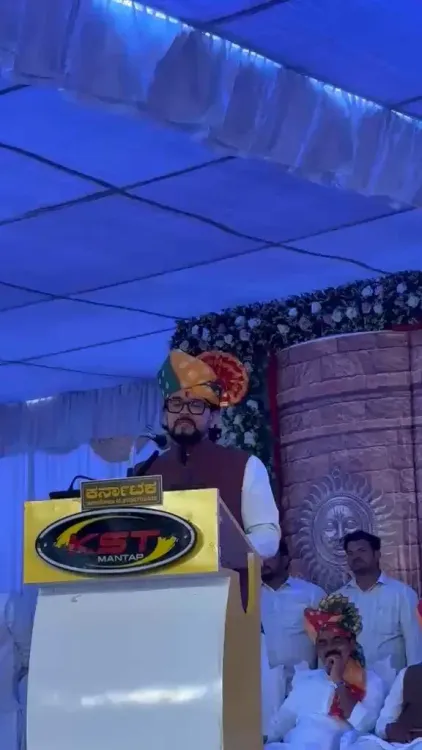
BJP MP Anurag Thakur, addressing a Karnataka audience on 15 November 2026, invoked Maharana Pratap's ideals and called for a strike against what he termed a 'Mughal-era mindset' still alive in India — a move that fits BJP's cultural-nationalist political playbook in a key contest state.
Key Takeaways
BJP MP Anurag Thakur made the statement during an event in Karnataka on 15 November 2026 .
He called on citizens to 'strike against Mughal-era thinking being nurtured inside India,' drawing on Maharana Pratap's ideals.
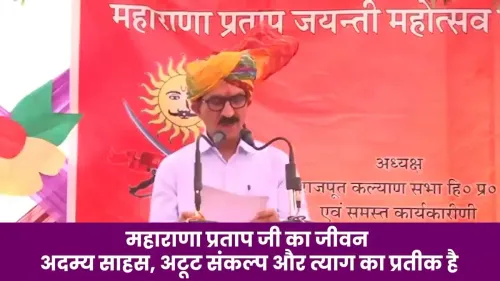
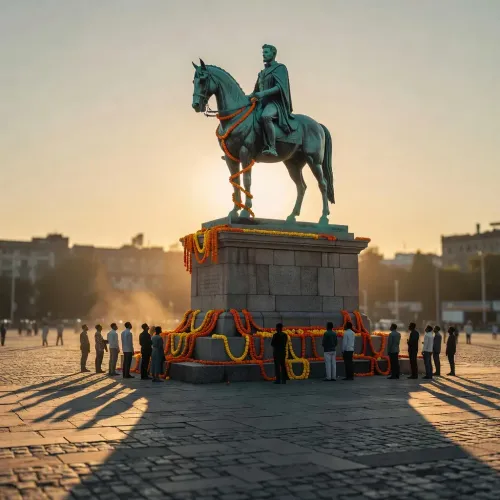
Maharana Pratap , the 16th-century Rajput ruler of Mewar , is a recurring symbol in BJP political messaging for cultural resistance.
Karnataka has been a frequent battleground for debates over historical memory, including narratives around Tipu Sultan and temple heritage.
The post was shared on X with a video and geotagged to Karnataka, amplifying its reach within state-level political discourse.
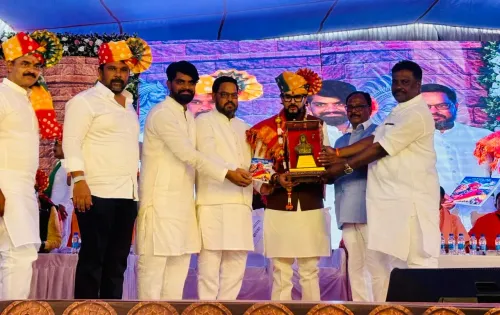
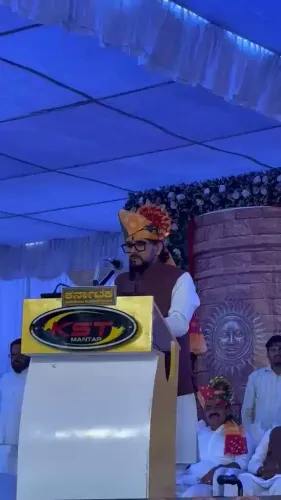
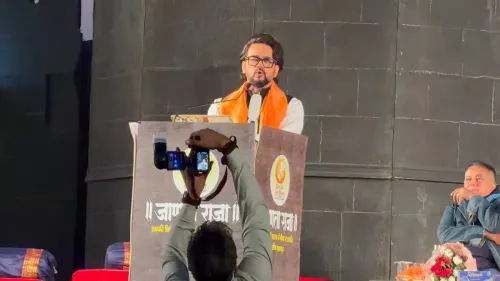
A medieval warrior's defiance — invoked on a modern political stage. Addressing an audience in Karnataka on Sunday, 15 November 2026, BJP MP Anurag Thakur drew on the legacy of Maharana Pratap to call for resistance against what he described as a 'Mughal mindset' still alive within India today.
Posting on X in Hindi, Thakur wrote: 'Aaj Mughal to nahin hain, lekin humein Maharana Pratap ke aadarsho par chalte hue Bharat mein pal rahe Mughaliya soch ke khilaf prahar karna hai' — 'The Mughals do not exist today, but we must strike, walking in the footsteps of Maharana Pratap's ideals, against the Mughal-era thinking that is being nurtured inside India.' The post, tagged to Karnataka, carried a video of the event.
Who was Maharana Pratap — and why he travels so far in BJP rhetoric
The reference is a familiar one in BJP political messaging. Maharana Pratap, the 16th-century Rajput ruler of Mewar, is celebrated in Indian public memory for refusing to submit to Mughal Emperor Akbar — most memorably at the Battle of Haldighati (1576). For BJP leaders, he has become shorthand for martial self-reliance, cultural pride, and the idea that Hindu civilisation was never entirely subdued.
Invoking Pratap is thus not merely a history lesson — it is a mobilising signal. The implicit argument runs: the battle was not just military, it was civilisational, and its spirit must be carried forward.
Karnataka: where history and electoral politics collide
Karnataka is one of the most competitive states in BJP-Congress politics, and it has been a repeated flashpoint for contests over historical memory. Debates around Tipu Sultan, temple heritage, and regional cultural identity have all featured in state-level campaigns over the past decade. For the BJP, rallying its base around cultural-nationalist narratives — especially in a state it lost to the Congress — is a core organisational tool.
Thakur's framing neatly aligns with that playbook: by locating the adversary not in a foreign empire but in a 'mindset within India,' the statement widens the target while keeping its historical resonance intact. It is an argument designed to travel — from a party rally floor to a social media feed.
Opposition responses in Karnataka are likely to sharpen around whether such language deepens communal polarisation — a charge the BJP typically contests by framing these invocations as cultural, not communal, pride.
From Mewar to Karnataka, Maharana Pratap's lance is still being aimed — and the direction it points says everything about where BJP believes the next political battle lies.
Point of View
' the rhetoric becomes harder to rebut and easier to circulate. In Karnataka, a state the BJP lost to Congress and is working to reclaim, such messaging serves a dual purpose: consolidating existing supporters while drawing sharper ideological lines ahead of future electoral contests. Whether it broadens the party's coalition or deepens polarisation will depend on how the opposition chooses to engage with it.
NationPress
15 Nov 2026
Frequently Asked Questions
What did Anurag Thakur say in Karnataka about Maharana Pratap?
Anurag Thakur said that while the Mughals no longer exist, Indians must follow Maharana Pratap's ideals and strike against what he called a 'Mughal mindset' being nurtured inside India today.
Who was Maharana Pratap and why do BJP leaders invoke him?
Maharana Pratap was a 16th-century Rajput ruler of Mewar who resisted Mughal Emperor Akbar, most famously at the Battle of Haldighati in 1576. BJP leaders invoke him as a symbol of cultural pride, martial self-reliance, and Hindu civilisational resistance.
What is 'Mughal mindset' as used by BJP politicians?
In BJP political discourse, the phrase 'Mughal mindset' is used to describe attitudes or ideologies that the party frames as contrary to Hindu cultural identity or Indian civilisational values — a rhetorical device that extends medieval-era symbolism into contemporary political debate.
Why is Karnataka significant for BJP's cultural-nationalist messaging?
Karnataka is a highly competitive state where BJP has previously engaged in debates over historical figures like Tipu Sultan and temple heritage. After losing the state to the Congress, the BJP uses cultural-nationalist narratives to energise its base and frame the political contest in civilisational terms.
Is Anurag Thakur currently a minister?
No. Anurag Thakur is currently a BJP Lok Sabha MP from Hamirpur, Himachal Pradesh. He previously served as Union Minister for Information and Broadcasting and Youth Affairs and Sports.