Anurag Thakur Meets Delhi CM on Bills to Oust Ministers Held 30 Days

Synopsis
BJP MP Anurag Thakur joined the Joint Parliamentary Committee in meeting Delhi CM Rekha Gupta on 17 June 2026 to present three bills, including a constitutional amendment requiring ministers held in custody for 30 consecutive days on serious charges to vacate office, framed as a step toward greater accountability under PM Modi.
Key Takeaways
BJP MP Anurag Thakur met Delhi CM Rekha Gupta alongside JPC members on 17 June 2026 for a legislative presentation.
Three bills were discussed: the Constitution (130th Amendment) Bill, 2025 , the J&K Reorganisation (Amendment) Bill , and the Union Territories Government (Amendment) Bill .
A key provision would require any minister — including the PM or CM — to vacate office if held in custody for 30 consecutive days on charges punishable with 5 or more years imprisonment.
The bills are under JPC scrutiny and have not yet been passed by Parliament.
Thakur linked the proposals to PM Narendra Modi 's broader agenda of strengthening democratic institutions.
The J&K Reorganisation (Amendment) Bill would further revise the governance framework introduced by the 2019 Reorganisation Act .
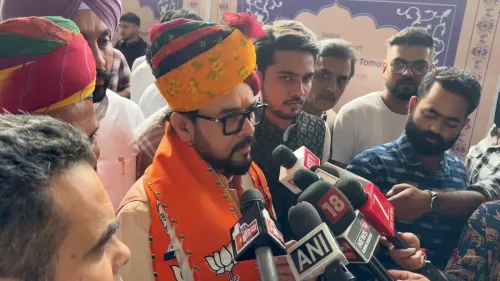
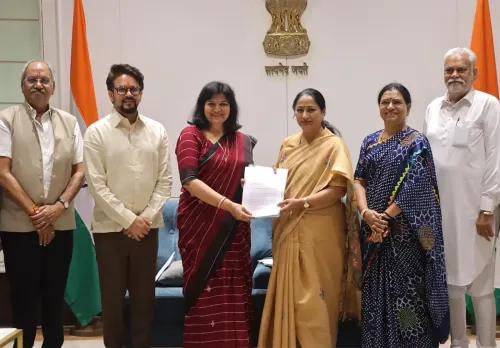
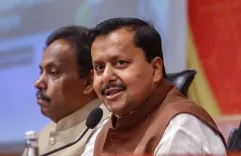
BJP MP Anurag Thakur met Delhi Chief Minister Smt. Rekha Gupta on Wednesday, 17 June 2026, alongside members of the Joint Parliamentary Committee (JPC), for a detailed presentation on three legislative proposals: the Constitution (130th Amendment) Bill, 2025, the J&K Reorganisation (Amendment) Bill, and the Union Territories Government (Amendment) Bill.
Context
Thakur, a Lok Sabha MP from Hamirpur, Himachal Pradesh and a member of the JPC, described the meeting as part of the committee's process of gathering inputs before the bills proceed to Parliament. The central provision highlighted by Thakur is a mandatory vacation-of-office clause: any minister — including the Prime Minister or Chief Minister — must vacate office if held in custody for 30 consecutive days on charges carrying a punishment of five years or more imprisonment. 'No one is above the law,' he stated in his post.
The JPC is the parliamentary panel tasked with detailed scrutiny of constitutional and statutory amendment bills before they are taken up for passage in either House. Its consultations with state and Union Territory administrations are a standard step in that process.
Policy Backdrop
The bills build on a longer arc of legislative and judicial action aimed at tightening eligibility norms for holding executive office in India. Supreme Court rulings in 2013 and 2014 strengthened disqualification provisions for convicted legislators, and subsequent statutory changes extended accountability frameworks to Union Territory governance.
The Jammu and Kashmir Reorganisation Act, 2019 — which converted the state into two Union Territories and restructured their legislative and administrative frameworks — is now itself subject to further amendment through the J&K Reorganisation (Amendment) Bill under JPC review. The Union Territories Government (Amendment) Bill similarly touches the governance architecture of centrally administered territories.
Thakur invoked the leadership of Prime Minister Narendra Modi, framing the three bills as part of a broader effort to 'strengthen democratic institutions of Bharat' by embedding ministerial accountability directly into constitutional and statutory law.
Stakeholders and Impact
The proposed 30-day custody rule would apply uniformly to ministers at every level of government — from Union Cabinet ministers to Chief Ministers of states and Union Territories — if enacted. Opposition parties are expected to scrutinise whether the provision could be misused through politically motivated arrests to dislodge elected governments.
For Delhi, the meeting carries additional significance because the capital's administrative framework has historically been contested between elected governments and the Centre. Thakur contrasted the current dispensation under CM Rekha Gupta — which he characterised as focused on 'transparency, accountability and clean governance' — with what he described as repeated violations of constitutional norms by the previous government, a clear reference to the preceding administration.
Union Territory administrations, including Jammu and Kashmir, would be directly affected by the J&K Reorganisation (Amendment) Bill, making their administrative and political stakeholders key voices in the JPC consultation process.
What's Next
The JPC's presentations and consultations will feed into a committee report that Parliament must consider before the bills are scheduled for debate and voting. Depending on the pace of committee work, the bills could come up during the monsoon or winter session of Parliament. Any Supreme Court observations on the ministerial accountability provisions — particularly the custody-triggered vacation clause — could also shape the final legislative text and its constitutional validity.
Point of View
Making it harder to dismiss as partisan targeting. By holding the consultation in Delhi and including CM Rekha Gupta, the BJP simultaneously frames the capital's new administration as a governance-reform partner, a pointed contrast with the previous Delhi government. The three-bill package — spanning constitutional amendment, J&K reorganisation, and Union Territory governance — suggests a coordinated legislative push that could define the monsoon or winter session's agenda. How opposition parties respond to the custody clause, and whether the Supreme Court is drawn into its constitutional validity, will determine whether this becomes landmark legislation or a protracted parliamentary battle.
NationPress
20 Sept 2026
Frequently Asked Questions
What is the Constitution (130th Amendment) Bill 2025 about?
The Constitution (130th Amendment) Bill, 2025 proposes, among other things, that any minister — including the Prime Minister or a Chief Minister — must vacate office if held in custody for 30 consecutive days on charges carrying a punishment of five or more years imprisonment. It is currently under review by a Joint Parliamentary Committee.
Why did Anurag Thakur meet Delhi CM Rekha Gupta?
Anurag Thakur, as a member of the Joint Parliamentary Committee, met Delhi CM Rekha Gupta on 17 June 2026 for a detailed presentation on three governance and constitutional amendment bills as part of the JPC's standard consultation process before the bills go to Parliament.
What happens to a minister held in custody for 30 days under the proposed bill?
Under the proposed provision, any minister — including the Prime Minister or Chief Minister — would be required to vacate office if held in custody for 30 consecutive days on serious charges punishable with imprisonment of five years or more.
What is the J&K Reorganisation Amendment Bill?
The J&K Reorganisation (Amendment) Bill proposes further changes to the governance framework established by the Jammu and Kashmir Reorganisation Act of 2019, which had converted the state into two Union Territories. It is one of three bills currently being reviewed by the Joint Parliamentary Committee.
When could these bills be passed in Parliament?
The bills are currently at the JPC consultation stage. Depending on the pace of the committee's work and its report, they could be taken up for debate and voting during the monsoon or winter session of Parliament.