Is Maharashtra's Non-Production of Undertrial Prisoners Appalling?
Click to start listening
Synopsis
The Supreme Court has sharply criticized Maharashtra authorities for their repeated failure to produce an undertrial prisoner before the court. With 55 non-productions noted, the situation raises serious concerns about the treatment of prisoners and the legal obligations of the state. This case highlights the urgent need for accountability in the judicial process.
Key Takeaways
- The Supreme Court has criticized Maharashtra for repeatedly failing to produce an undertrial prisoner.
- Shashi alias Shahi Chikna Vivekanand Jurmani has been in custody for over four years.
- The court emphasized the importance of producing accused individuals in court.
- Accountability measures have been ordered for the Maharashtra Prisons Department.
- The case raises serious concerns about prisoner rights and judicial procedures.
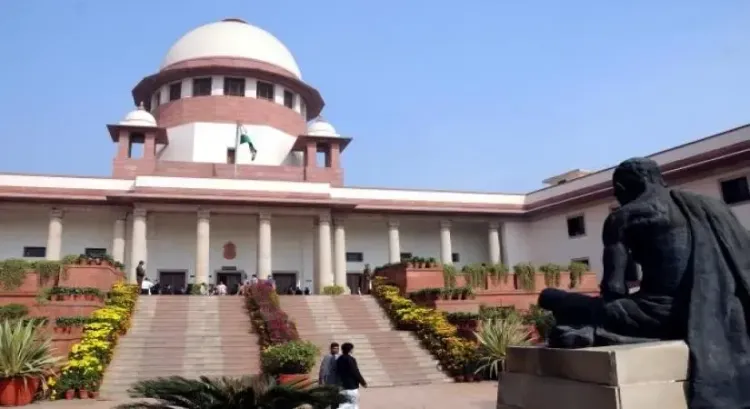
New Delhi, Dec 3 (NationPress) The Supreme Court has strongly criticized Maharashtra's authorities for their failure to present an undertrial prisoner in court for over 50 hearings. A bench comprising Justices Ahsanuddin Amanullah and Prashant Kumar Mishra described the matter as 'appalling and shocking' after discovering that an undertrial had not been produced during 55 out of 85 hearings.
This hearing involved a bail plea from Shashi alias Shahi Chikna Vivekanand Jurmani, who has been incarcerated for over four years in connection with a 2021 attempt-to-murder case lodged at the Vitthalwadi police station in Thane’s Ulhasnagar.
The charges against the petitioner include various sections of the IPC, including 143, 147, 148, 149, 307, 326, 353, and 333. The defense argued that the original FIR indicated a stabbing, but later testimonies clarified that the petitioner only engaged in physical assault using fists and kicks.
In the victim's statement taken by a police constable prior to his death, he attributed the knife attack to another co-accused.
While granting bail, the bench noted that a co-accused, Umesh @ Omi Bansilal Kishnani, who was in a similar situation, had already been released on bail. The Supreme Court expressed its concern over the authorities’ continuous failure to produce the petitioner before the trial court.
“We are alarmed at the conduct of the state authorities,” the bench remarked, emphasizing that producing an accused is not merely a procedural formality, but a 'safeguard to prevent abuse' and to allow the accused to voice grievances against the authorities.
Labeling it a 'serious violation of fundamental safeguards', the Supreme Court issued strict directives to the Maharashtra Prisons Department. It commanded the Director General of Prisons to conduct a personal inquiry, establish accountability, and take action against those responsible for the recurrent non-production.
The bench warned that any attempts to protect negligent officials would lead to personal liability for the DG Prisons. “If any effort is made to shield anyone, the Director General of Prisons or Head of Department will be held personally responsible,” the order cautioned.
Furthermore, the court required a personally affirmed affidavit and a detailed report to be submitted within two months, with the matter tentatively slated for review on February 3, 2026.
Point of View
My perspective aligns with the principles of justice and accountability. The repeated non-production of an undertrial prisoner in Maharashtra is not just a procedural oversight—it represents a significant breach of fundamental rights. It is imperative that state authorities uphold their responsibilities to ensure justice and protect the rights of individuals in custody.
NationPress
03/12/2025
Frequently Asked Questions
What was the Supreme Court's reaction to Maharashtra's handling of undertrial prisoners?
The Supreme Court expressed strong disapproval, labeling the situation 'appalling and shocking' due to the failure to produce an undertrial prisoner over 55 hearings.
Who is the undertrial prisoner involved in this case?
The undertrial prisoner in question is Shashi alias Shahi Chikna Vivekanand Jurmani, who has been in custody for over four years related to an attempt-to-murder case.
What actions has the Supreme Court mandated regarding this situation?
The court ordered the Director General of Prisons to conduct a personal inquiry and take responsibility for the repeated non-production of the undertrial.
What are the implications of failing to produce an undertrial prisoner?
Failure to produce an undertrial compromises their legal rights and can lead to abuse and violation of fundamental safeguards in the justice system.
When is the next hearing scheduled for this case?
The next hearing is tentatively scheduled for February 3, 2026.