CM Pema Khandu: APSSB conducted 38 exams, hired 5,836 since 2019

Synopsis
Arunachal Pradesh CM Pema Khandu highlights that the APSSB has conducted 38 examinations and made 5,836 recruitments since 2019, showcasing the state's commitment to merit-based, transparent government hiring under a decade of BJP governance.
Key Takeaways
38 examinations conducted by the APSSB since 2019 , as of September 2026 .
5,836 recruitments made through the centralised exam-based system during this period.
APSSB was constituted in 2018 to replace ad-hoc departmental hiring plagued by irregularity allegations.
CM Pema Khandu framed the record as part of a decade of BJP governance under #10YearsOfSeva .
The board's model aligns with a broader northeast India trend of strengthening independent staff selection bodies since 2014.
Future credibility hinges on sustaining exam frequency and publishing transparent annual data through 2027 and beyond.
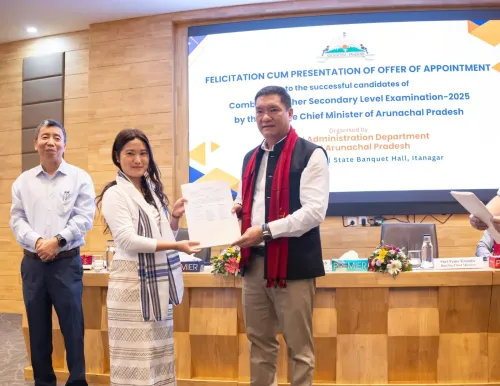
Nearly six thousand young people from Arunachal Pradesh now hold government jobs they earned through a competitive exam — and Arunachal Pradesh Chief Minister Pema Khandu wants the state to know exactly how that happened. On Friday, October 16, 2026, the Chief Minister took to X to mark a governance milestone, detailing how the Arunachal Pradesh Staff Selection Board (APSSB) has quietly reshaped the way the state hires its workforce.
38 examinations, 5,836 jobs — the APSSB scorecard
Since 2019, the APSSB has conducted 38 examinations, resulting in 5,836 recruitments as of September 2026, according to the Chief Minister's post. Khandu framed this as the payoff of a deliberate shift — away from opaque, department-level hiring and toward a centralised, exam-based system built on what he called 'merit, integrity and public trust.' Those are not just buzzwords in Arunachal's context. They are a direct answer to a history of contested appointments.
Why the APSSB was born — and what it replaced
The APSSB was constituted in 2018 to replace ad-hoc departmental recruitments that had long attracted allegations of favouritism and irregularity. Arunachal was not alone: across the northeast, states began establishing or fortifying independent selection boards in the years following 2014, responding to both public pressure and a surge in litigation over government jobs. Centralising the process under a single board was meant to standardise cut-offs, reduce political interference, and give every aspirant — regardless of district or connection — the same starting line.
Khandu's post carries the hashtags #10YearsOfSeva and #10SaalBemisaal — ten years of service, ten years without parallel — anchoring the APSSB numbers inside a broader BJP governance narrative as the party marks a decade of rule in the state. The framing is deliberate: recruitment reform as a signature of the tenure, not a bureaucratic footnote.
What a 'level playing field' means for Arunachal's youth
Arunachal Pradesh is a frontier state sharing international borders with China, Myanmar, and Bhutan — and retaining educated young people in government service matters as much for strategic depth as for local development. A credible recruitment pipeline reduces brain drain and gives locally rooted youth a reason to compete at home rather than migrate. Nearly 5,836 recruits since 2019 represents a measurable injection of state-employed professionals into departments spread across one of India's most geographically challenging territories.
The Chief Minister's language — 'level playing field for every aspirant' — signals that the political value of this record is as much about perception as process. When people trust that jobs are won, not awarded, they engage with the system. That trust, once built, is harder to erode than any individual policy.
What the next chapter looks like
The metrics Khandu cited run only to September 2026. Whether the pace of APSSB examinations accelerates through 2027, and whether annual reports back the transparency claims with granular data, will determine if this scorecard becomes a benchmark or a ceiling. The board's credibility now rests on consistency — and the youth of Arunachal will be watching every notification.
Point of View
The BJP in Arunachal attempts to convert administrative continuity into electoral credibility under the '#10YearsOfSeva' narrative. The choice of a centralised recruitment board as the showcase metric is telling — in a state where jobs were historically the currency of patronage politics, making hiring visibly merit-based disrupts an old transactional playbook. For the opposition, the challenge is not to dispute the numbers but to ask whether 5,836 jobs over seven years is fast enough for Arunachal's aspirant demographic. The APSSB story, if sustained by verifiable annual reports, could become a replicable template for other capacity-constrained northeastern states.
NationPress
16 Oct 2026
Frequently Asked Questions
What is the APSSB and what does it do?
The Arunachal Pradesh Staff Selection Board (APSSB) is a state body constituted in 2018 to conduct centralised competitive examinations for non-gazetted posts in Arunachal Pradesh government departments, replacing ad-hoc departmental recruitments.
How many people has APSSB recruited since 2019?
According to CM Pema Khandu's post, the APSSB has made 5,836 recruitments as of September 2026 through 38 examinations conducted since 2019.
Why was the APSSB set up in Arunachal Pradesh?
The APSSB was set up in 2018 to address allegations of favouritism and irregularity in departmental hiring, standardise recruitment processes, and reduce litigation over government jobs in the state.
What is the '#10YearsOfSeva' hashtag about?
The '#10YearsOfSeva' hashtag marks a decade of BJP governance in Arunachal Pradesh, used by CM Pema Khandu and the party to highlight administrative milestones like the APSSB's recruitment record.
Is Arunachal Pradesh the only northeastern state with a staff selection board?
No. Several northeastern states strengthened or established independent staff selection boards between 2014 and 2019 as part of a regional push for transparent, exam-based government hiring and to reduce political interference in recruitment.