Arunachal border villages rising as tourism hubs under Vibrant Village Programme
Synopsis
Arunachal Pradesh is quietly rewriting the story of its border villages — from security-sensitive frontiers to tourism and livelihood hubs. With ₹2,800 crore flowing into 455 villages under the Vibrant Village Programme and a ₹1.9 lakh crore hydropower decade declared, CM Pema Khandu's Independence Day address was less a ceremonial speech and more a state-of-the-frontier report.
Key Takeaways
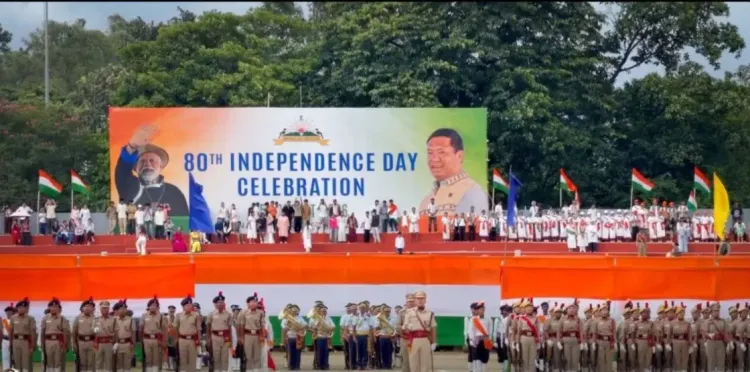
Pema Khandu addressed the 80th Independence Day at Indira Gandhi Park, Itanagar on 15 August 2025 .
Vibrant Village Programme Phase-I : ₹ 2,800 crore in projects across 455 villages on the India-Tibet (China) border; Phase-II adds 122 villages on India-Myanmar and India-Bhutan borders.
Arunachal targets 19 GW of hydropower by 2035, backed by ₹1.9 lakh crore in investment; Subansiri Lower Project already producing 1,000 MW . ₹3,112.50 crore invested in Mission Shikshit Arunachal Phase-I ; government school enrolment up 13.33% .
Over 1.5 lakh women organised into 16,000+ SHGs across the state.
Centre released ₹44.55 crore in advance under the State Disaster Response Fund for flood and landslide relief.
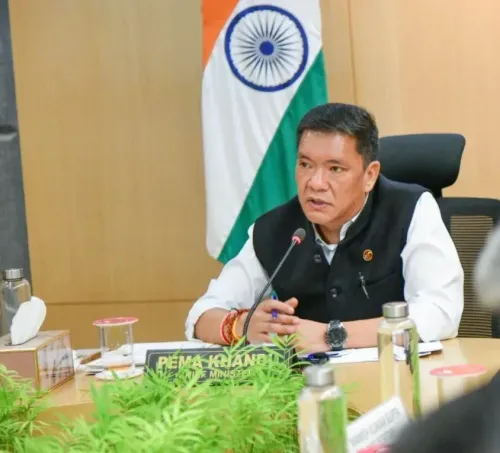
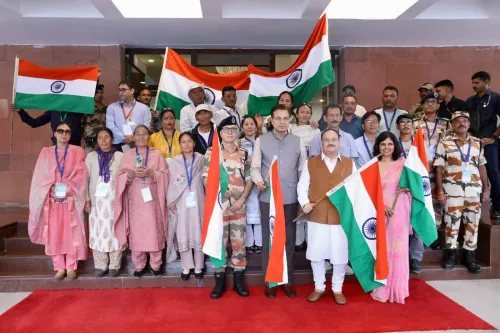
Arunachal Pradesh Chief Minister Pema Khandu on 15 August 2025 declared that the state's border villages are fast emerging as centres of tourism, livelihood, and local enterprise, crediting the Vibrant Village Programme for unlocking new opportunities in frontier communities. Hoisting the Tricolour at Indira Gandhi Park in Itanagar on the occasion of the 80th Independence Day, Khandu outlined a sweeping development agenda spanning hydropower, education, women's empowerment, and disaster relief.
Vibrant Village Programme: Scale and Reach
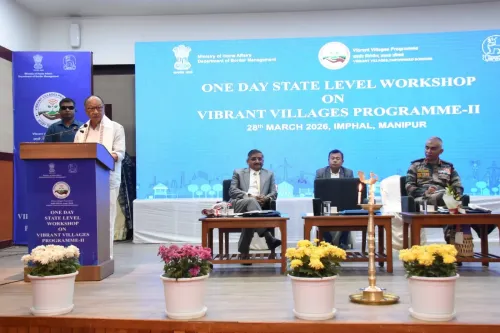
Under Phase-I of the Vibrant Village Programme, projects worth approximately ₹2,800 crore are being implemented across 455 villages along the India-Tibet (China) border. The programme is improving infrastructure, strengthening local livelihoods, and showcasing the natural beauty and rich cultural heritage of these remote communities.
In Phase-II, an additional 122 villages along the India-Myanmar and India-Bhutan borders have been brought under the scheme. Khandu said the initiatives are designed to create sustainable livelihood opportunities while reinforcing connectivity in areas that have historically been difficult to reach.
Hydropower Ambitions: The Decade of 19 GW
Highlighting Arunachal Pradesh's considerable hydropower potential, Khandu said the state has a unique role in India's clean energy transition. “Guided by this vision, we declared 2025-2035 as the Decade of Hydropower, with a target of commissioning nearly 19 GW of hydropower capacity, supported by investments of approximately ₹1.9 lakh crore,” he said.
The Subansiri Lower Hydroelectric Project — described as India's largest hydropower project — has already operationalised four of its eight generating units, producing 1,000 MW of clean energy. The remaining four units are expected to become operational this year. The Union Government has separately approved investments of about ₹40,175 crore for the 1,720 MW Kamala Hydro Electric Project and the 1,200 MW Kalai-II Hydro Electric Project. Work is also progressing on the Tato-I, Tato-II, and Heo hydroelectric projects.
Education and Women's Empowerment
On the education front, ₹3,112.50 crore has been invested in Phase-I of Mission Shikshit Arunachal to overhaul infrastructure, governance, teaching quality, digital education, and institutional capacity. An additional ₹500 crore has been committed to upgrade 50 government schools into Golden Jubilee Schools. These investments have already contributed to a 13.33% increase in enrolment in government schools, Khandu said.
On women's empowerment, the Chief Minister noted that more than 1.5 lakh women are now organised into over 16,000 Self Help Groups (SHGs), with thousands becoming entrepreneurs, community leaders, and agents of change.
Flood Relief and Federal Support
Khandu expressed solidarity with families affected by recent floods and landslides in Arunachal Pradesh and neighbouring Assam and Nagaland. He thanked Prime Minister Narendra Modi and Union Home Minister Amit Shah for approving the advance release of ₹44.55 crore under the State Disaster Response Fund, saying the assistance had strengthened relief, rescue, and rehabilitation efforts in flood-affected areas. An Inter-Ministerial Central Team also visited the state to assess damage.
Khandu recalled Prime Minister Modi's visit to Itanagar on 22 September 2025, during which the Prime Minister dedicated and laid foundation stones for development projects worth over ₹5,100 crore, including the 186 MW Tato-I and 240 MW Heo hydroelectric projects involving cumulative investments of over ₹3,700 crore.
Sustainable Development and Buddhist Heritage
Emphasising environmentally responsible growth, Khandu said Arunachal Pradesh — as custodian of some of India's richest forests, rivers, and mountain ecosystems — has a responsibility to pursue climate-resilient development. He also highlighted efforts to promote the state's Buddhist heritage, following the Union Budget announcement on developing Buddhist circuits in the Northeast. With hydropower targets, border tourism, and education reforms all in motion, the state's next milestones will test whether frontier ambition translates into lasting ground-level change.
Point of View
But the harder question is absorption capacity: ₹2,800 crore across 455 villages is meaningful, but Arunachal's track record on project completion timelines in high-altitude terrain warrants scrutiny. The hydropower decade target of 19 GW is ambitious — India's entire installed hydropower capacity today is around 47 GW — and Arunachal alone accounting for nearly 40% of that addition would be transformative, if it materialises on schedule.
NationPress
29 Sept 2026
Frequently Asked Questions
What is the Vibrant Village Programme in Arunachal Pradesh?
The Vibrant Village Programme is a Central Government initiative aimed at developing border villages in Arunachal Pradesh through infrastructure, connectivity, and livelihood projects. Phase-I covers 455 villages along the India-Tibet (China) border with investments of around ₹2,800 crore, while Phase-II has added 122 villages on the India-Myanmar and India-Bhutan borders.
What is Arunachal Pradesh's Decade of Hydropower?
Chief Minister Pema Khandu declared 2025-2035 as the Decade of Hydropower, targeting the commissioning of nearly 19 GW of hydropower capacity backed by investments of approximately ₹1.9 lakh crore. The Subansiri Lower Hydroelectric Project — India's largest — is already producing 1,000 MW from four of its eight units.
How has education improved in Arunachal Pradesh?
Under Phase-I of Mission Shikshit Arunachal, ₹3,112.50 crore has been invested to reform infrastructure, governance, and teaching quality. An additional ₹500 crore has upgraded 50 government schools into Golden Jubilee Schools, contributing to a 13.33% rise in government school enrolment.
What flood relief has Arunachal Pradesh received?
The Centre approved an advance release of ₹44.55 crore under the State Disaster Response Fund for flood and landslide relief in Arunachal Pradesh. An Inter-Ministerial Central Team also visited the state to assess damage in areas also affected across neighbouring Assam and Nagaland.
Who are the border villages in Arunachal Pradesh targeted at?
The border villages targeted under the Vibrant Village Programme are frontier communities living along the India-Tibet (China), India-Myanmar, and India-Bhutan borders. The programme aims to provide them with better infrastructure, connectivity, and sustainable livelihood opportunities while boosting tourism in these remote areas.