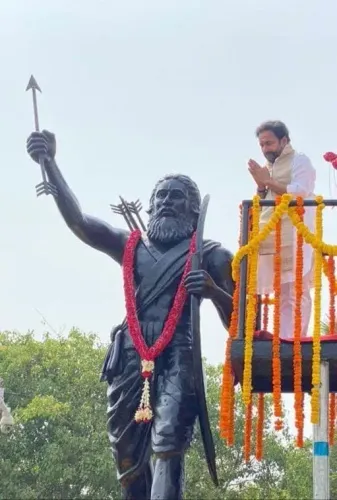
Kishan Reddy: ASI Declares Palampet Shiva Temple National Monument

Synopsis
The ASI has officially notified the 13th-century Palampet Shiva Temple in Mulugu, Telangana, as a Monument of National Importance under the 1958 Act. Union Minister G. Kishan Reddy announced the Gazette notification, calling it a step that strengthens Kakatiya heritage preservation alongside the nearby UNESCO-listed Ramappa Temple.
Key Takeaways
The ASI has issued an official Gazette notification declaring the Palampet Shiva Temple in Mulugu district, Telangana , a Monument of National Importance.
The declaration is made under the Ancient Monuments and Archaeological Sites and Remains Act, 1958 , formally designating the site as 'national wealth.' The temple is a 13th-century Kakatiya-era structure located in the same Palampet cluster as the UNESCO World Heritage Site Ramappa Temple , inscribed in 2021 .
Kishan Reddy announced the notification on 7 July 2026 , thanking PM Narendra Modi on behalf of the people of Telangana.
The ASI notification strengthens legal protection against encroachment and opens pathways for central conservation funding at the Palampet heritage cluster.
The move is expected to boost heritage tourism in Mulugu district and could pave the way for further notifications covering other Kakatiya-era monuments.
Union Coal and Mines Minister G. Kishan Reddy announced on Tuesday, 7 July 2026 that the Archaeological Survey of India (ASI) has issued an official Gazette notification declaring the historic Palampet Shiva Temple in Mulugu district, Telangana, a 'Monument of National Importance' under the Ancient Monuments and Archaeological Sites and Remains Act, 1958 — formally designating it as 'national wealth' (jatiya sampada).
Context
The Palampet Shiva Temple is a 13th-century Kakatiya-era structure located in Mulugu district, the same locality that is home to the Ramappa Temple (Rudreshwara Temple) — a UNESCO World Heritage Site inscribed in 2021. Kishan Reddy, who also serves as BJP Telangana state president, stated in his post that the new ASI recognition will further enhance the global stature of the Ramappa complex and the broader Kakatiya heritage cluster at Palampet.
In his post, the minister expressed gratitude to Prime Minister Narendra Modi on behalf of the people of Telangana, saying the decision reflects the Modi government's commitment to preserving 'invaluable Kakatiya heritage for future generations.'
Policy Backdrop
The Ancient Monuments and Archaeological Sites and Remains Act, 1958 empowers the ASI, functioning under the Union Ministry of Culture, to notify monuments as being of national importance, thereby bringing them under the central government's legal protection framework. Such declarations restrict construction activity in the vicinity, mandate conservation standards, and unlock central funding for upkeep.
The Ramappa Temple's UNESCO inscription in July 2021 drew renewed attention to the Kakatiya architectural tradition, characterised by distinctive floating brick technology and intricately carved sandstone sculptures. Central notifications for monuments in the same heritage cluster are a common follow-through after UNESCO recognition, aimed at building integrated conservation circuits and boosting heritage tourism.
Stakeholders and Impact
The declaration is significant for local communities in Mulugu district, one of Telangana's newer districts carved out from the erstwhile Warangal region, which stands to benefit from increased heritage tourism footfall. The Palampet cluster — now comprising a UNESCO World Heritage Site and a freshly notified Monument of National Importance — positions the area as a major cultural destination in southern India.
Heritage conservationists and scholars of medieval South Indian temple architecture are also key stakeholders: the ASI notification creates a stronger legal shield against encroachment and deterioration of the Kakatiya dynasty's architectural legacy, spanning roughly the 12th to 14th centuries.
What's Next
With the Gazette notification in place, attention will now turn to whether the central and state governments advance tourism infrastructure proposals for the Palampet heritage cluster, including access roads, visitor facilities, and conservation MoUs. There is also the question of whether other Kakatiya-era monuments across Telangana may be placed on ASI's radar for similar national-importance notifications or even UNESCO tentative list entries in the future.
The Palampet Shiva Temple's formal elevation to national monument status marks a consolidation of Telangana's heritage identity on the national map — and signals continued central government focus on medieval temple conservation as a cultural-policy priority.
Point of View
Extending the halo of the Ramappa Temple's 2021 inscription to the wider Kakatiya cluster. For Kishan Reddy, as both a Union minister and BJP's Telangana state president, the announcement carries clear political salience: it allows the party to position the Modi government as a guardian of Telangana's distinct medieval heritage in a state where it remains in opposition. The declaration also advances a broader central-government strategy of building integrated heritage circuits that can drive tourism and regional economic activity. Whether this translates into on-the-ground conservation investment at Mulugu will be the real test of the notification's long-term impact.
NationPress
6 Oct 2026
Frequently Asked Questions
What is the Palampet Shiva Temple and where is it located?
The Palampet Shiva Temple is a 13th-century Kakatiya-era Shiva shrine located in Palampet village, Mulugu district, Telangana. It stands near the UNESCO World Heritage Site Ramappa (Rudreshwara) Temple and has now been declared a Monument of National Importance by the ASI.
What does 'Monument of National Importance' mean under the 1958 Act?
Under the Ancient Monuments and Archaeological Sites and Remains Act, 1958, a Monument of National Importance is a protected site under the jurisdiction of the Archaeological Survey of India. The designation restricts construction in the surrounding area, mandates conservation standards, and enables central government funding for maintenance.
How is the Palampet Shiva Temple related to the Ramappa Temple?
Both temples are located in Palampet, Mulugu district, and are products of the Kakatiya dynasty's architectural tradition. The Ramappa Temple was inscribed as a UNESCO World Heritage Site in 2021; the Palampet Shiva Temple has now received national monument status, strengthening the heritage cluster in the same locality.
Who announced the ASI notification for the Palampet Shiva Temple?
Union Coal and Mines Minister and BJP Telangana state president G. Kishan Reddy announced the development on his official X (formerly Twitter) account on 7 July 2026, crediting the Modi government and expressing gratitude on behalf of the people of Telangana.
What is the significance of the Kakatiya dynasty for Telangana's heritage?
The Kakatiya dynasty ruled the Telangana region from roughly the 12th to 14th centuries and is celebrated for a distinctive temple-building tradition featuring floating brick technology and elaborate stone carvings. Their monuments, including the Ramappa and Palampet Shiva temples, are central to Telangana's cultural identity.