Assam's Anna Sewa Din: 1.24 lakh MT rice delivered in 8 days
Synopsis
Assam's Chief Minister's Office reports that by Day 8 of November's Anna Sewa Din, over 1.24 lakh MT of subsidised rice (91.14%) has been distributed, alongside high completion rates for Masur Dal and Sugar, with remaining beneficiaries urged to collect from Fair Price Shops.
Key Takeaways
1,24,261.50 MT of subsidised rice distributed by Day 8 of November's Anna Sewa Din — 91.14% of the monthly target.
Masur Dal distribution reached 61,341.34 quintals (87.45%) and Sugar 61,275.45 quintals (87.35%) at the same point.
Anna Sewa Din is Assam's structured monthly PDS drive, operationalising entitlements under the National Food Security Act, 2013 .
The state government has urged remaining eligible beneficiaries to collect their quota from designated Fair Price Shops before the window closes.
The drive is conducted under the leadership of CM Dr Himanta Biswa Sarma , who has prioritised monthly PDS tracking since taking office in May 2021 .
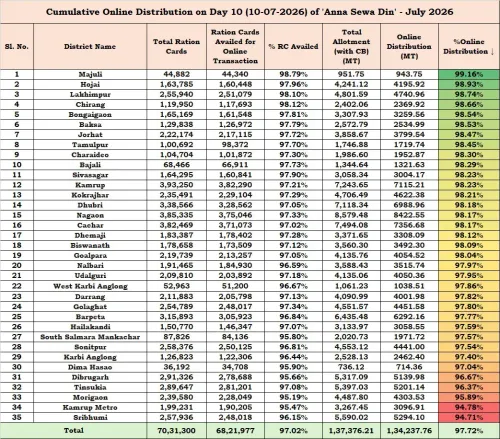
Eight days into November's Anna Sewa Din, Assam's state-run food distribution machine is running at full throttle — with over 1,24,261.50 metric tonnes of subsidised rice already reaching beneficiaries across the state under the leadership of Chief Minister Dr Himanta Biswa Sarma, the Chief Minister's Office of Assam confirmed on Sunday, November 8, 2026.
The Day 8 numbers: rice, dal, and sugar by the lakh
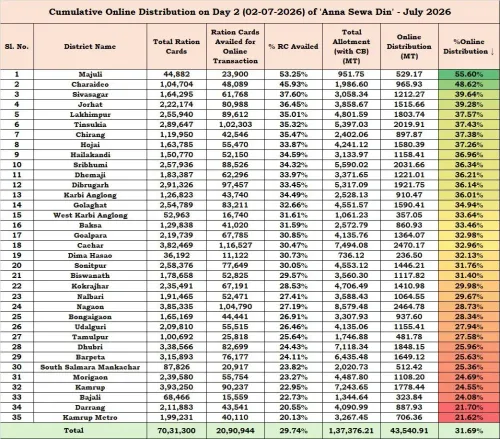
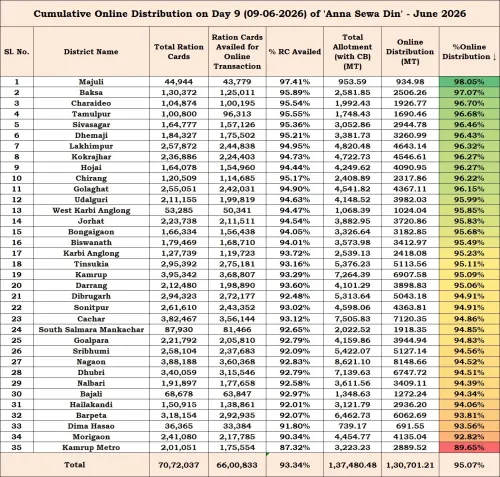
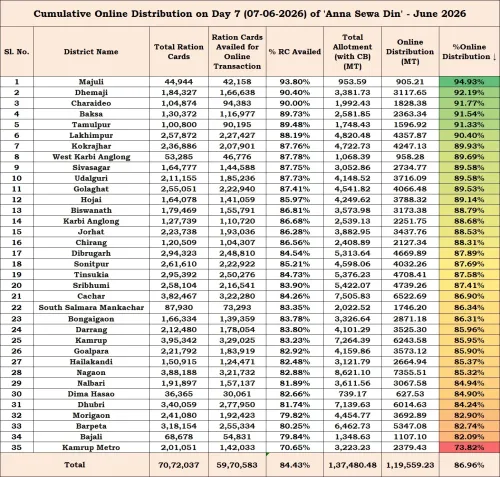
The cumulative distribution figures released by the CMO paint a detailed picture of the drive's reach. Subsidised rice distribution stands at 1,24,261.50 MT, covering 91.14% of the month's target — the strongest performer across the three commodities. Masur Dal distribution has touched 61,341.34 quintals, or 87.45% of the target, while Sugar clocked 61,275.45 quintals at 87.35% completion.
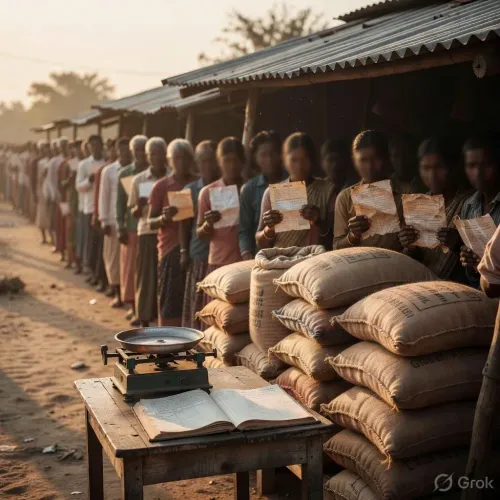
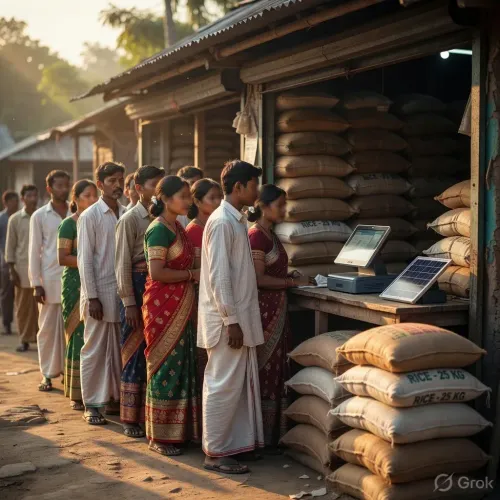
The government has urged all remaining eligible beneficiaries to collect their monthly quota from their designated Fair Price Shops without delay — a nudge that signals the final stretch of the monthly window is approaching.
Anna Sewa Din and Assam's PDS commitment
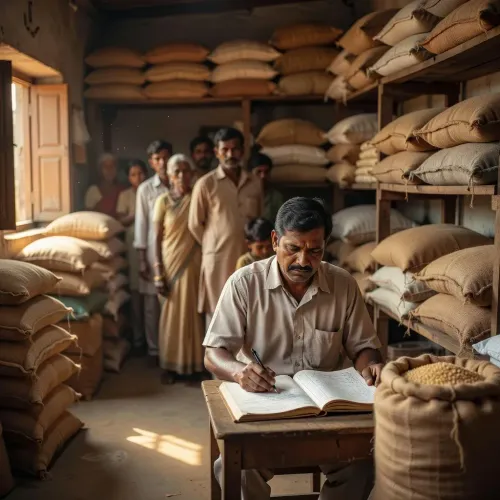
Anna Sewa Din is Assam's structured monthly drive to operationalise the entitlements under the National Food Security Act, 2013, which guarantees subsidised rice, wheat, and essential commodities to priority households through state Public Distribution System networks. The drive brings administrative focus to what can otherwise become a quietly neglected routine — turning ration delivery into a tracked, time-bound event rather than an open-ended obligation.
Under CM Himanta Biswa Sarma, who has led the state since May 2021, the Assam government has consistently emphasised monthly PDS drives as a marker of welfare delivery, aligning state machinery with central food security norms while keeping visibility on beneficiary coverage gaps.
Who still needs to act — and why the window matters
With roughly 9–13% of targeted commodities yet to reach beneficiaries as of Day 8, the gap is not trivial. For ration card holders in rural and semi-urban Assam — many of whom depend on subsidised grains as a primary food security net — missing a monthly quota is not a minor inconvenience. The government's public nudge to collect from designated Fair Price Shops reflects an awareness that uncollected allocations can skew official coverage metrics and leave the most marginalised households behind.
What to watch now: whether Assam closes the remaining distribution gap before month-end, and whether any official review surfaces coverage shortfalls or beneficiary grievances from this cycle.
Point of View
The administration makes food security delivery measurable and visible, raising the political cost of under-performance. The 87–91% completion range by Day 8 suggests strong logistical momentum but also reveals a persistent last-mile gap that disproportionately affects the most marginalised ration card holders. The drive's design mirrors a broader BJP-ruled state strategy of converting central welfare entitlements into branded, CM-attributed programmes. Whether the remaining 9–13% gap closes cleanly will determine whether this cycle is cited as a governance success or a cautionary note on PDS reach.
NationPress
8 Nov 2026
Frequently Asked Questions
What is Anna Sewa Din in Assam?
Anna Sewa Din is Assam's monthly state-level drive to distribute subsidised food grains — including rice, Masur Dal, and Sugar — to eligible beneficiaries through Fair Price Shops under the Public Distribution System.
How much rice has been distributed in November 2026 Anna Sewa Din?
By Day 8 of November's Anna Sewa Din, 1,24,261.50 metric tonnes of subsidised rice had been distributed, representing 91.14% of the monthly target.
Who oversees Anna Sewa Din in Assam?
Anna Sewa Din is conducted under the leadership of Chief Minister Dr Himanta Biswa Sarma , with updates officially released by the Chief Minister's Office of Assam.
What is the last date to collect ration under Anna Sewa Din November 2026?
The CMO has urged all remaining eligible beneficiaries to collect their monthly quota 'without delay' from their designated Fair Price Shops; exact final dates are communicated through the state's Food and Civil Supplies Department.
What is the National Food Security Act and how does it relate to Assam's PDS?
The National Food Security Act, 2013, entitles priority households to subsidised rice and other essentials through state PDS networks. Anna Sewa Din is Assam's mechanism to operationalise these entitlements on a monthly basis.