CM Himanta's AnnaSewaDin Drive Covers 77.96% Ration Cards in Assam
Synopsis
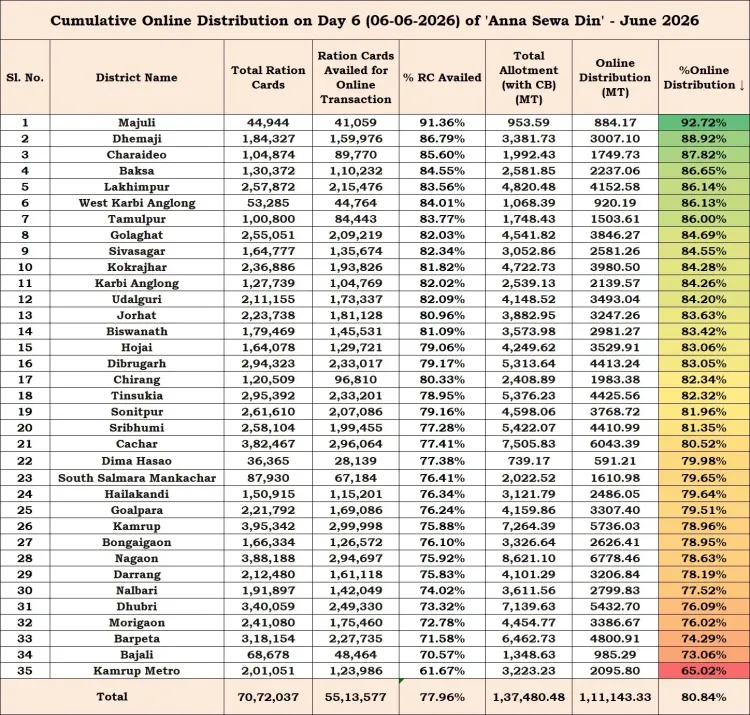
Assam's AnnaSewaDin campaign completed Day 6 on June 6, 2026, with 55.13 lakh ration cards covered at 77.96% and 1,11,143 MT of free PMGKAY rice distributed at 80.84%, under Chief Minister Himanta Biswa Sarma's direction.
Key Takeaways
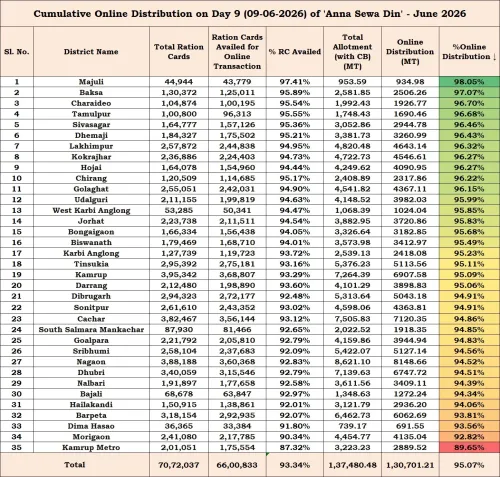
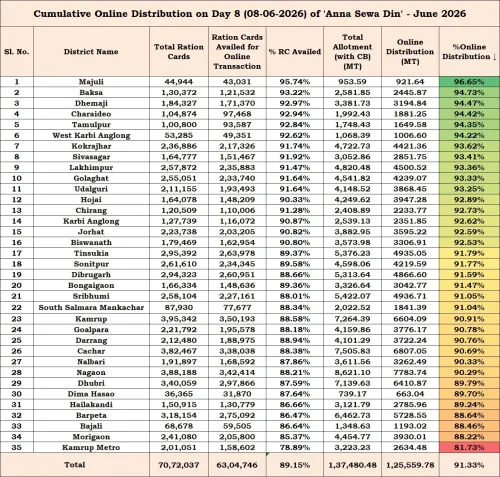
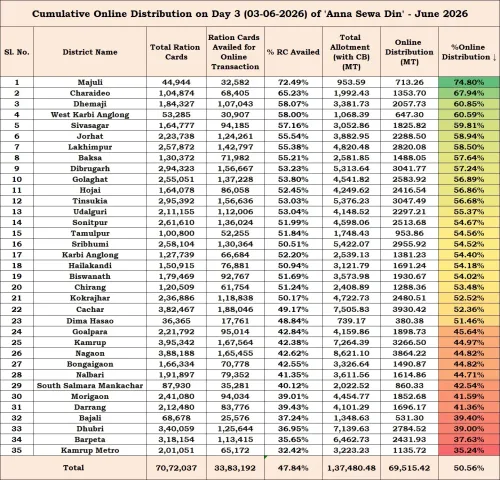
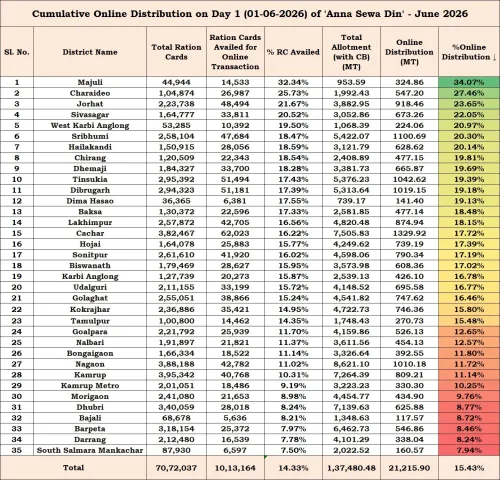
55,13,577 ration cards were serviced by Day 6 of the AnnaSewaDin campaign, covering 77.96 per cent of Assam's beneficiary base.
1,11,143.33 metric tonnes of PMGKAY rice were distributed, representing 80.84 per cent of the targeted allocation.
The campaign is being conducted under the leadership of Chief Minister Dr.
Himanta Biswa Sarma to reinforce food security across Assam .
PMGKAY , launched in March 2020, provides free foodgrains to approximately 80 crore NFSA beneficiaries nationally.
Rice offtake at 80.84 per cent is tracking ahead of card-coverage at 77.96 per cent , indicating efficient ground-level logistics.
Approximately 22 per cent of ration cards and 19 per cent of rice allocation remain to be covered in the campaign's remaining days.
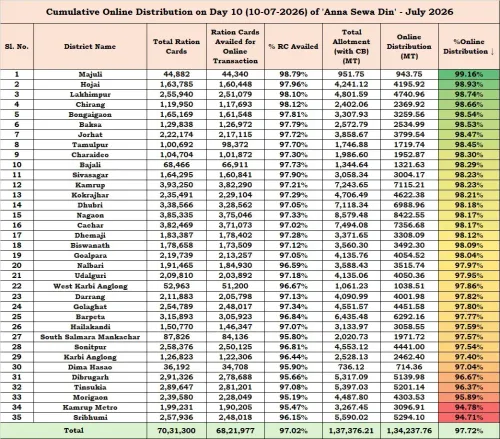
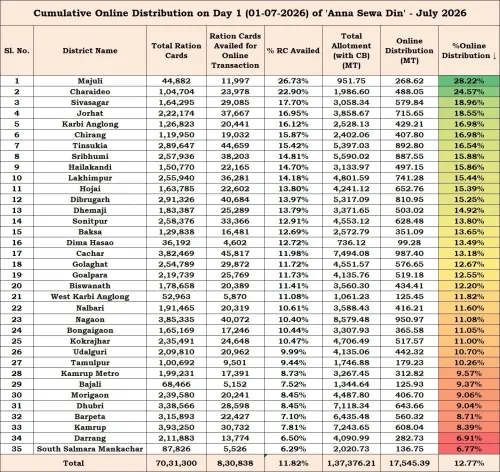
The Chief Minister's Office of Assam announced on Saturday, June 6, 2026, that Day 6 of the ongoing AnnaSewaDin campaign concluded with significant progress, covering 55,13,577 ration cards — representing 77.96 per cent of the state's beneficiary base — and distributing 1,11,143.33 metric tonnes of PMGKAY rice, accounting for 80.84 per cent of the targeted allocation.
Context
The AnnaSewaDin campaign is a state-level saturation drive launched under the direction of Chief Minister Dr. Himanta Biswa Sarma to maximise outreach under the Pradhan Mantri Garib Kalyan Anna Yojana (PMGKAY) and the National Food Security Act (NFSA). The campaign aims to ensure that every eligible household in Assam receives its entitled free foodgrain without gaps in the public distribution chain. Day 6 figures suggest the drive is sustaining momentum well into its second week.
The Chief Minister's Office stated that the campaign is being conducted 'with massive coverage, reinforcing food security across Assam,' reflecting the state government's emphasis on last-mile delivery of welfare entitlements. The rice distributed under PMGKAY is provided free of cost to priority households identified under the NFSA framework.
Policy Backdrop
PMGKAY was originally launched in March 2020 during the COVID-19 pandemic to provide free foodgrains to approximately 80 crore National Food Security Act beneficiaries across India. The scheme has since been extended multiple times, becoming a structural pillar of India's food security architecture rather than a purely emergency measure.
The National Food Security Act, 2013 established the legal entitlement to subsidised grains for priority households, and state governments are responsible for operationalising distribution through their Public Distribution System (PDS) networks. Assam, with a large rural population significantly dependent on PDS, has pursued saturation-style campaigns since 2021 to close coverage gaps and improve grain offtake rates under the central scheme's framework.
Stakeholders and Impact
The primary beneficiaries are low-income and rural households across Assam holding priority ration cards under the NFSA. With over 55 lakh ration cards serviced in six days, the campaign represents one of the state's larger near-term welfare delivery exercises. The 80.84 per cent rice distribution figure indicates that the physical grain offtake is tracking slightly ahead of the card-coverage percentage, suggesting efficient logistics at the fair-price shop level.
State food and civil supplies officials, district administrations, and fair-price shop operators are the key implementation stakeholders. For beneficiaries, the campaign translates directly into access to free monthly rice allocations that form a critical part of household food budgets, particularly in Assam's rural and semi-urban belts.
What's Next
With the campaign still ongoing beyond Day 6, the remaining gap — approximately 22 per cent of ration cards and 19 per cent of rice allocation — will be the focus of the drive's concluding phase. Completion reports and final saturation figures are expected once the campaign closes, and these will likely inform state-level coordination decisions on future PMGKAY distribution cycles.
Sustained high coverage in the closing days would position Assam as a benchmark for PMGKAY implementation among northeastern states, and could factor into the state's case during central-level discussions on scheme renewal or allocation revisions.
Point of View
And near-daily public updates on campaign progress serve both a transparency function and a political signalling one. The 80.84 per cent rice offtake outpacing the 77.96 per cent card-coverage rate suggests the state's logistics chain is performing efficiently, though the final 20 per cent will test the campaign's reach into the most remote and underserved pockets. How Assam closes that gap in the campaign's final days will determine whether AnnaSewaDin becomes a replicable template for other northeastern states operating under similar PMGKAY frameworks.
NationPress
21 Oct 2026
Frequently Asked Questions
What is the AnnaSewaDin campaign in Assam?
AnnaSewaDin is a state-level food security drive in Assam aimed at maximising ration card coverage and distributing free rice under the central PMGKAY scheme to all eligible NFSA beneficiaries.
How many ration cards were covered in Assam's AnnaSewaDin campaign by Day 6?
By Day 6 on June 6, 2026, a total of 55,13,577 ration cards had been serviced, representing 77.96 per cent of Assam's eligible beneficiary base.
What is PMGKAY and who benefits from it in Assam?
PMGKAY, or Pradhan Mantri Garib Kalyan Anna Yojana, is a central government scheme that provides free foodgrains to priority households under the National Food Security Act; in Assam, low-income and rural households are the primary beneficiaries.
How much PMGKAY rice was distributed in Assam during AnnaSewaDin?
As of Day 6, 1,11,143.33 metric tonnes of PMGKAY rice had been distributed in Assam, accounting for 80.84 per cent of the total targeted allocation for the campaign.
Who is leading the AnnaSewaDin food security campaign in Assam?
The campaign is being conducted under the leadership of Chief Minister Dr. Himanta Biswa Sarma, with implementation carried out through Assam's district administrations and public distribution system network.