CM Himanta's AnnaSewaDin Drive Covers 89% Assam Ration Cards
Synopsis
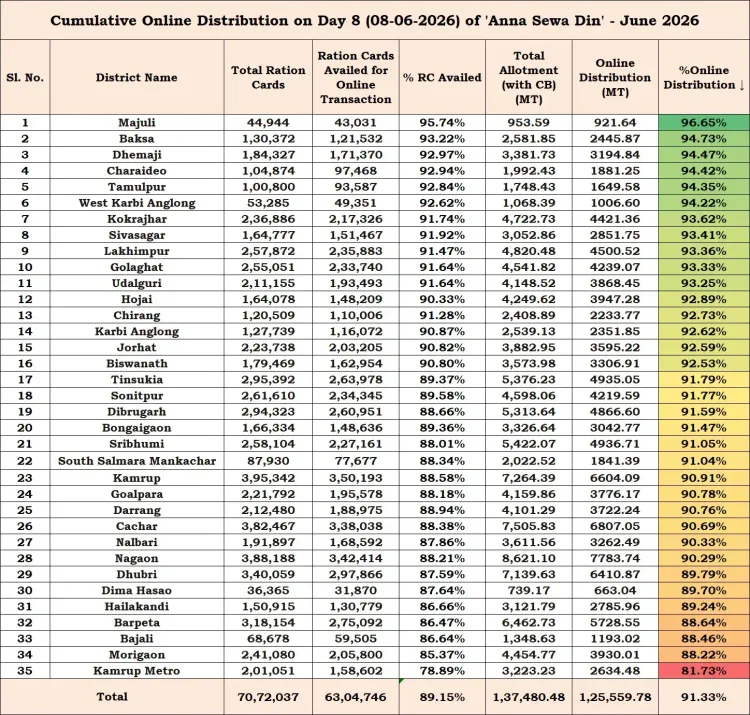
Assam's AnnaSewaDin campaign completed Day 8 on June 8, 2026, with 89.15% of ration cards availed and 1,25,559.78 MT of PMGKAY rice distributed — signalling strong last-mile delivery under CM Himanta Biswa Sarma's leadership.
Key Takeaways
Day 8 of the AnnaSewaDin campaign concluded on June 8, 2026 in Assam .
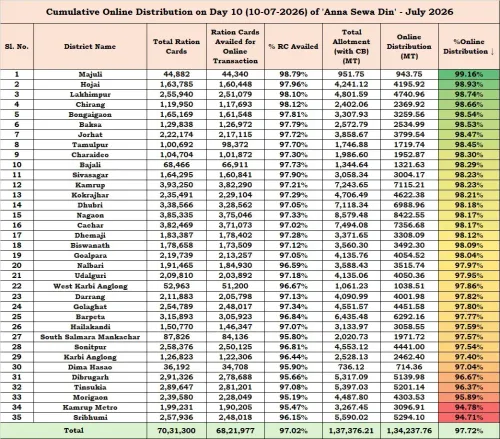
63,04,746 ration cards have been availed, representing 89.15% of the total eligible cards.
1,25,559.78 MT of PMGKAY rice has been distributed, achieving 91.33% of the target quantity.
The campaign operates under the leadership of Chief Minister Dr.
Himanta Biswa Sarma .
PMGKAY , originally launched in March 2020 as COVID relief, provides free foodgrains to NFSA beneficiaries.
The drive is part of Assam's ongoing effort to achieve last-mile delivery saturation under national food security schemes.
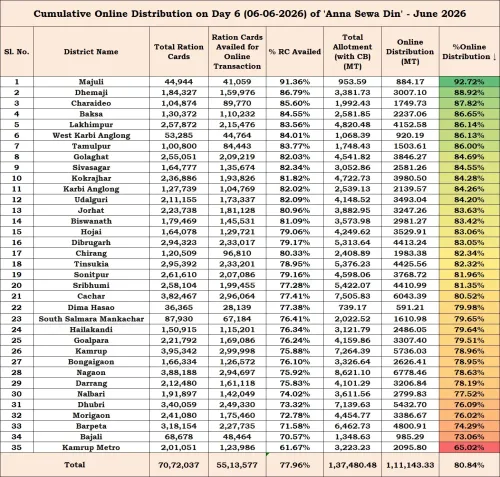
The Chief Minister's Office of Assam announced on Monday, June 8, 2026, that Day 8 of the ongoing AnnaSewaDin campaign has concluded with significant coverage, reporting that 63,04,746 ration cards — representing 89.15% of the total — have been availed across the state under the drive led by Chief Minister Dr. Himanta Biswa Sarma.
Context
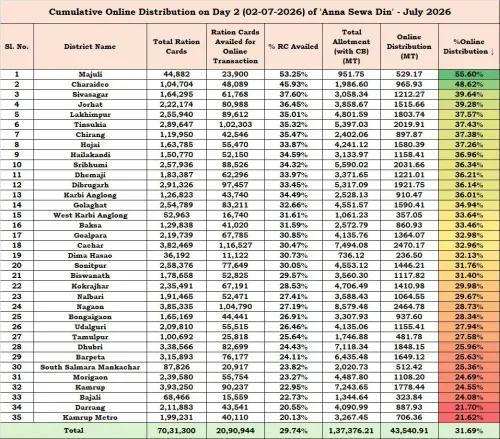
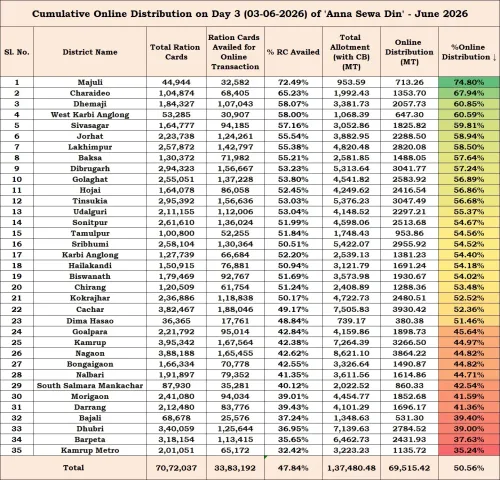
The AnnaSewaDin campaign is a state-level intensive food distribution drive aimed at maximising last-mile delivery of foodgrains to eligible beneficiaries in Assam. As of Day 8, the campaign has distributed 1,25,559.78 metric tonnes (MT) of PMGKAY rice, achieving 91.33% of the targeted quantity. The figures signal strong on-ground mobilisation by the state food and civil supplies machinery.
Policy Backdrop
The Pradhan Mantri Garib Kalyan Anna Yojana (PMGKAY) was originally launched in March 2020 as emergency COVID-19 relief, providing free foodgrains to beneficiaries listed under the National Food Security Act (NFSA). The scheme has since been extended in successive phases, becoming a cornerstone of India's food security architecture for economically vulnerable households. Assam has periodically run special drives since 2021 to update ration card databases, eliminate duplicate entries, and ensure that genuine NFSA beneficiaries receive their entitlements without leakage. The AnnaSewaDin campaign fits squarely within this tradition of time-bound, high-intensity outreach.
Chief Minister Dr. Himanta Biswa Sarma, who has helmed the state since May 2021, has positioned food security delivery as a visible governance priority, linking ration card saturation drives to broader welfare commitments. The campaign's daily progress updates — shared directly from the CMOfficeAssam handle — reflect the administration's emphasis on transparent, real-time reporting of scheme implementation.
Stakeholders and Impact
The primary beneficiaries are NFSA-enrolled households across Assam, particularly in rural and semi-urban areas where supply chain gaps have historically limited access. With over 63 lakh ration cards activated in eight days, the campaign has reached a substantial share of the state's food-insecure population. The 91.33% rice off-take rate suggests that distribution infrastructure — fair-price shops, transport logistics, and beneficiary verification — is functioning at near-optimal capacity during the drive.
State food department officials, fair-price shop dealers, and district administration teams are the key implementation stakeholders. For beneficiary households, the campaign translates directly into access to free rice under PMGKAY, reducing out-of-pocket food expenditure for the most economically vulnerable segments.
What's Next
With the campaign still ongoing beyond Day 8, the administration is expected to push coverage toward full saturation of eligible ration card holders. The final off-take figures, once the drive concludes, will feed into state-level reporting to the central government on PMGKAY utilisation. Observers will watch whether Assam achieves near-complete coverage — and whether the campaign model influences similar drives in other states seeking to close last-mile delivery gaps under the national food security framework.
Point of View
A metric that carries both welfare and political weight ahead of any future electoral cycle. Chief Minister Sarma's administration has consistently used real-time, data-driven communication to project governance efficiency, and the daily campaign updates are consistent with that pattern. The near-convergence of card coverage and rice distribution percentages suggests tight coordination between beneficiary verification and supply logistics, which has historically been a weak link in food security delivery. If the campaign closes above 95%, it would set a benchmark that other states running similar NFSA drives will be measured against.
NationPress
23 Oct 2026
Frequently Asked Questions
What is the AnnaSewaDin campaign in Assam?
AnnaSewaDin is a state-level intensive food distribution drive in Assam designed to maximise last-mile delivery of foodgrains to eligible NFSA beneficiaries and ensure ration card saturation within a fixed campaign window.
What is PMGKAY and who benefits from it?
The Pradhan Mantri Garib Kalyan Anna Yojana (PMGKAY) is a central government scheme that provides free foodgrains — primarily rice and wheat — to households enrolled under the National Food Security Act (NFSA), targeting India's economically vulnerable population.
How many ration cards have been covered in Assam's AnnaSewaDin campaign so far?
As of Day 8 of the campaign on June 8, 2026, a total of 63,04,746 ration cards have been availed, representing 89.15% of the total eligible cards in Assam.
How much PMGKAY rice has been distributed in Assam's AnnaSewaDin drive?
By Day 8, a total of 1,25,559.78 metric tonnes of PMGKAY rice had been distributed in Assam, achieving 91.33% of the campaign's distribution target.
Who is leading the AnnaSewaDin campaign in Assam?
The campaign is being led under the leadership of Chief Minister Dr. Himanta Biswa Sarma, who has made food security delivery a visible governance priority since taking office in May 2021.