Assam CM Sarma Allocates Portfolios to Newly Inducted Ministers
Synopsis
The Chief Minister's Office of Assam formally announced portfolio allocations for 12 newly inducted ministers on June 9, 2026. CM Himanta Biswa Sarma retained the Home, Power, and PWD portfolios, signalling continuity in the BJP-led government's administrative priorities as the new ministers begin their responsibilities.
Key Takeaways
The Assam CMO announced formal portfolio allocation to 12 newly inducted ministers on June 9, 2026 .
CM Himanta Biswa Sarma retained the Home, Power, and PWD portfolios, consolidating control of key departments.
Portfolio allocation marks the formal commencement of ministerial responsibilities, enabling ministers to engage with state bureaucracy.
The cabinet expansion is part of a broader pattern of coalition management under the BJP -led government in Assam.
New ministers are expected to assume departmental charge and face scrutiny at the next Assam Legislative Assembly session.
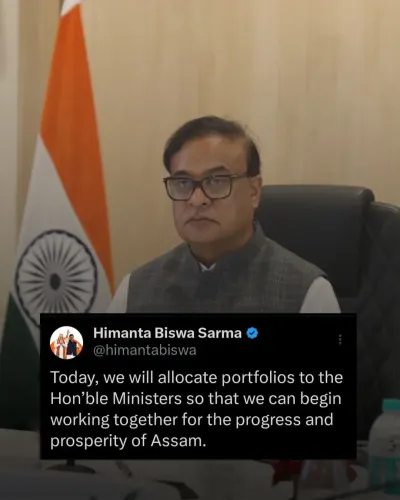
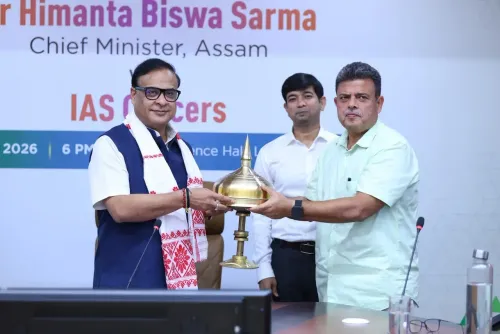
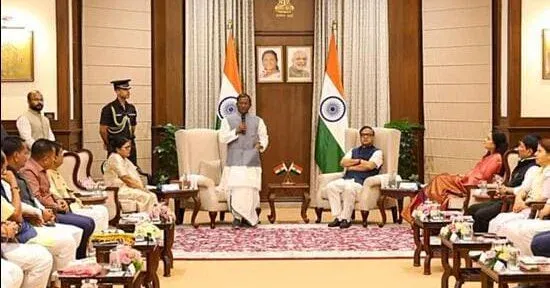
The Chief Minister's Office of Assam announced on Tuesday, June 9, 2026 that portfolios have been formally allocated to the newly inducted members of the Assam Council of Ministers, marking the official commencement of their ministerial responsibilities. The announcement, made via the CMO's official account on X, confirmed that the cabinet expansion has moved from ceremony to administration.
Context
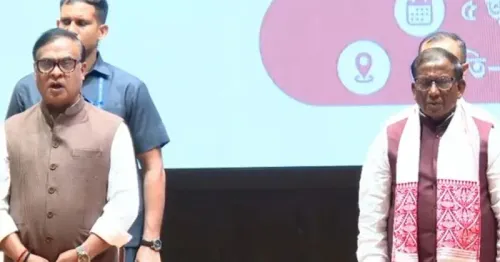
The portfolio allocation follows the swearing-in of 12 newly inducted ministers into the Assam Council of Ministers. Such formal allocation is the procedural step that translates political appointments into administrative authority, enabling ministers to begin issuing orders, convening departmental meetings, and engaging with the state bureaucracy under their charge.
Chief Minister Himanta Biswa Sarma, who has led the BJP-led government in Assam since May 2021, is reported to have retained key portfolios including Home, Power, and Public Works Department (PWD), consolidating oversight of the state's most consequential departments in his own hands.
Policy Backdrop
Cabinet expansions and portfolio realignments are a recurring feature of coalition governance in Indian states. In Assam, the BJP-led coalition has periodically refreshed its ministerial lineup to accommodate alliance partners, reward political loyalty, and inject fresh administrative energy into key departments.
The decision by CM Sarma to retain Home, Power, and PWD is consistent with a pattern seen across BJP-governed states, where the Chief Minister maintains direct control over departments that carry both security and developmental weight. Home affairs governs law enforcement and internal security, while Power and PWD are central to infrastructure delivery — areas that directly shape electoral perception.
Stakeholders and Impact
The 12 newly inducted ministers now bear formal responsibility for their assigned departments, with the state bureaucracy expected to align reporting structures accordingly. Each minister's first task will typically involve reviewing departmental budgets, pending policy files, and ongoing schemes inherited from their predecessors or newly carved from existing portfolios.
For citizens and civil society, the allocation signals which political figures will be the points of contact for grievances, project approvals, and policy decisions across Assam's diverse districts. Alliance partners within the coalition will watch closely to assess whether the portfolio distribution reflects their negotiated share of administrative influence.
What's Next
The new ministers are expected to formally assume charge of their departments in the coming days, with departmental briefings and introductory meetings with senior bureaucrats typically following within the first week. The next session of the Assam Legislative Assembly will be an early test, as ministers may be required to respond to questions and present departmental priorities on the floor of the House.
Progress in high-visibility departments such as Home, Power, and PWD — retained directly by CM Sarma — will be closely tracked through government orders and budget utilisation data in the months ahead, setting the tone for the administration's performance trajectory.
Point of View
Power, and PWD, CM Sarma reinforces his grip over the departments most visible to voters — law and order, electricity supply, and road infrastructure — while distributing secondary portfolios to inductees in a manner that manages coalition arithmetic. This pattern mirrors the approach of BJP-led governments in other large states, where the Chief Minister functions as a centralising force rather than a delegating one. The real test will come in the assembly session, where new ministers must demonstrate command of their briefs under opposition scrutiny.
NationPress
24 Oct 2026
Frequently Asked Questions
Who are the newly inducted ministers in the Assam cabinet in 2026?
The Assam CMO confirmed on June 9, 2026 that portfolios were allocated to 12 newly inducted ministers, though the specific names of all inductees are yet to be officially detailed in the public announcement.
Which portfolios did CM Himanta Biswa Sarma retain after the Assam cabinet expansion?
CM Himanta Biswa Sarma retained the Home, Power, and Public Works Department (PWD) portfolios, keeping the most strategically significant departments under his direct oversight.
Why did Assam expand its cabinet in June 2026?
Cabinet expansions in Assam are typically conducted to accommodate coalition partners, refresh administrative leadership, and align ministerial capacity with governance priorities — consistent with the BJP-led government's approach since 2021.
What happens after portfolio allocation to new Assam ministers?
After formal portfolio allocation, newly inducted ministers are expected to assume departmental charge, receive bureaucratic briefings, and begin overseeing policy files, schemes, and budget utilisation within their assigned departments.
How long has Himanta Biswa Sarma been Chief Minister of Assam?
Himanta Biswa Sarma has served as Chief Minister of Assam since May 2021, when he was sworn in following the BJP-led coalition's victory in the state assembly elections.