Assam CM Backs Nijut Moina to Cut Child Marriage, Dropouts

Synopsis
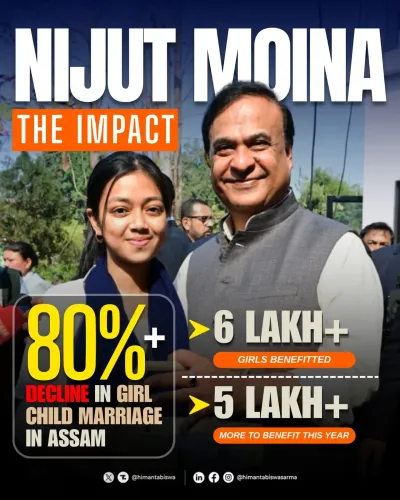
The Chief Minister's Office of Assam on October 13, 2026, spotlighted the Nijut Moina scheme as a direct intervention against child marriage and school dropouts among girls, linking educational access to child protection across the state's most vulnerable districts.
Key Takeaways
The Chief Minister's Office of Assam highlighted the Nijut Moina scheme on October 13, 2026 , framing it as a tool against both child marriage and school dropout among girls.
Assam has historically recorded high rates of child marriage, especially in rural and tea-garden belt districts.
The scheme follows a pattern of incentive-based, girl-child-focused welfare interventions the state has run since the mid-2010s, including extensions of the national Beti Bachao Beti Padhao framework.
CM Himanta Biswa Sarma , in power since 2021 , has consistently used named welfare schemes as public accountability mechanisms.
Rollout details, budget provisions, and impact data — including school retention and child marriage prevalence rates — remain the critical metrics to watch.
A social wager is being placed in Assam: link girls' education directly to the fight against child marriage, and the numbers will move. The Chief Minister's Office of Assam amplified that wager on Tuesday, October 13, 2026, spotlighting the Nijut Moina scheme as the state's sharpest tool against two of its most stubborn social crises — child marriage and early school dropouts among girls.
The post, shared from the official CMO account, frames Nijut Moina as a twin-pronged intervention: keep girls in school, and the conditions that enable child marriage begin to erode. Simple logic. Brutally hard to execute in practice.
What Nijut Moina targets — and why Assam needs it
Assam has long carried some of the highest rates of child marriage among Indian states, particularly in rural and tea-garden belt districts. The state's terrain — remote villages, economic precarity, social norms — has historically made school retention for adolescent girls a live policy challenge, not a paperwork one. Incentive-linked girl-child education schemes have been part of Assam's policy toolkit since the mid-2010s, often as state-level extensions of the national Beti Bachao Beti Padhao framework. Nijut Moina appears to sharpen that tradition, explicitly naming child marriage prevention as a co-equal outcome alongside dropout reduction — a framing that signals the state is connecting schooling directly to protection, not treating them as separate departments.CM Himanta's governance stamp on girl-child welfare
Chief Minister Himanta Biswa Sarma, who has helmed the state since 2021, has made welfare and education among his administration's recurring public-messaging pillars. The CMO's decision to amplify Nijut Moina in this framing reflects a pattern: use visible, named schemes to signal intent and consolidate public accountability around measurable social outcomes. The approach — combining awareness drives with incentive-based interventions — is well-worn in Northeast India policy circles. The real question, as with every such scheme, is what happens at the district collector's desk and the village school gate: Does the financial or educational incentive actually reach the girl most at risk? Does it arrive before the wedding is arranged?The metrics that will matter
Scheme announcements are the start, not the story. What will determine Nijut Moina's legacy are the rollout details, budget allocation, and — crucially — whether subsequent state welfare reports show measurable movement in child marriage prevalence and school retention rates across Assam's most vulnerable districts. Those numbers are the verdict.Point of View
Amplifying named schemes through the official CMO account is a consistent governance-communication strategy that builds public accountability around measurable social outcomes. The real test, however, lies in implementation depth: Assam's rural and tea-garden districts have seen multiple scheme cycles without commensurate data improvement, making outcome-linked monitoring the differentiating factor. If Nijut Moina produces verifiable district-level data on dropout and marriage rates, it could become a replicable model for other high-prevalence northeastern states.
NationPress
13 Oct 2026
Frequently Asked Questions
What is the Nijut Moina scheme in Assam?
Nijut Moina is an Assam government initiative designed to combat child marriage and reduce school dropout rates among girls, linking educational support to child protection outcomes.
How does Assam plan to fight child marriage through education?
By tying girls' school retention directly to child marriage prevention through the Nijut Moina scheme, the state uses incentive-based interventions to keep adolescent girls in school and delay early marriage.
What is Assam's child marriage situation?
Assam has historically recorded among the highest child marriage rates in India, particularly in rural and tea-garden belt districts, making targeted state welfare schemes a policy priority.
Who is promoting the Nijut Moina scheme?
The Chief Minister's Office of Assam, under CM Himanta Biswa Sarma, has been publicly amplifying the Nijut Moina scheme as a key girl-child welfare and education initiative.
What will determine the success of the Nijut Moina scheme?
Rollout details, budget allocation, and measurable changes in child marriage prevalence and school retention rates across Assam's vulnerable districts will determine the scheme's real-world impact.