Assam CM Himanta doubles down on child marriage crackdown
Synopsis
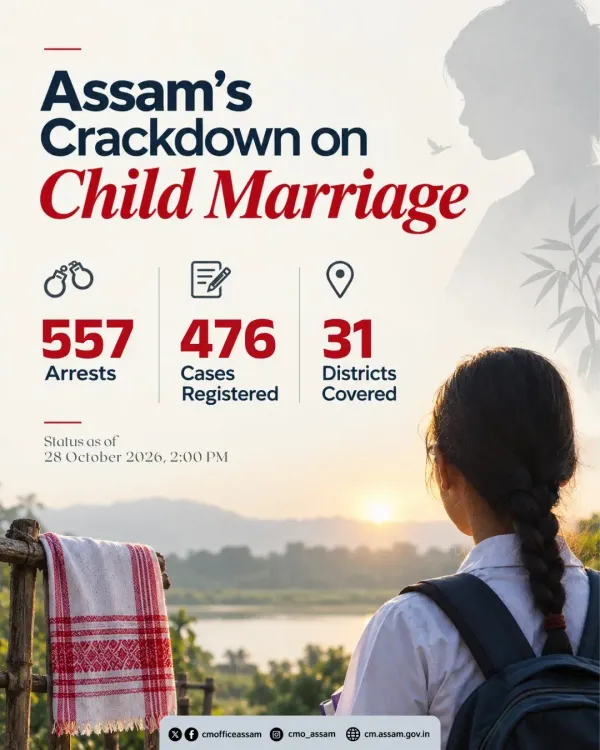
The Chief Minister's Office of Assam confirmed on October 28, 2026 that the state's intensified campaign against child marriage — running since CM Himanta Biswa Sarma took office in 2021 — continues with full force, anchored in the Prohibition of Child Marriage Act, 2006.
Key Takeaways
Assam's Chief Minister's Office reaffirmed on October 28, 2026 the state's ongoing crackdown on child marriage.
CM Dr Himanta Biswa Sarma has led intensified enforcement drives since taking office in 2021 .
The legal backbone is the central Prohibition of Child Marriage Act, 2006 , enforced through state-level police and administrative action.
Assam has historically recorded above-average child marriage prevalence in national family health surveys, making enforcement especially consequential.
The campaign combines policing, community mobilisation, and district-level administrative monitoring.
Next NFHS or Census data on Assam will be the critical test of whether the drive has shifted ground-level indicators.
A child's right to childhood — that is the stakes Assam has planted its flag on. The Chief Minister's Office of Assam reaffirmed on Wednesday, October 28, 2026 that the state's enforcement drive against child marriage continues under Chief Minister Dr Himanta Biswa Sarma, with a clear message that the campaign remains unrelenting.
A crackdown that began in 2021 — and has not let up
When Dr Himanta Biswa Sarma took charge as Chief Minister in 2021, one of the earliest and most visible commitments his government made was to treat child marriage as a law-and-order problem — not merely a social one. The state leaned hard on the Prohibition of Child Marriage Act, 2006, the central legislation that empowers state authorities to register cases, make arrests, and pursue prosecution against those who facilitate underage unions.
What followed was a wave of enforcement drives — thousands of cases registered across districts, families called in for questioning, and village-level officials put on notice. The message from Dispur was deliberate: silence and complicity would no longer be shielded by custom.
Why Assam sits at the centre of this national fight
Assam has featured repeatedly in national family health survey data as one of the states with elevated child marriage prevalence, particularly in its rural and tea-garden belt districts. That epidemiological reality is precisely why the state's campaign draws national attention — and why its persistence matters beyond the northeastern region alone.
The broader national architecture includes the Beti Bachao Beti Padhao scheme and periodic NFHS-driven district action plans. But schemes alone rarely move numbers. Assam's approach — combining police action with community mobilisation and administrative monitoring at the district level — represents one of the more muscular state-level interpretations of that national framework. Girls in rural households and the families around them are at the centre of every intervention.
What the next data cycle will reveal
The real verdict on five years of enforcement will come when the next round of NFHS or Census data on child marriage indicators is released for Assam. Numbers will either vindicate the crackdown's scale or demand harder questions about whether arrests alone shift deeply entrenched social behaviour. Possible state-level legislative amendments or new district-task-force structures are also on the horizon as the government looks to institutionalise what began as an enforcement surge.
For now, the Chief Minister's Office has made its position plain: the drive is not a campaign with an expiry date. Every child's childhood, in the government's own framing, is a non-negotiable.
Point of View
The government claims high moral ground while also signalling administrative muscle to rural communities. The real test, however, is whether arrest-led deterrence without equally robust school-retention and economic-support programmes produces durable change — or merely drives the practice underground. The next data cycle will be a decisive verdict on whether this model deserves replication elsewhere.
NationPress
29 Oct 2026
Frequently Asked Questions
What is Assam's child marriage crackdown?
It is an intensified law-enforcement campaign launched by the Assam government under Chief Minister Dr Himanta Biswa Sarma from 2021 onward, registering thousands of cases under the Prohibition of Child Marriage Act, 2006 to prosecute those who facilitate underage marriages in the state.
Which law is used to crack down on child marriage in Assam?
The primary legal instrument is the central Prohibition of Child Marriage Act, 2006 , which empowers state authorities to register cases, make arrests, and pursue prosecution against individuals who arrange or participate in child marriages.
Why does Assam have high child marriage rates?
National Family Health Survey data has consistently identified certain districts in Assam — particularly in rural and tea-garden belt areas — as having above-average child marriage prevalence, driven by poverty, low school-retention rates, and entrenched social norms.
Who is leading Assam's child marriage crackdown?
Chief Minister Dr Himanta Biswa Sarma , who has been in office since 2021, is the political driver of the campaign, which involves police departments, district administrations, and community outreach arms of the state government.
What is the Beti Bachao Beti Padhao scheme and how does it relate to Assam's drive?
Beti Bachao Beti Padhao is a central government scheme aimed at improving the welfare, survival, and education of the girl child across India. Assam's enforcement drive operates alongside — and is amplified by — this national programme, combining policing with awareness and administrative monitoring.