Assam CMO Highlights Ancient Kevda Fossil Find

Synopsis
The Chief Minister's Office of Assam has spotlighted the discovery of ancient Kevda (Pandanus) fossils in the state, with findings indicating the species thrived millions of years before human civilisation — reinforcing Assam's standing as a significant site of deep-time natural heritage in northeastern India.
Key Takeaways
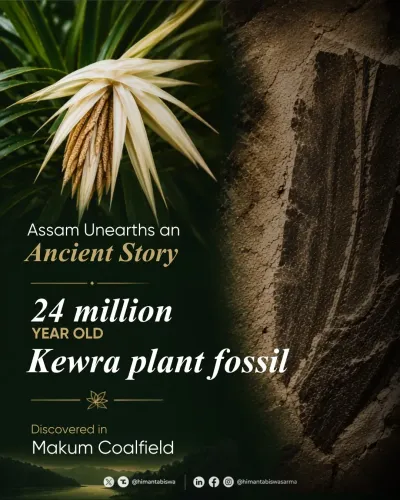
The Chief Minister's Office of Assam announced the discovery of ancient Kevda (Pandanus) fossils in the state on 21 July 2026 .
The fossils indicate the Kevda species thrived millions of years before the emergence of human civilisation.
The discovery adds to Northeast India's documented record of ancient flora preserved in its geologically active sedimentary formations.
Palaeobotanists and heritage researchers are the primary academic stakeholders, with potential implications for natural heritage tourism in Assam .
Peer-reviewed publication of stratigraphic context and dating methods will be the next critical step in validating the find's significance.
The Chief Minister's Office of Assam on Tuesday, 21 July 2026 drew attention to the discovery of ancient Kevda (Pandanus) fossils in the state, noting that the specimens demonstrate the species thrived millions of years before the emergence of human civilisation — adding a significant chapter to Assam's documented natural heritage.
Context
The CMO's post stated that 'Assam's rich natural heritage continues to reveal its ancient legacy' through the Kevda fossil discovery, underscoring that the plant species predates human civilisation by millions of years. Kevda, known scientifically as Pandanus, is a tropical plant still found across coastal and riverine zones of South and Southeast Asia, making the fossil find particularly striking in tracing the species' deep evolutionary roots.
The announcement positions the discovery as evidence of Assam's role as a repository of pre-Quaternary biological history, a characterisation consistent with the state's recognised status as a biodiversity hotspot in northeastern India.
Policy Backdrop
Geological and palaeontological surveys in Northeast India have periodically surfaced evidence of ancient flora and fauna since mid-20th century expeditions, reflecting the region's complex tectonic history. The subcontinent's collision with the Eurasian plate created sedimentary formations across the northeastern states that are conducive to fossil preservation, and researchers have documented plant and animal remains across multiple decades of fieldwork.
India's broader scientific establishment has long supported documentation of its deep-time natural history through state-backed geological bodies, and discoveries of ancient plant fossils contribute to the academic understanding of how tropical ecosystems evolved over geological timescales. Findings of this nature typically feed into peer-reviewed literature on Gondwana-era and post-Gondwana flora distributions across the Indian subcontinent.
Stakeholders and Impact
The primary beneficiaries of such discoveries are the palaeobotanical and heritage research communities, who gain fresh data points for reconstructing ancient ecosystems across South Asia. For Assam specifically, the find reinforces the state's scientific and cultural profile at a time when northeastern India is receiving growing attention for both its ecological diversity and its geological significance.
Public interest in natural heritage tourism and science education also stands to benefit, as fossil discoveries of this scale can anchor interpretation centres, museum exhibits, and school-level awareness programmes. Conservationists may additionally call for formal site protection measures to safeguard the stratigraphic context of the specimens.
What's Next
The scientific community will look to peer-reviewed publications detailing the stratigraphic context, dating methodology, and institutional findings behind the Kevda fossil specimens. Precise dating — whether through radiometric analysis or biostratigraphic correlation — will be central to establishing the specimens' place in the global palaeobotanical record.
Any state-level response, including plans for site protection or the development of heritage interpretation infrastructure around the discovery site, will determine how far this finding translates from academic interest into public engagement with Assam's ancient natural legacy.
Point of View
Not just its better-known wildlife reserves. Fossil announcements of this nature serve a dual purpose: they attract academic attention while building a soft-power narrative around northeastern India's deep geological past. The move fits a broader pattern of state governments leveraging environment and heritage discoveries to reinforce regional distinctiveness. Whether this translates into concrete site-protection policy or remains a communications exercise will be the real test of institutional follow-through.
NationPress
20 Oct 2026
Frequently Asked Questions
What are the Kevda fossils found in Assam?
The Kevda fossils found in Assam are ancient remains of the Pandanus plant, a tropical species still found today across South and Southeast Asia. The discovery indicates the plant species thrived millions of years before human civilisation, making it a significant palaeobotanical find for northeastern India.
Where exactly were the Kevda fossils discovered in Assam?
The precise site coordinates of the Kevda fossil discovery in Assam have not been officially confirmed in publicly available information as of this report. The Chief Minister's Office of Assam referenced the discovery in the context of the state's broader natural heritage without specifying an exact location.
How old are the Kevda fossils found in Assam?
The fossils are described as predating human civilisation by millions of years, though exact dating figures have not been officially published. Precise age estimates will depend on peer-reviewed stratigraphic and radiometric analysis of the specimens.
What is Kevda and why is this fossil discovery significant?
Kevda, known scientifically as Pandanus, is a tropical plant found in coastal and riverine areas across South and Southeast Asia. The discovery of its fossils in Assam millions of years old is significant because it extends the known evolutionary timeline of the species and adds to the palaeobotanical record of pre-Quaternary ecosystems in the Indian subcontinent.
What will happen next after the Assam Kevda fossil discovery?
Scientists and researchers are expected to publish peer-reviewed findings detailing the dating methods and stratigraphic context of the Kevda fossils. There may also be calls for formal site protection and the development of heritage interpretation infrastructure around the discovery location in Assam.