Assam CMO Pitches Jogighopa Logistics Park as Eastern Trade Hub
Synopsis
The Chief Minister's Office of Assam has projected the Jogighopa Multi-Modal Logistics Park as a transformative hub for Eastern India, citing its potential to enhance multimodal transport, strengthen cross-border trade and position the state as a strategic gateway to South Asian markets under the leadership of PM Modi and CM Himanta Biswa Sarma.
Key Takeaways
Assam CMO has framed the Jogighopa Multi-Modal Logistics Park as a transformative project for Eastern India.
The park is pitched as a strategic gateway linking Assam with neighbouring countries and regional markets.
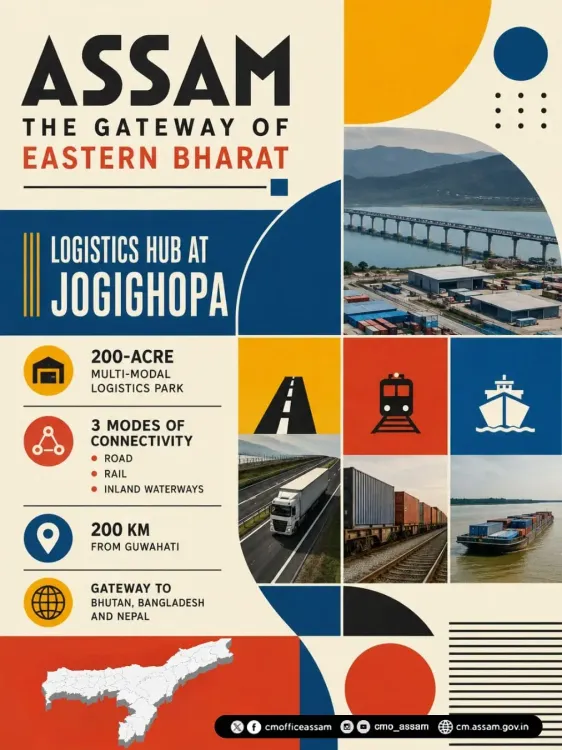
Located on the Brahmaputra in Bongaigaon district, the site enables integrated rail, road and inland waterway transport.
The initiative aligns with the Act East Policy, PM Gati Shakti and the National Logistics Policy.
Exporters from Assam and the wider Northeast are among the principal expected beneficiaries.
The Chief Minister's Office of Assam on 4 June 2026 projected the Multi-Modal Logistics Park at Jogighopa as a transformative node for connectivity and trade across Eastern India, framing it as a strategic asset that will deepen Assam's linkages with neighbouring countries and regional markets. The post credited the project to the policy direction of Prime Minister Narendra Modi and the execution leadership of Chief Minister Himanta Biswa Sarma.
According to the post, the facility 'is set to redefine connectivity and trade across Eastern Bharat, while strengthening Assam's linkages with neighbouring countries and regional markets.' It further described the park as a 'landmark initiative' that 'will enhance multimodal transport, boost cross-border trade and position Assam as a strategic gateway connecting India with the broader South Asian region.'
Context
Jogighopa, located in Bongaigaon district on the banks of the Brahmaputra, has long been identified as a natural confluence point for rail, road and inland waterway transport. Its location on the river offers direct access to the Indo-Bangladesh Protocol Route, while road and rail corridors radiate toward Bhutan, Meghalaya and the rest of the Northeast.
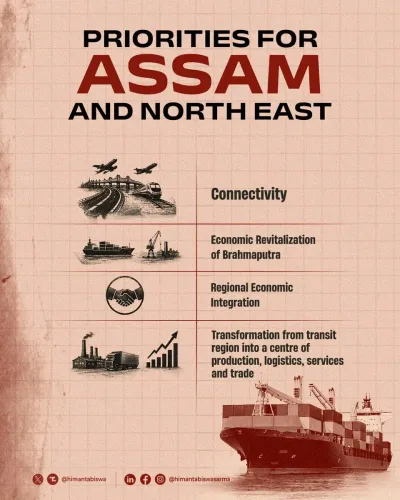
A multi-modal logistics park at this site is designed to consolidate freight, reduce handling costs and shorten dwell times for goods bound for cross-border markets. The Assam government has consistently presented the facility as central to its push to recast the state from a landlocked terminus into a forward trading post.
Policy backdrop
The Jogighopa project sits within a layered national framework. India's Act East Policy, formalised in 2014, set the strategic direction for binding the Northeast to ASEAN economies through improved transport links. The PM Gati Shakti National Master Plan, launched in 2021, then provided the planning architecture to coordinate ministries, states and infrastructure agencies around integrated multimodal corridors.
The National Logistics Policy of 2022 added explicit targets for reducing logistics costs and rolling out multi-modal parks across the country. Jogighopa is positioned as one of the eastern anchors of that ambition, complementing port-led trade in the south and west with a river-rail-road interchange in the Northeast.
Stakeholders and impact
For Assam's exporters, the park promises lower freight costs on commodities such as tea, agri-produce, plywood and cement, all of which currently bear high logistics overheads. Regional traders operating along the India-Bangladesh and India-Bhutan borders stand to gain from streamlined customs and warehousing at a single node.
Logistics operators and shipping firms using the Brahmaputra waterway are likely beneficiaries, as containerised cargo movement on National Waterway 2 becomes more viable with an organised transhipment hub. Producers across the wider Northeast, including from Meghalaya, Arunachal Pradesh and Nagaland, could route exports through Jogighopa instead of relying on longer overland chains.
What's next
Attention will turn to the sequencing of construction milestones, land parcel readiness and the commissioning of rail sidings and river jetties that determine when the park can begin commercial operations. Linked road upgrades and customs notifications for cross-border cargo will be equally important in translating the announcement into on-ground throughput.
If Jogighopa moves from blueprint to functioning hub, it could materially reshape freight flows between the Indian Northeast and the eastern South Asian neighbourhood, offering an early test of whether the country's multimodal logistics agenda can deliver measurable trade gains for its frontier states.
Point of View
The messaging reinforces a cooperative-federalism narrative that has become central to BJP communication in the Northeast. Strategically, multimodal hubs on the Brahmaputra are where India's logistics ambitions meet its neighbourhood diplomacy, especially with Bangladesh and Bhutan. The real test will be whether throughput numbers eventually match the rhetorical framing.
NationPress
18 Oct 2026
Frequently Asked Questions
What is the Jogighopa Multi-Modal Logistics Park?
It is an integrated logistics facility planned at Jogighopa in Assam's Bongaigaon district, designed to combine rail, road and inland waterway transport on the Brahmaputra to support freight movement and cross-border trade.
Why is Jogighopa important for Assam's trade?
Jogighopa sits at a natural confluence of river, rail and road corridors, giving it direct access to routes linking Assam with Bangladesh, Bhutan and the wider Northeast, which can reduce logistics costs for exporters.
How does the project connect to PM Gati Shakti?
The park aligns with the PM Gati Shakti National Master Plan launched in 2021, which coordinates multimodal infrastructure planning across ministries to cut logistics costs and improve connectivity.
Which sectors are likely to benefit from the Jogighopa park?
Tea, agri-produce, plywood, cement and other Northeast commodities are expected to benefit, along with logistics operators using the Brahmaputra waterway and traders along the India-Bangladesh and India-Bhutan borders.
How does Jogighopa fit into the Act East Policy?
It is intended to operationalise the Act East Policy by serving as a gateway node that integrates Northeast India into regional value chains with Bangladesh, Bhutan, Myanmar and ASEAN markets.