Assam CMRF gets community surge as flood relief deepens
Synopsis
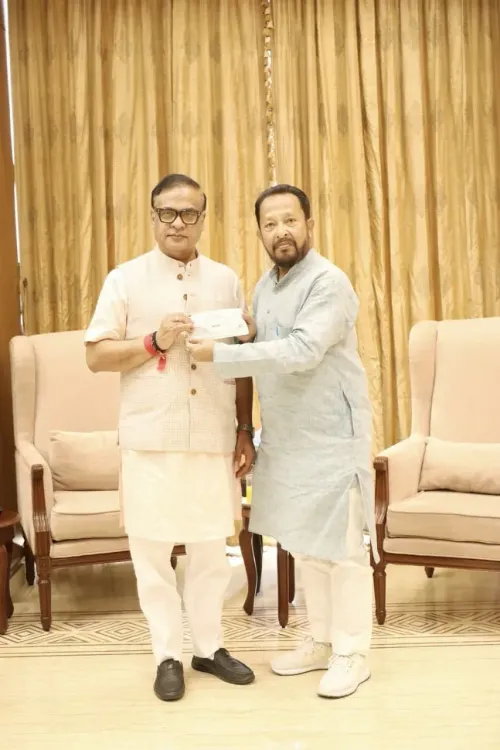
The Chief Minister's Office of Assam announced on 29 July 2026 that over 33 organisations and individuals — from religious bodies and trade associations to a child's piggy bank — donated to the CMRF, with CM Himanta Biswa Sarma thanking contributors as monsoon flood relief operations continue across the state.
Key Takeaways
33+ contributors donated to Assam's Chief Minister's Relief Fund on 29 July 2026 .
Bohagi Utshav Margherita Babosaiye Santha gave the largest single amount: ₹10,00,000 .
Contributors range from religious institutions and trade bodies to individual citizens, including child donor Vedanshi Karjee ( ₹22,500 from a piggy bank).
Darrang Zila Parishad , a statutory local body, contributed ₹1,00,000 , reflecting institutional participation.
The CMRF channels funds into immediate relief, rehabilitation, and recovery for flood-affected families across Assam.
CM Himanta Biswa Sarma expressed gratitude to all contributors and reaffirmed the state's commitment to flood-hit communities.
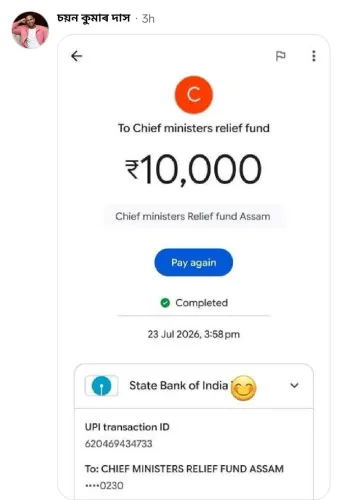
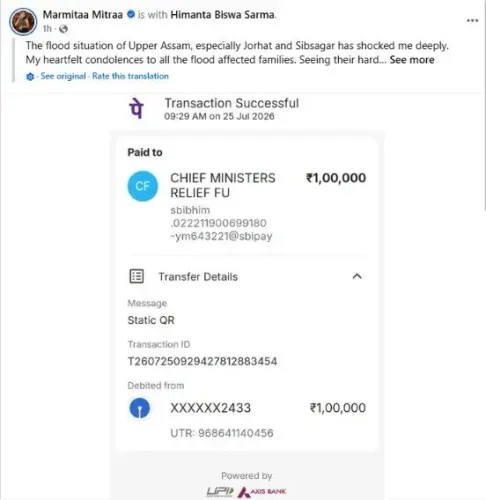
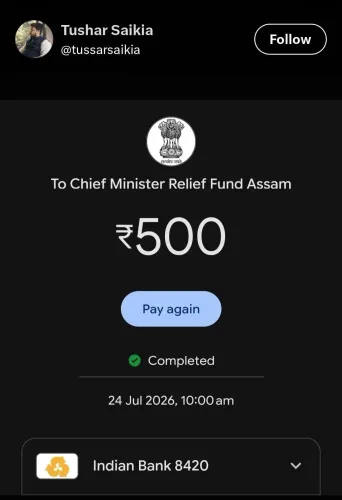
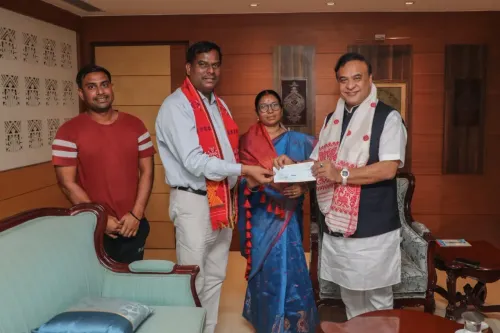
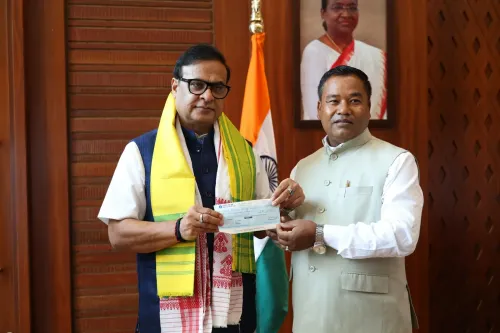
From a child's piggy bank to a district council's treasury, Assam saw a cross-section of civil society rally behind flood-hit families on Wednesday, 29 July 2026 — as the Chief Minister's Office of Assam announced a fresh wave of donations to the Chief Minister's Relief Fund (CMRF), with contributions totalling well over ₹20 lakh in a single day.
Who gave, and how much
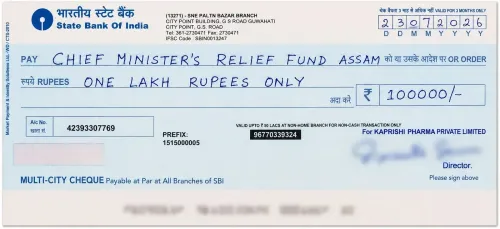
The list spans thirty-three contributors — temples, trade bodies, private firms, elected bodies, and individual citizens. Bohagi Utshav Margherita Babosaiye Santha led the round with ₹10,00,000, followed by Sri Sri Batadrava Than Parrichalana Samiti at ₹5,00,000 — a notable contribution from an institution tied to the Vaishnavite legacy of Srimanta Sankardev. Kamakhya Hardware Store gave ₹2,00,000 and Highland Engineering ₹1,51,000.
Among the most striking entries: Vedanshi Karjee, listed simply as a piggy-bank donor, gave ₹22,500. Darrang Zila Parishad, a statutory local body, contributed ₹1,00,000, signalling institutional participation alongside private generosity. Contributions as small as ₹5,000 — from namghars, senior-citizen groups, and reading clubs — round out the roll.
Himanta Biswa Sarma's acknowledgement and what the CMRF does
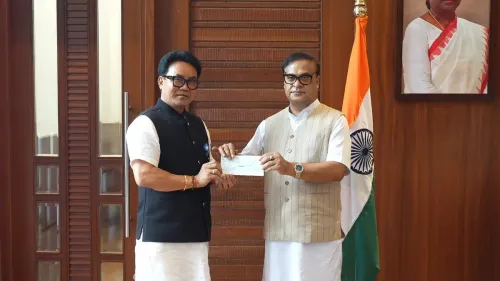
Chief Minister Dr. Himanta Biswa Sarma expressed 'heartfelt gratitude to every contributor for their generosity and solidarity,' according to the CMO post. The CMRF is the state's primary vehicle for channelling public donations into immediate relief, rehabilitation, and recovery for families displaced or damaged by Assam's annual Brahmaputra floods. The fund has been a fixture of Assam's disaster management architecture for decades, activated each monsoon season as rising waters swallow farmland and homes across multiple districts.
Assam is among India's most flood-prone states — the Brahmaputra and its tributaries inundate vast stretches every year, displacing tens of thousands and straining state resources. Civil-society contributions to the CMRF are a recurring feature of that response, bridging the gap between government allocations and ground-level need.
The breadth of this mobilisation
What stands out in this particular round is the range. Religious bodies, hardware traders, tea industry players, infrastructure firms, a sports club, a cremation-service society, and private individuals gave side by side. That breadth — cutting across profession, faith, and geography — reflects the degree to which flood relief in Assam has become a shared civic reflex, not merely a government ask. The monsoon is far from over. Every rupee collected now feeds directly into relief camps, shelter repair, and livelihood support for families still waiting for the waters to recede.
Point of View
Named donor list — down to a child's piggy bank — is a deliberate act of public accountability and social mobilisation: it signals to prospective donors that no contribution is too small and that the state is watching and honouring every rupee. For CM Himanta Biswa Sarma, who has made visible disaster-response a cornerstone of his governance brand since 2021, this kind of public acknowledgement doubles as political capital during a perennially difficult monsoon season. The inclusion of statutory bodies like Darrang Zila Parishad alongside civil-society actors also underscores the state's strategy of blending government and community resources in disaster management — a model Assam has refined over decades of Brahmaputra flooding. With the monsoon still active, how quickly these funds translate into measurable relief on the ground will be the real test.
NationPress
29 Jul 2026
Frequently Asked Questions
What is the Chief Minister's Relief Fund (CMRF) in Assam?
The CMRF is a state-level fund maintained by the Assam government to collect public donations and channel them into immediate relief, rehabilitation, and recovery for people affected by natural calamities such as floods. It has been operational for decades and is activated each monsoon season.
Who donated to the Assam CMRF on 29 July 2026?
Over 33 organisations and individuals donated, including Bohagi Utshav Margherita Babosaiye Santha (₹10,00,000), Sri Sri Batadrava Than Parrichalana Samiti (₹5,00,000), Darrang Zila Parishad (₹1,00,000), and child donor Vedanshi Karjee (₹22,500 from a piggy bank), among others.
How can I donate to the Assam Chief Minister's Relief Fund?
The Assam government accepts donations to the CMRF through official government channels. Prospective donors can contact the Chief Minister's Office of Assam or check the official Assam government website for current donation procedures.
Why does Assam face floods every year?
Assam is situated in the Brahmaputra river valley in Northeast India. The Brahmaputra and its numerous tributaries overflow during the monsoon season each year, inundating farmland, villages, and infrastructure across multiple districts and displacing large numbers of people.
What does CM Himanta Biswa Sarma's government do with CMRF donations?
Funds collected through the CMRF are directed toward immediate relief operations, temporary shelter, and longer-term rehabilitation and recovery efforts for flood-affected families across Assam's flood-hit districts during and after the monsoon season.