CM Himanta Reviews Assam Flood Plain Zoning Bill Progress

Synopsis
Chief Minister Himanta Biswa Sarma reviewed Assam's proposed Flood Plain Zoning Bill on November 5, 2026, which would create prohibited and restricted zones along river channels and protect ST/SC communities. The Bill is set to be tabled in the next session of the Assam Legislative Assembly.
Key Takeaways
CM Himanta Biswa Sarma reviewed the progress of the proposed Flood Plain Zoning Bill on November 5, 2026 .
The Bill will designate prohibited and restricted zones along Assam's river channels to regulate land use.
Flood Zoning Authorities will be established at multiple administrative levels to enforce the framework.
The legislation covers both rural and urban areas and aims to protect lives, property, and livelihoods.
CM Sarma directed that the interests of ST and SC communities traditionally residing along riverbanks must be safeguarded.
The Bill is proposed to be tabled in the next session of the Assam Legislative Assembly .
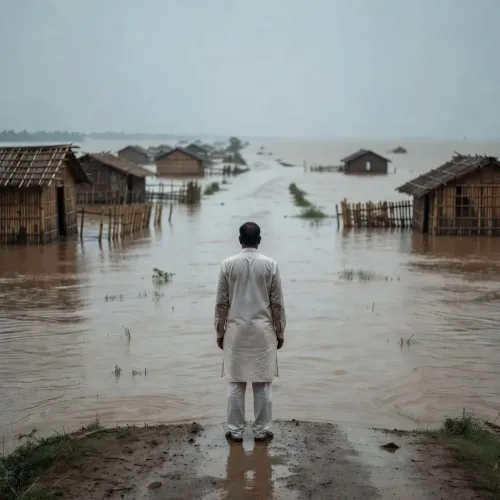
Every monsoon, the Brahmaputra swallows villages whole — and Assam has long known that embankments alone cannot hold back the river. On Thursday, November 5, 2026, the Chief Minister's Office of Assam announced that Chief Minister Dr. Himanta Biswa Sarma reviewed the progress toward enacting the state's proposed Flood Plain Zoning Bill, a legislative push to fundamentally rethink how Assam manages its relationship with its flood-prone river channels.
Zoning the Floodplain: What the Bill Would Do
The proposed legislation would regulate land use along river channels by designating prohibited and restricted zones, backed by Flood Zoning Authorities operating at multiple administrative levels. The framework would apply across both rural and urban areas, covering the full breadth of the state's flood-exposed geography.
The core logic is a departure from decades of purely structural flood-fighting. Rather than only building higher embankments and deeper drainage, the Bill would give rivers the physical space to expand naturally during peak flood events — reducing the catastrophic pressure that bursts containment infrastructure and inundates communities downstream.
Protecting ST and SC Communities Along the Banks
CM Sarma specifically directed that the legislative framework must safeguard the interests of Scheduled Tribe (ST) and Scheduled Caste (SC) communities who have traditionally lived and worked along Assam's riverbanks. These populations face a double vulnerability — both the highest flood exposure and the greatest risk of displacement if zoning restrictions curtail their customary land use.
The directive signals that the Bill is designed to protect lives and property without uprooting the livelihoods of those most historically tied to the river. How that balance is codified in the draft provisions will be among the most closely watched elements when the Bill surfaces for debate.
Path to the Assembly Floor
The Bill is proposed to be tabled in the next session of the Assam Legislative Assembly, the state's unicameral legislature and the body that must pass any such land-use regulation into law. The move draws its broader mandate from the Disaster Management Act, 2005, which empowers states to adopt flood zoning and integrated risk-reduction measures as part of a national framework.
Successive Assam governments have explored regulatory tools alongside physical infrastructure, but a dedicated flood plain zoning law would mark a structural shift in how the state approaches annual monsoon disasters. The notification of Flood Zoning Authorities, public consultation processes, and the eventual demarcation of prohibited and restricted zones along each major river channel will determine whether the legislation translates from intent to enforceable policy on the ground.
Assam's flood season claims lives, destroys crops, and displaces hundreds of thousands of people with grim annual regularity. If the Bill clears the Assembly and its zoning authorities gain teeth, it could reset the terms on which the state — and its riverbank communities — live alongside the Brahmaputra.
Point of View
Infrastructure-led flood control toward preventive, land-use regulation aligned with the Disaster Management Act, 2005. The explicit protection clause for ST and SC communities reflects political awareness that zoning laws, if poorly designed, can function as displacement instruments against marginalised riverbank populations. Tabling the Bill in the next Assembly session will test whether the state can sustain legislative consensus on a measure that constrains property development in ecologically critical corridors. The broader significance is national: a successful Assam model could pressure other flood-prone river states to move beyond embankments as the default answer.
NationPress
5 Nov 2026
Frequently Asked Questions
What is the Assam Flood Plain Zoning Bill?
The Assam Flood Plain Zoning Bill is a proposed state legislation that would regulate land use along river channels by creating prohibited and restricted zones, supported by Flood Zoning Authorities at multiple levels, to reduce flood risk in both rural and urban areas.
When will the Assam Flood Plain Zoning Bill be tabled?
The Bill is proposed to be tabled in the next session of the Assam Legislative Assembly, though a specific session date has not been officially announced.
How will the Flood Plain Zoning Bill affect ST and SC communities in Assam?
Chief Minister Himanta Biswa Sarma has directed that the Bill's framework must specifically safeguard the interests of Scheduled Tribe and Scheduled Caste communities who have traditionally lived along Assam's riverbanks.
What is flood plain zoning and how does it reduce floods?
Flood plain zoning restricts or prohibits certain types of land use in areas adjacent to rivers, allowing rivers to expand naturally during heavy rainfall. This reduces the catastrophic pressure on embankments and lowers the risk of flooding in densely populated areas.
What law empowers Assam to enact flood zoning legislation?
The Disaster Management Act, 2005, empowers Indian states to implement flood zoning and land-use regulations as part of integrated disaster risk reduction.