Assam Emerges as India's 3rd Largest Rubber Producer
Synopsis
Assam has emerged as India's third-largest natural rubber producer, cultivating the crop across 50,000 hectares. The milestone signals a major shift in the state's agricultural economy, driven by Rubber Board programmes and state support aimed at reducing India's dependence on rubber imports.
Key Takeaways
Assam now cultivates natural rubber across 50,000 hectares , according to the Chief Minister's Office.
The state has become India's third-largest natural rubber producer , behind Kerala and Tripura .
The Rubber Board has promoted rubber cultivation in northeastern states since the 1990s through plantation development programmes.
Rubber expansion supports India's strategy to reduce imports from Thailand , Indonesia , and Vietnam .
Smallholder rubber farmers benefit from the crop's long productive life of over 30 years , providing stable income.
Future growth will depend on state budget allocations for extension services and new targets set with the Rubber Board .
The Chief Minister's Office of Assam announced on Thursday, June 11, 2026, that the northeastern state now cultivates rubber across 50,000 hectares, positioning Assam as India's third-largest natural rubber producer.
Context
The post shared by the Chief Minister's Office of Assam highlights a significant agricultural milestone for the state, which has historically been associated with tea and petroleum. Assam's rise to third place in rubber production marks a structural shift in its agricultural economy, coming after Kerala — the country's dominant producer — and Tripura, which pioneered large-scale rubber cultivation in the northeast from the 1960s onward.
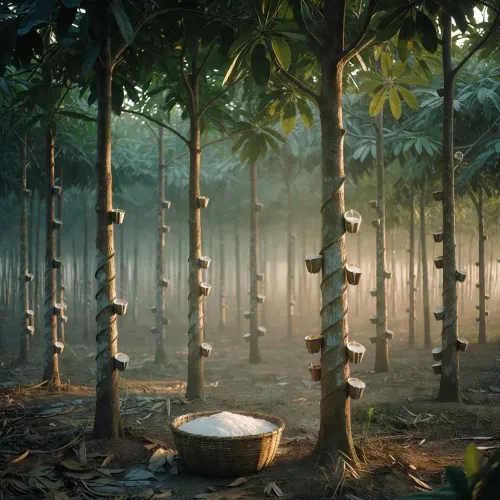
Natural rubber, derived from Hevea brasiliensis, requires warm, humid conditions with well-distributed rainfall — agro-climatic conditions that the northeastern states share with traditional growing regions in south India. Assam's terrain and climate have made it increasingly viable for rubber cultivation as farmers and planners look beyond the state's legacy crops.
Policy Backdrop
The Rubber Board, a statutory body under the Ministry of Commerce and Industry, began systematically promoting rubber cultivation in non-traditional northeastern states including Assam from the 1990s through its plantation development programmes. These initiatives provided planting material, technical guidance, and financial support to smallholder farmers willing to diversify into rubber.
India's broader rubber strategy has long sought to reduce dependence on imports from Thailand, Indonesia, and Vietnam, which together supply a large share of the country's industrial rubber needs. Expanding the cultivated base in the northeast is central to that import-substitution goal. Assam's reported 50,000 hectares under rubber represents a meaningful contribution to that national objective.
State-level support — including budget allocations for extension services, nursery development, and farmer training — has complemented central schemes in driving area expansion. The convergence of central and state efforts has accelerated rubber's footprint in Assam over the past two decades.
Stakeholders and Impact
The primary beneficiaries of this expansion are rubber farmers and plantation workers across Assam, many of whom have transitioned from subsistence or tea-adjacent agriculture to rubber as a more stable cash crop. Rubber trees have a productive life of over 30 years once mature, offering long-term income security compared with annual crops.
For the wider economy, a larger domestic rubber base supports downstream industries — tyre manufacturing, automotive components, footwear, and industrial goods — that depend on natural rubber as a raw material. Reduced import dependence also has foreign-exchange implications at the national level.
Smallholder farmers, who form the bulk of rubber cultivators in the northeast, stand to gain from better price realisations if organised marketing infrastructure and processing facilities keep pace with the area expansion. The Rubber Board's extension network plays a critical role in ensuring quality standards and connecting growers to markets.
What's Next
Attention will now turn to whether Assam sets formal targets for further area expansion in coordination with the Rubber Board's next planning cycle. State budget allocations for rubber extension services in the coming fiscal year will be a key indicator of the government's commitment to sustaining this growth trajectory.
As northeastern states collectively increase their share of India's rubber output, the region's role in national agricultural diversification and import substitution is set to grow — making Assam's third-place ranking not a ceiling but a baseline for future ambition.
Point of View
This milestone serves a dual political purpose: demonstrating economic governance credentials while aligning with New Delhi's import-substitution agenda for natural rubber. The Rubber Board's decades-long extension work in the region is now yielding visible results, validating a patient, institution-led approach to crop diversification. If area expansion is matched by processing and marketing infrastructure, Assam's rubber sector could become a model for other northeastern states seeking to move beyond subsistence agriculture.
NationPress
29 Jul 2026
Frequently Asked Questions
Is Assam a major rubber producer in India?
Yes, Assam has emerged as India's third-largest natural rubber producer, cultivating the crop across 50,000 hectares, behind Kerala and Tripura.
Which state is the largest rubber producer in India?
Kerala remains India's largest natural rubber producer, followed by Tripura and now Assam in third place.
How did rubber cultivation start in Assam?
The Rubber Board began systematic promotion of rubber in Assam and other northeastern states from the 1990s through plantation development programmes that provided planting material, technical guidance, and financial support to farmers.
Why is India expanding rubber cultivation in the northeast?
India is expanding rubber cultivation in the northeast to reduce dependence on imports from Thailand, Indonesia, and Vietnam, and to boost domestic natural rubber supply for industries such as tyres and automotive components.
What are the benefits of rubber farming for Assam farmers?
Rubber offers smallholder farmers a stable, long-term cash crop with a productive life of over 30 years, providing more consistent income compared with annual crops and supporting agricultural diversification beyond tea.