CM Himanta's Assam infrastructure push targets connected, prosperous state
Synopsis
The Chief Minister's Office of Assam on 15 June 2026 reaffirmed the state's major infrastructure and developmental roadmap, positioning ongoing road, bridge and connectivity investments as the path to a more connected, prosperous and future-ready Assam.
Key Takeaways
The Chief Minister's Office of Assam on 15 June 2026 publicly reaffirmed the state's major infrastructure drive and developmental roadmap.
Chief Minister Himanta Biswa Sarma has led Assam's infrastructure agenda since May 2021 , aligning state plans with national programmes.
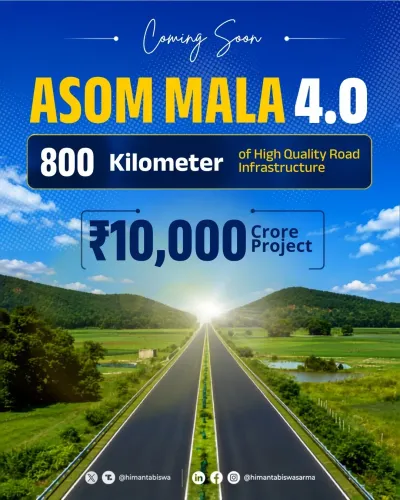
The Asom Mala scheme targets intra-state highway and bridge upgradation, while Bharatmala Pariyojana funds key national highway corridors through Assam.
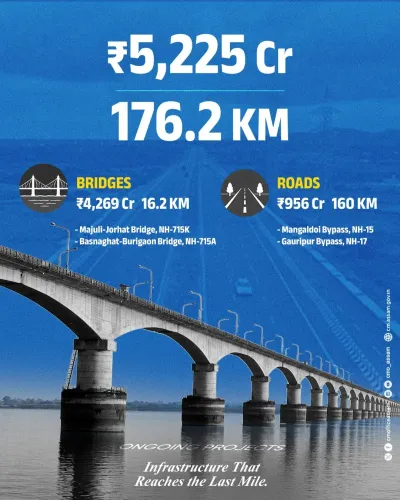
The Bogibeel Bridge , inaugurated in 2018 , marked a milestone in Assam's Brahmaputra connectivity push, with further crossings still under development.
Improved connectivity in Assam underpins India's Act East policy , positioning the Northeast as a gateway to Southeast Asia.
State budget allocations and central project reviews for 2026-27 will be key indicators of the roadmap's pace and scale.
The Chief Minister's Office of Assam on Monday, 15 June 2026 highlighted the state's ongoing infrastructure expansion, describing a major drive and developmental roadmap designed to make Assam more connected, prosperous and future-ready.
The official post stated that 'the major infrastructure drive and developmental roadmap for Assam is paving the way for a more connected, prosperous and future-ready state,' signalling the government's continued emphasis on physical connectivity as the foundation for economic growth.
Context
Assam has been at the centre of the central government's push to accelerate infrastructure development across the Northeast since 2014. Under Chief Minister Himanta Biswa Sarma, who has led the state since May 2021, the administration has aligned state-level plans with national programmes to reduce travel times, lower logistics costs and improve market access for businesses and residents alike. The June 2026 communication reinforces that this agenda remains a governing priority.Policy Backdrop
Assam's infrastructure strategy draws from multiple layers of policy. The state-run Asom Mala programme targets upgradation of intra-state highways and bridges, while the centrally sponsored Bharatmala Pariyojana funds several national highway corridors passing through the state. Assam formally aligned with Bharatmala in 2017 to upgrade key NH stretches. A landmark in this connectivity arc was the inauguration of the Bogibeel Bridge over the Brahmaputra in 2018, one of the longest rail-road bridges in India. The current roadmap builds on that foundation, with attention now turning to remaining Brahmaputra crossings and expressway segments. The state has also aligned its plans with the PM Gati Shakti national master plan, which seeks to integrate road, rail, waterway and air connectivity through a unified digital platform.Stakeholders and Impact
The beneficiaries of Assam's infrastructure push span a wide cross-section. Residents across the state stand to gain from faster, safer road links that cut travel times between districts. Businesses and traders — particularly in agriculture, tea and petroleum — depend on reliable highway and bridge networks to move goods to markets. Logistics operators and freight companies operating on the Northeast's supply chains are watching tender awards and project timelines closely. Beyond the state's borders, improved connectivity in Assam is central to India's 'Act East' policy, which positions the Northeast as a gateway to Southeast Asia through land and multimodal corridors.What's Next
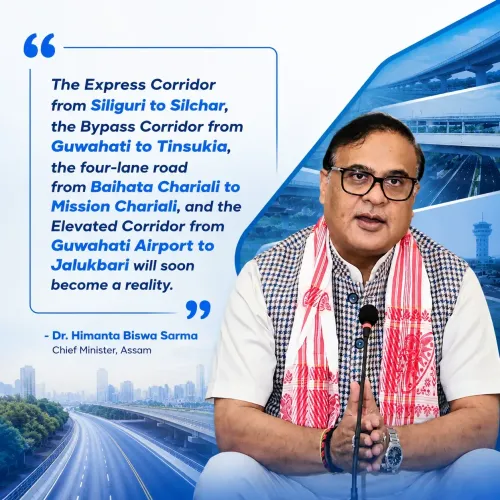
Policy watchers will track state budget allocations and tender awards for the remaining Brahmaputra bridge projects and expressway segments in the 2026-27 fiscal cycle. Central project review meetings scheduled for the same period are expected to assess progress under Bharatmala and Asom Mala. The government's framing of a 'future-ready' roadmap suggests further announcements on connectivity investments are likely as Assam positions itself as a hub for regional trade and investment in the years ahead.Point of View
The government is reinforcing a development-first identity that has been central to BJP-led state politics in the Northeast since 2014. The alignment of Asom Mala with Bharatmala and PM Gati Shakti also reflects a broader pattern of state governments leveraging central scheme branding to amplify local policy wins. Watchers will note whether concrete project completions and tender awards follow the rhetorical push in the months ahead.
NationPress
14 Sept 2026
Frequently Asked Questions
What is Assam's infrastructure roadmap about?
Assam's infrastructure roadmap refers to the state government's coordinated drive to upgrade roads, bridges and multimodal connectivity across the state, combining state-run schemes like Asom Mala with central programmes like Bharatmala Pariyojana and PM Gati Shakti.
What is the Asom Mala scheme?
Asom Mala is an Assam state government programme launched to upgrade intra-state highways and bridges, aimed at improving connectivity between districts and reducing travel times for residents and freight operators.
How does Bharatmala Pariyojana benefit Assam?
Bharatmala Pariyojana funds the construction and upgradation of national highway corridors passing through Assam. The state aligned with the programme in 2017, and several key NH stretches in the Northeast are being upgraded under it.
What is the significance of the Bogibeel Bridge for Assam?
The Bogibeel Bridge, inaugurated in 2018, is one of India's longest rail-road bridges and spans the Brahmaputra river in Assam. It was a landmark project in the state's connectivity push and set the template for further Brahmaputra crossings.
What is India's Act East policy and how does Assam fit in?
India's Act East policy aims to deepen economic and strategic ties with Southeast Asian nations. Assam's location makes it a critical transit corridor for this policy, and improved road and bridge infrastructure in the state directly supports cross-border trade and connectivity goals.