Assam CM Office: NMEO-OP gives farmers ₹71,000/ha aid
Synopsis
The Chief Minister's Office of Assam says the state is providing up to ₹71,000 per hectare in financial assistance and assured procurement to farmers under the central NMEO-OP scheme, aiming to make Assam self-sufficient in edible oil production under CM Dr Himanta Biswa Sarma.
Key Takeaways
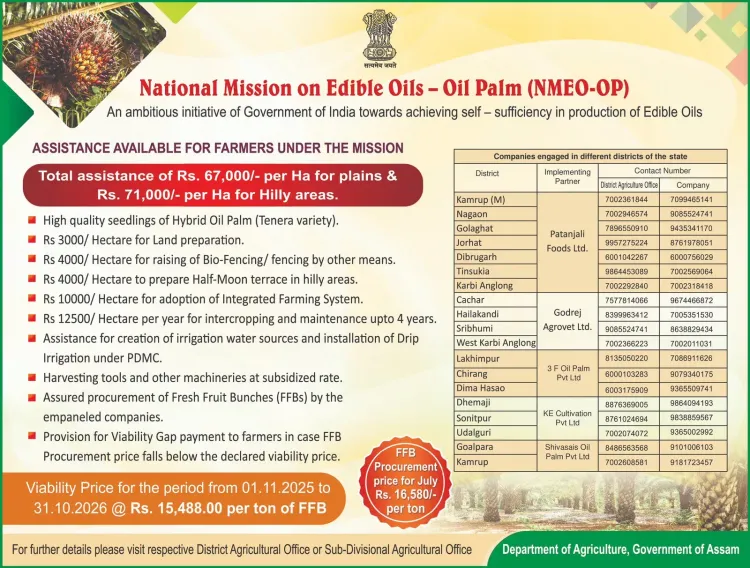
The Government of Assam is offering farmers up to ₹71,000 per hectare under the National Mission on Edible Oils – Oil Palm (NMEO-OP) .
The scheme also provides assured procurement , shielding farmers from edible oil market price volatility.
The initiative is guided by Chief Minister Dr Himanta Biswa Sarma and aims at edible oil self-sufficiency for Assam.
The Union Cabinet approved NMEO-OP in August 2021 with an outlay of ₹11,040 crore , targeting 10 lakh hectares of oil palm by 2025-26.
India imports over 60 percent of its edible oil needs; palm oil is the largest component of those imports.
Assam's state-level incentives are layered on top of the central framework, making the Northeast a priority expansion zone.
The Chief Minister's Office of Assam announced on Tuesday, 28 July 2026 that the state government is providing financial assistance of up to ₹71,000 per hectare to farmers under the National Mission on Edible Oils – Oil Palm (NMEO-OP), alongside assured procurement support, as part of a push toward edible oil self-sufficiency.
Context
The CMO post states that under NMEO-OP, the Government of Assam is offering farmers 'financial assistance of up to ₹71,000/ha and assured procurement,' guided by Chief Minister Dr Himanta Biswa Sarma. The stated goal is to 'achieve self-sufficiency in edible oil production and secure long-term prosperity for Assam's agrarian sector.' Oil palm, a high-yield crop suited to Assam's tropical climate, has been identified as a key vehicle for that ambition.
Policy Backdrop
The Union Cabinet approved NMEO-OP in August 2021 with a total outlay of ₹11,040 crore, targeting the expansion of oil palm cultivation to 10 lakh hectares across India by 2025-26. The scheme is administered by the Ministry of Agriculture and Farmers Welfare and provides a central framework of price support, planting material subsidies, and infrastructure development, with states expected to layer additional incentives on top. Assam's announcement of state-level financial assistance of up to ₹71,000 per hectare represents precisely such a top-up, designed to make oil palm cultivation financially attractive compared with traditional crops like tea and rice.
India currently imports over 60 percent of its edible oil requirement, with palm oil constituting the single largest share of those imports. Successive central administrations have pushed for domestic oil palm expansion in non-traditional growing regions, with the Northeast — including Assam — identified as having significant untapped agro-climatic potential. The NMEO-OP framework specifically prioritises these regions to diversify cultivation away from traditional palm-growing belts.
Stakeholders and Impact
The primary beneficiaries are Assam's farming communities, particularly smallholder cultivators who have historically been dependent on rain-fed rice or the tea estate economy. The per-hectare assistance, combined with an assured procurement mechanism, is intended to reduce market risk — a key deterrent that has slowed oil palm adoption in previous policy cycles. Assured procurement means farmers are guaranteed a buyer at a pre-determined price, insulating them from price volatility in the edible oil market.
The broader edible oil sector stands to benefit as well. Increased domestic production of crude palm oil could ease pressure on India's import bill, which runs into tens of thousands of crore rupees annually. For Assam, successful oil palm expansion would also add an industrial processing dimension — mills, refineries, and ancillary supply chains — creating rural employment beyond primary agriculture.
What's Next
The key metric to watch over the next two planting seasons is the actual area brought under oil palm cultivation in Assam and whether farmer uptake matches the scheme's ambitions. State budget allocations for NMEO-OP in 2026-27 will indicate the depth of fiscal commitment behind the announcement. CM Dr Himanta Biswa Sarma's administration has positioned agricultural diversification as central to the state's economic roadmap, and oil palm expansion is now a visible pillar of that strategy. Progress on ground-level implementation — seed distribution, mill infrastructure, and procurement logistics — will determine whether the policy translates into durable income gains for Assam's farmers.
Point of View
The Himanta Biswa Sarma administration is signalling that agricultural diversification — not just tea and rice — is now a fiscal priority. The assured procurement clause is particularly significant: past oil palm drives in India faltered precisely because farmers had no guaranteed buyer once the crop matured. Whether Assam has the mill infrastructure and cold-chain logistics to honour that assurance at scale will be the real test of this policy's durability.
NationPress
26 Oct 2026
Frequently Asked Questions
What is NMEO-OP and how does it help Assam farmers?
NMEO-OP (National Mission on Edible Oils – Oil Palm) is a central government scheme launched in August 2021 with an outlay of ₹11,040 crore to expand domestic oil palm cultivation. In Assam, the state government is adding financial assistance of up to ₹71,000 per hectare and assured procurement on top of the central benefits.
How much financial assistance do Assam farmers get under NMEO-OP?
The Government of Assam is providing up to ₹71,000 per hectare to farmers who cultivate oil palm under the NMEO-OP framework, along with an assured procurement mechanism that guarantees a buyer for their produce.
Why is India promoting oil palm cultivation?
India imports over 60 percent of its edible oil, with palm oil forming the largest share. Promoting domestic oil palm cultivation is intended to reduce this import dependency and improve the country's edible oil self-sufficiency.
Which states are targeted under NMEO-OP for oil palm expansion?
The NMEO-OP prioritises non-traditional oil palm regions, including the Northeastern states such as Assam, which have suitable agro-climatic conditions but have historically not cultivated oil palm at scale.
What is the role of CM Himanta Biswa Sarma in Assam's oil palm initiative?
Chief Minister Dr Himanta Biswa Sarma has been cited by the Chief Minister's Office as the guiding force behind Assam's participation in NMEO-OP, positioning oil palm expansion as part of a broader agricultural diversification and rural prosperity agenda for the state.