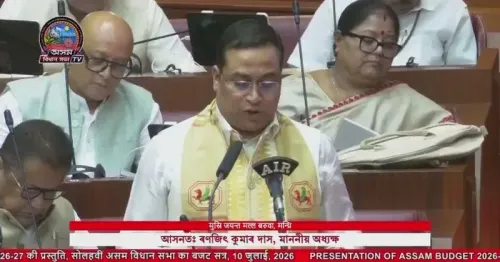
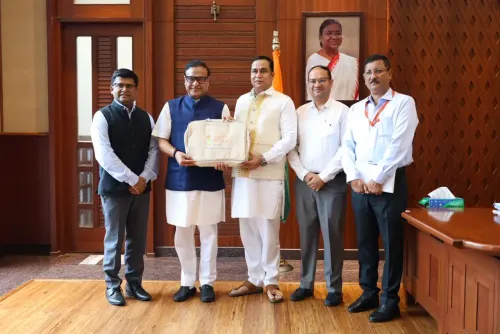
Assam FM Jayanta Mallabaruah Presents Budget 2026 in Assembly
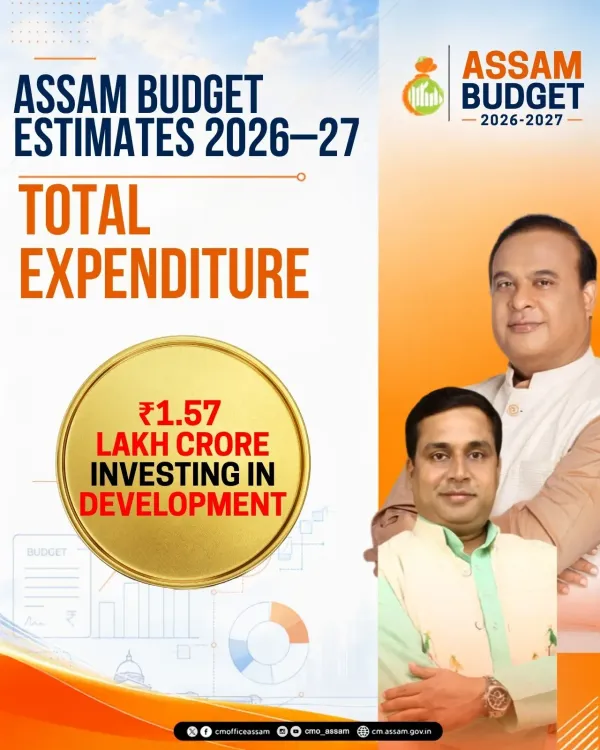
Synopsis
Finance Minister Jayanta Mallabaruah presented the Assam Budget 2026 on 10 July on behalf of CM Himanta Biswa Sarma's government, projecting aggregate receipts of over ₹2.88 lakh crore, aggregate expenditure of over ₹2.85 lakh crore, a ₹3,225 crore surplus, and a 3% fiscal deficit target.
Key Takeaways
Assam Budget 2026 was presented by Finance Minister Jayanta Mallabaruah on 10 July 2026 on behalf of CM Dr.
Himanta Biswa Sarma 's government.
Consolidated Fund receipts are projected at over ₹1.51 lakh crore ; aggregate receipts exceed ₹2.88 lakh crore .
Consolidated Fund expenditure is pegged at over ₹1.56 lakh crore ; aggregate expenditure exceeds ₹2.85 lakh crore .
The budget projects a surplus of ₹3,225 crore , reflecting fiscal prudence.
Assam targets a 3% fiscal deficit , in line with the national FRBM benchmark for sustainable growth.
Budget estimates will be debated in the Assam Legislative Assembly before passage as appropriation bills.
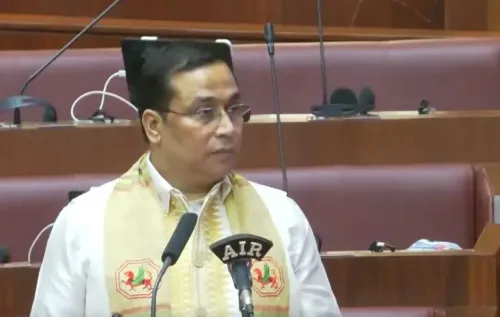
The Chief Minister's Office of Assam announced on Friday, 10 July 2026 that Finance Minister Shri Jayanta Mallabaruah presented the Assam Budget 2026 in the state assembly on behalf of the government led by Chief Minister Dr. Himanta Biswa Sarma. The budget projects a surplus and commits to a 3% fiscal deficit target, signalling the state's intent to maintain fiscal discipline while pursuing sustainable growth.
Key Figures at a Glance
The budget estimates reveal a substantial fiscal footprint for Assam. Consolidated Fund receipts are projected at over ₹1.51 lakh crore, while aggregate receipts stand at over ₹2.88 lakh crore — a figure that includes off-budget and public account flows alongside the consolidated fund.
On the expenditure side, the Consolidated Fund expenditure is pegged at over ₹1.56 lakh crore, with aggregate expenditure crossing ₹2.85 lakh crore. The difference between aggregate receipts and expenditure yields a projected budget surplus of ₹3,225 crore, which the government has highlighted as a marker of fiscal prudence.
Context
Assam presents its annual budget under the framework of the Assam Fiscal Responsibility and Budget Management Act, 2005, which mandates the state to progressively reduce its fiscal deficit and maintain transparency in public finances. The 3% fiscal deficit target announced in this budget aligns with the national FRBM benchmark that the central government expects all states to adhere to.
The budget was presented by Finance Minister Jayanta Mallabaruah, who holds the portfolio in the BJP-led Assam government under Chief Minister Dr. Himanta Biswa Sarma, in power since May 2021. Sarma's administration has consistently emphasised development spending alongside efforts to contain the state's debt burden.
Policy Backdrop
Indian states routinely table annual budgets that detail the split between their Consolidated Fund — which covers all tax revenues, grants, and borrowings — and broader aggregate accounts that include public account transactions such as provident funds and small savings. Assam's aggregate receipt figure of over ₹2.88 lakh crore being significantly larger than its Consolidated Fund receipts is consistent with this accounting convention.
The emphasis on a projected surplus and adherence to the 3% fiscal deficit ceiling mirrors a pattern visible across several BJP-governed states that seek to balance welfare commitments with fiscal credibility ahead of central devolution cycles and market borrowings.
Stakeholders and Impact
The budget directly affects Assam's residents, state government employees, and contractors engaged in infrastructure projects, all of whom look to the annual estimates for signals on salary revisions, scheme continuations, and capital works outlays. A projected surplus, if realised, would give the state additional headroom for developmental expenditure or debt repayment during the 2026-27 fiscal year.
The fiscal discipline signalled by the 3% deficit target is also closely watched by the central government and credit rating agencies that assess state finances when evaluating borrowing limits under the Net Borrowing Ceiling framework.
What's Next
The budget estimates will now be taken up for detailed discussion in the Assam Legislative Assembly before being passed into appropriation and finance bills. Observers will track whether the ₹3,225 crore projected surplus is sustained through the year or revised in a mid-year supplementary demand. Any significant reallocation of sectoral funds — particularly in infrastructure, health, and education — will emerge from the detailed budget documents and assembly debates in the weeks ahead.
Point of View
Making its announcement as much a signal to New Delhi as to voters. The sheer scale of aggregate receipts — over ₹2.88 lakh crore — reflects Assam's growing public account flows and suggests an expanding fiscal base, though the gap between Consolidated Fund and aggregate figures warrants scrutiny in assembly debates. How the projected surplus translates into on-ground capital expenditure will be the real test of this budget's ambition.
NationPress
8 Oct 2026
Frequently Asked Questions
What is the total budget size of Assam Budget 2026?
The Assam Budget 2026 projects aggregate receipts of over ₹2.88 lakh crore and aggregate expenditure of over ₹2.85 lakh crore , with Consolidated Fund receipts at over ₹1.51 lakh crore and Consolidated Fund expenditure at over ₹1.56 lakh crore .
Who presented the Assam Budget 2026?
Finance Minister Jayanta Mallabaruah presented the Assam Budget 2026 in the state assembly on 10 July 2026 on behalf of the government led by Chief Minister Dr. Himanta Biswa Sarma .
What is Assam's fiscal deficit target for 2026?
Assam has set a 3% fiscal deficit target in the Budget 2026, aligning with the national Fiscal Responsibility and Budget Management benchmark to ensure fiscal discipline and sustainable growth.
Is Assam Budget 2026 a surplus or deficit budget?
The Assam Budget 2026 projects a budget surplus of ₹3,225 crore , making it a surplus budget on the overall balance between aggregate receipts and aggregate expenditure.
What is the Consolidated Fund expenditure in Assam Budget 2026?
The Consolidated Fund expenditure in Assam Budget 2026 is projected at over ₹1.56 lakh crore , covering all regular state government spending financed through tax revenues, grants, and borrowings.