CM Himanta Leads Assam Into Next Phase of Land Reforms
Synopsis
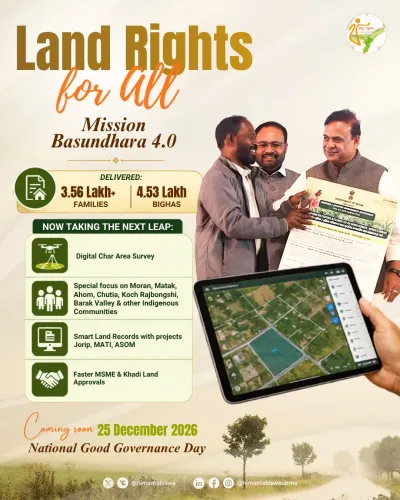
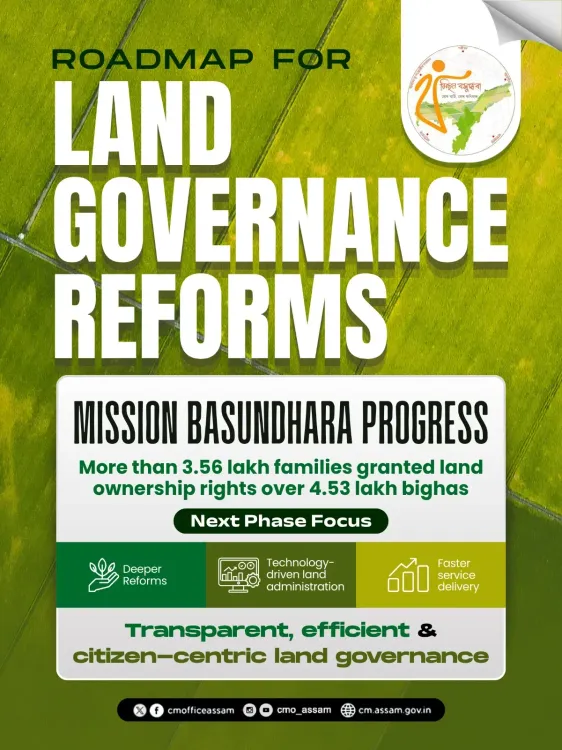
The Chief Minister's Office of Assam has announced a next phase of land reforms under CM Dr. Himanta Biswa Sarma, promising deeper policy changes, faster service delivery, and technology-driven land administration to build a more transparent, citizen-centric governance system.
Key Takeaways
The Chief Minister's Office of Assam announced on 30 May 2026 that the state is moving toward transparent, citizen-centric land governance.
Himanta Biswa Sarma will lead the next phase, focusing on deeper reforms and faster service delivery.
Technology-driven land administration is a stated priority, building on digitisation work begun after 2021 .
Assam's efforts align with the central Digital India Land Records Modernization Programme , launched in 2008 .
Key stakeholders include landowners, farmers, and indigenous communities who stand to benefit from reduced disputes and clearer records.
District-level portal rollouts and pending mutation case data will be key indicators of on-ground progress.
The Chief Minister's Office of Assam announced on Saturday, 30 May 2026 that the state is advancing toward a more transparent, efficient, and citizen-centric governance system, with a particular focus on land rights and land reforms under the leadership of Chief Minister Dr. Himanta Biswa Sarma.
Context
The official post from the Chief Minister's Office of Assam stated that 'from land rights to land reforms, Assam is advancing towards a more transparent, efficient and citizen-centric governance system.' It further noted that the next phase will focus on 'deeper reforms, faster service delivery and technology-driven land administration.' The announcement signals a continuing policy thrust under Dr. Himanta Biswa Sarma, who has helmed the state since May 2021.
Policy Backdrop
Assam's land governance challenges are rooted in a legal framework dating back to the Assam Land and Revenue Regulation of 1886, which established foundational rules for land rights and administration. Periodic amendments over more than a century have sought to address encroachment, indigenous rights, and revenue disputes in the northeastern state. Since 2021, the state government has prioritised digitising land mutation and record access, aligning with the Digital India Land Records Modernization Programme — a central scheme launched in 2008 to computerise land records, reduce disputes, and enable online services.
Assam's push fits a broader national pattern in which states have progressively adopted technology-driven land administration since the mid-2000s under central schemes aimed at curbing corruption and reducing litigation. The emphasis on citizen-centric metrics and reduced manual intervention in revenue departments is consistent with governance priorities pursued across several states in recent years.
Stakeholders and Impact
The reforms are expected to directly affect landowners, farmers, and indigenous communities across Assam — groups that have historically borne the burden of protracted land disputes and opaque mutation processes. Faster service delivery and technology-driven administration could significantly reduce the time and cost involved in accessing land records or resolving ownership disputes. For indigenous communities in particular, clearer land rights documentation has long been a demand tied to cultural identity and economic security.
The state's revenue administration machinery, including district-level offices, will be central to implementing any expanded digitisation drive. Reduced manual intervention is also expected to curb opportunities for corruption at the local bureaucratic level, a concern that has historically plagued land administration in the region.
What's Next
The announcement does not specify a detailed timeline or the precise scope of the 'next phase' of reforms. Observers will watch for updates on district-level rollout of land record portals, any amendments to revenue laws tabled in the Assam Legislative Assembly, and integration with central digital infrastructure dashboards. Reported reductions in pending mutation cases will serve as a key performance indicator for the initiative's on-ground effectiveness.
If the state follows through on the stated direction, Assam could emerge as a reference model for technology-led land governance in Northeast India — with implications for how other states in the region approach longstanding land rights complexities.
Point of View
Forward-moving project under Dr. Himanta Biswa Sarma's stewardship ahead of what is likely an active legislative and administrative calendar. Land governance sits at the intersection of economic development and identity politics in Assam, making it a high-salience issue for both the ruling dispensation and opposition voices. The emphasis on 'technology-driven' administration echoes a governance vocabulary that BJP-led state governments have consistently deployed to project efficiency and anti-corruption credentials. Whether the 'next phase' translates into measurable outcomes — reduced litigation, faster mutations, better indigenous land protections — will determine if this remains a communication exercise or becomes a substantive policy legacy.
NationPress
16 Oct 2026
Frequently Asked Questions
What are the land reforms being announced in Assam in 2026?
The Chief Minister's Office of Assam announced on 30 May 2026 that the state will pursue a next phase of land reforms focused on deeper policy changes, faster service delivery, and technology-driven land administration under CM Dr. Himanta Biswa Sarma. Specific legislative or programmatic details had not been released at the time of the announcement.
What is the Digital India Land Records Modernization Programme?
The Digital India Land Records Modernization Programme is a central government scheme launched in 2008 to computerise land records across Indian states, reduce land disputes, and enable citizens to access records online. Assam has been an implementing state under this programme.
How does Assam's land reform affect indigenous communities?
Indigenous communities in Assam have historically faced challenges related to land encroachment and unclear ownership documentation. Technology-driven land administration and clearer land rights records are expected to benefit these communities by reducing disputes and providing more secure documentation of their holdings.
Who is Himanta Biswa Sarma and what is his role in Assam's governance?
Dr. Himanta Biswa Sarma is the Chief Minister of Assam, a position he has held since May 2021. A senior BJP leader, he has driven administrative and land-related reforms in the state, and the latest announcement positions him as the central figure in the next phase of land governance improvements.
What should I watch for in Assam's land administration rollout?
Key indicators to track include district-level rollout of updated land record portals, any amendments to revenue laws tabled in the Assam Legislative Assembly, integration with central digital dashboards, and official data on reductions in pending land mutation cases.