CM Himanta Launches Assam State Data Policy 2026

Synopsis
Assam Chief Minister Himanta Biswa Sarma unveiled the Assam State Data Policy 2026 on 4 July, positioning it as a framework that protects citizen privacy while enabling anonymised data use for AI-powered governance and informed policymaking in the state.
Key Takeaways
Assam State Data Policy 2026 was announced by Chief Minister Himanta Biswa Sarma on 4 July 2026 .
The policy aims to balance citizen data privacy with the use of anonymised data for AI-enabled governance.
It is designed to operate within India's national data architecture, including the Digital Personal Data Protection Act, 2023 .
Assam's roughly 3.5 crore citizens and multiple state departments are the primary stakeholders.
As NEDA convenor, CM Sarma's policy could serve as a model for other northeastern states.
Implementation rules, data-sharing templates, and pilot projects are the key next steps to watch.
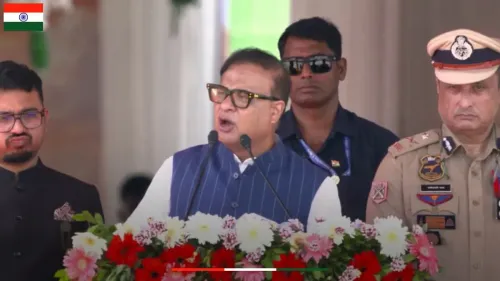
Assam Chief Minister Himanta Biswa Sarma on Saturday, 4 July 2026 announced the Assam State Data Policy 2026, describing it as a framework that balances citizen privacy with the use of anonymised data to improve governance and policy outcomes in the state.
Context
Posting on X, CM Sarma said: 'We are aware of the immense value of data in an AI powered world. Assam State Data Policy 2026 strikes a fine balance between privacy and using anonymized data for better policy outcomes, informed choices and drives citizen centric governance.' The statement positions Assam as a state that is conscious of both the economic opportunity and the civil-liberties risks embedded in large-scale data use.
The announcement arrives as Indian states increasingly frame sub-national data policies to operationalise artificial-intelligence use cases while staying consistent with the national data-protection architecture. Assam, under the BJP-led government that came to power in 2021, has repeatedly positioned itself as an early mover on digital governance reforms in the northeast.
Policy Backdrop
India has two foundational instruments that the Assam State Data Policy 2026 must nest within. The National Data Sharing and Accessibility Policy (NDSAP), notified in 2012, established the principle of proactive sharing of government-held data. More recently, the Digital Personal Data Protection Act, 2023 set binding rules for the processing of personal data across the country, making privacy a statutory obligation rather than a policy preference.
State-level frameworks like the one announced by CM Sarma are designed to operationalise these national instruments at the delivery end — translating broad legislative intent into departmental workflows, data-sharing templates, and AI-enabled citizen services. The emphasis on 'anonymised data' in the Chief Minister's post signals an attempt to unlock the analytical value of public datasets without triggering personal-data protections under the 2023 Act.
Stakeholders and Impact
Assam's roughly 3.5 crore citizens are the primary stakeholders, as the policy governs how state departments collect, store, and share data generated through interactions with public services. Government departments — from health and education to revenue and welfare — stand to gain access to anonymised, aggregated datasets that could sharpen targeting of schemes and reduce duplication.
CM Sarma also leads the North-East Democratic Alliance (NEDA), the BJP-anchored coalition of northeastern states. A functioning data policy in Assam could serve as a template for other NEDA-aligned state governments, amplifying the policy's regional significance beyond Guwahati.
What's Next
The immediate focus will be on the release of implementation rules, data-sharing templates, and the identification of pilot projects under the new policy. Observers will watch whether the Assam government tables specific provisions in the next assembly session or references allocations in the forthcoming state budget to back the framework with institutional and financial resources.
If Assam moves quickly to operationalise the policy, it could influence how other northeastern and smaller Indian states approach the intersection of AI adoption, data governance, and citizen rights — a question that will only grow in urgency as AI tools become embedded in public administration.
Point of View
' the Assam government is signalling alignment with the Digital Personal Data Protection Act, 2023 while carving out operational space for state-level AI deployments. For NEDA-aligned states, this could function as a replicable template, giving the northeast a collective identity as a region that embraces data-driven governance. The real test, however, will be in implementation — whether the policy produces concrete departmental reforms or remains a declaratory framework.
NationPress
3 Oct 2026
Frequently Asked Questions
What is the Assam State Data Policy 2026?
The Assam State Data Policy 2026 is a state-level governance framework announced by Chief Minister Himanta Biswa Sarma that seeks to balance citizen data privacy with the use of anonymised data for AI-powered policymaking and citizen services.
Why did Assam announce a data policy?
Assam announced the policy to operationalise AI-enabled governance while complying with India's Digital Personal Data Protection Act, 2023 , reflecting a broader trend of Indian states framing sub-national data policies.
How does Assam's data policy protect citizen privacy?
According to Chief Minister Sarma , the policy relies on anonymised data — stripping personally identifiable information before data is used for policy analysis — as its primary privacy safeguard.
What is NEDA and why does it matter here?
NEDA , the North-East Democratic Alliance, is a BJP-anchored coalition of northeastern states convened by CM Sarma . A working data policy in Assam could become a template for other NEDA -member states.
What happens next after the Assam data policy announcement?
The next steps include release of implementation rules, data-sharing templates, and pilot projects; the policy may also feature in the next Assam assembly session or state budget.