Assam Governor Reaffirms 2 Lakh Jobs Pledge, Energy Push

Synopsis
Assam Governor Laxman Prasad Acharya on 22 May 2026 reaffirmed the Himanta Biswa Sarma government's pledge to create 2 lakh jobs for youth and highlighted the state's push for industrial infrastructure and energy self-reliance.
Key Takeaways
Governor Laxman Prasad Acharya publicly reaffirmed the Assam government's commitment to providing 2 lakh jobs to the state's youth.
The remarks were shared by the Chief Minister's Office of Assam on 22 May 2026 .
The government cited Chief Minister Dr.
Himanta Biswa Sarma's leadership as central to fulfilling the employment pledge.
Strengthening industrial infrastructure was identified as a key government focus alongside job creation.
Achieving energy self-reliance in production was highlighted as a distinct strategic priority for Assam .
The commitment to youth employment was first anchored when the BJP-led government took office in May 2021 .
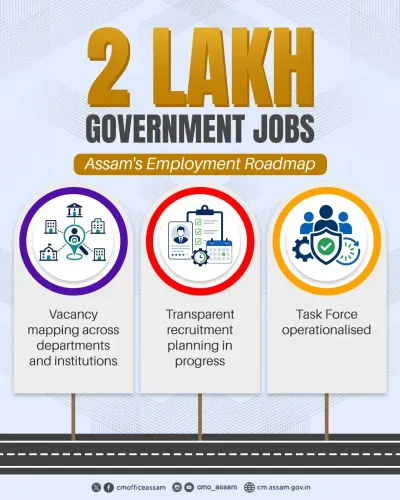
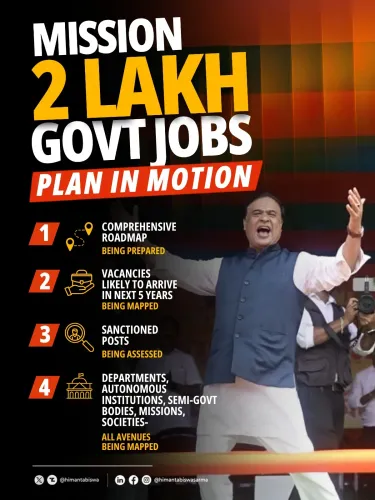
The Chief Minister's Office of Assam on Friday, 22 May 2026, shared that Governor Laxman Prasad Acharya reaffirmed the state government's commitment to generating 2 lakh jobs for Assam's youth, citing the leadership of Chief Minister Dr. Himanta Biswa Sarma. The Governor also underscored the government's focus on strengthening industrial infrastructure and achieving self-reliance in energy production.
Context
Speaking on 22 May 2026, the Governor stated that the government 'will work towards fulfilling the commitment of providing 2 lakh jobs to the youth.' The remarks signal a continued official emphasis on employment generation as a central pillar of the Sarma administration's agenda. The Governor also highlighted energy self-reliance as a parallel priority, reflecting the state's broader economic ambitions.
Policy Backdrop
The pledge to create 2 lakh employment opportunities for Assam's youth was anchored in the BJP-led government's agenda when Dr. Himanta Biswa Sarma assumed office in May 2021. The commitment has since been pursued through industrial expansion and infrastructure development across the state. Assam's push for energy self-reliance aligns with national priorities for reducing dependence on external power supply and boosting manufacturing capacity in the Northeast.
The Northeast region has been a focus of central government investment in recent years, with infrastructure corridors, industrial clusters, and power projects receiving sustained attention. Assam, as the largest economy in the region, has positioned itself as a gateway for these initiatives, leveraging its geographic and resource advantages to attract industrial activity.
Stakeholders and Impact
Assam's youth population stands as the most direct stakeholder in the jobs commitment, with unemployment among young people remaining a persistent concern in the state. Delivery on the 2 lakh jobs target would have significant implications for household incomes, migration patterns, and social stability across districts. Local industries, particularly in manufacturing and energy sectors, are expected to be key vehicles for job creation under the government's framework.
The energy self-reliance agenda carries implications for both industrial competitiveness and household electricity access. A state less dependent on external power sources would be better positioned to support industrial growth and reduce the cost burden on consumers and businesses alike.
What's Next
Observers will watch for concrete details on industrial infrastructure projects and any new employment-linked schemes in forthcoming Assam budget sessions or policy announcements. The Governor's public reaffirmation of these commitments adds institutional weight to the agenda, and implementation timelines are likely to face scrutiny from opposition parties and civil society. Progress on energy projects — including power generation capacity additions — will serve as a measurable indicator of the government's self-reliance goals.
Point of View
Lending constitutional authority to what has been a political commitment since 2021. Pairing employment targets with energy self-reliance signals that the government is framing job creation and industrial growth as interconnected rather than separate policy tracks. For a state historically dependent on central transfers and external energy supply, progress on both fronts would mark a structural shift in Assam's economic standing within the Northeast. The timing of such reaffirmations ahead of potential budget or policy cycles suggests the administration is managing public expectations while keeping its core electoral promises in the spotlight.
NationPress
24 Sept 2026
Frequently Asked Questions
What is the Assam government's commitment on jobs for youth?
The Assam government, under Chief Minister Dr. Himanta Biswa Sarma, has committed to providing 2 lakh jobs to the state's youth, a pledge reaffirmed by Governor Laxman Prasad Acharya on 22 May 2026 .
Who is the Chief Minister of Assam in 2026?
Dr. Himanta Biswa Sarma is the Chief Minister of Assam, leading a BJP-led government since May 2021 .
What is Assam's energy self-reliance plan?
The Assam government has prioritised making the state self-reliant in energy production as part of its industrial infrastructure push, though specific project details are expected to be outlined in upcoming policy announcements.
What did Assam Governor say about employment on 22 May 2026?
Governor Laxman Prasad Acharya stated that the government will work towards fulfilling its commitment of providing 2 lakh jobs to Assam's youth, and also highlighted the focus on industrial infrastructure and energy self-reliance.
How is Assam addressing youth unemployment?
Assam is pursuing youth employment through industrial expansion, infrastructure development, and energy sector growth, with a stated target of 2 lakh jobs under the Himanta Biswa Sarma administration.