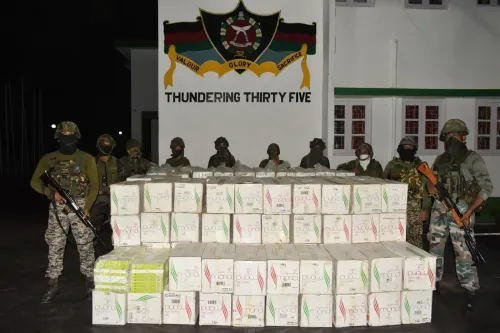
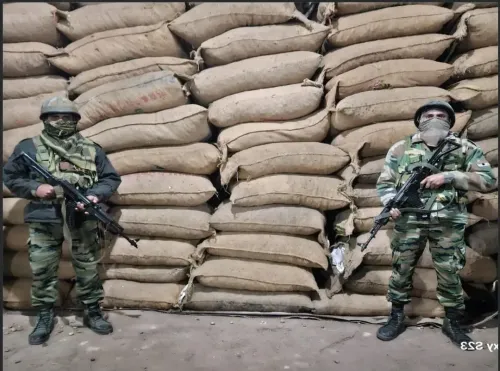
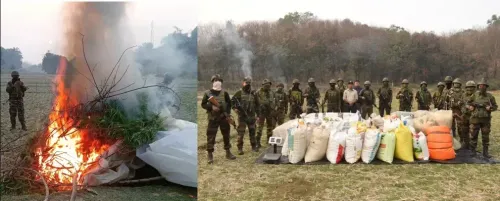
Assam Rifles, Customs seize 501 kg of ganja worth ₹2.50 crore in Tripura's Khowai
Synopsis
Two major ganja seizures in Tripura's Khowai district within three days — 501 kg on Thursday and 340 kg on 6 October — together worth over ₹4.24 crore, reveal a sustained narcotics corridor running from Tripura's hilly interiors toward Bihar and Uttar Pradesh. The driver escaped both times, raising questions about intelligence-to-arrest conversion in Northeast India's anti-narcotics operations.
Key Takeaways
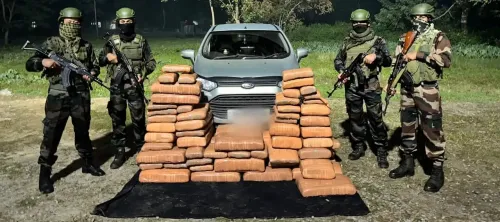
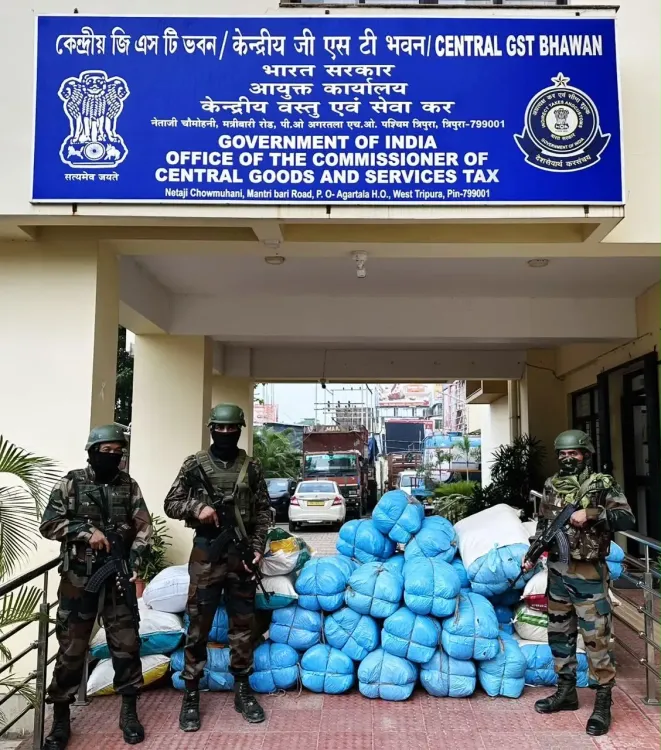
Assam Rifles and Customs seized 501 kg of ganja worth ₹2.50 crore in Khowai district, Tripura on Thursday evening .
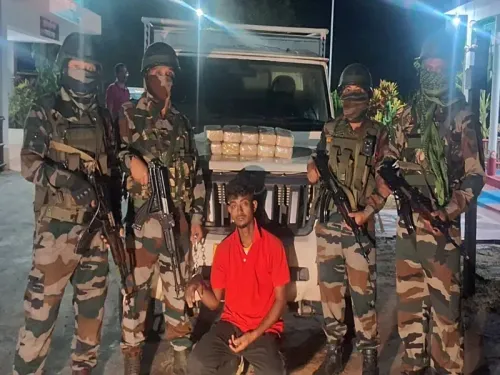
The vehicle driver fled the scene; no arrests were reported in connection with the seizure.
A second seizure in the same district on 6 October netted 340 kg worth ₹1.74 crore — bringing the three-day total to over 840 kg valued at ₹4.24 crore .
Dry ganja from Tripura is reportedly trafficked to Bihar and Uttar Pradesh , where it commands higher prices.
Under the NDPS Act, 1985 , violations carry fines and imprisonment of up to 20 years .
The recovered contraband has been handed to Customs for further investigation and legal proceedings.
Assam Rifles, acting in coordination with Customs officials, seized 501 kg of ganja (marijuana) valued at approximately ₹2.50 crore in Tripura's Khowai district on Thursday evening, according to a defence spokesperson. The operation — triggered by intelligence inputs and continuous surveillance — underscores the persistent narcotics trafficking challenge along Tripura's porous borders.
How the Operation Unfolded
Acting on credible intelligence, a joint team of Assam Rifles and Customs officials intercepted a suspected vehicle and initiated a chase starting from West Sonatala. The pursuit concluded at Baikhuntapur village, roughly 18 km short of Hezamara block, on the boundary between West Tripura and Khowai district. The driver of the vehicle managed to flee the scene during the operation, and no arrests were reported. The recovered contraband has since been handed over to Customs authorities for further investigation and legal proceedings.
Second Major Seizure in Khowai Within Days
Notably, this is not an isolated incident. On 6 October, the Assam Rifles and Customs officials had separately seized 340 kg of ganja worth approximately ₹1.74 crore in the same Khowai district. Together, the two seizures within three days amount to over 840 kg of illicit marijuana with a combined estimated value exceeding ₹4.24 crore — signalling sustained trafficking activity in the region.
Tripura as a Transit Route for Narcotics
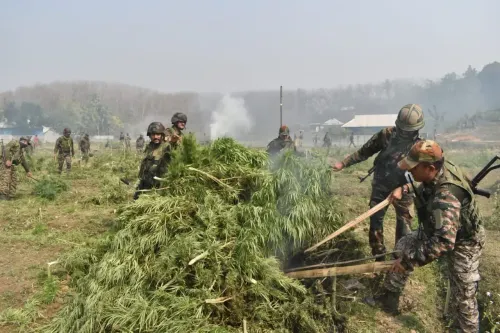
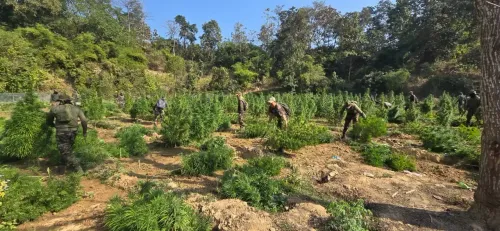
According to police officials, dry ganja produced in Tripura is not consumed locally. Instead, it is reportedly smuggled to other states — primarily Bihar and Uttar Pradesh — where it fetches significantly higher prices. Consignments are typically transported via trucks, small vehicles, and even passenger trains. Sepahijala district, which shares a border with Bangladesh, has been identified as a particularly active zone for illicit cannabis cultivation. State police, Assam Rifles, Tripura State Rifles (TSR), and other security forces regularly conduct joint operations to destroy illegal ganja crops in hilly and inaccessible areas across the state.
The Ground Reality: Livelihoods and Law
Residents — including women — have reportedly acknowledged cultivating cannabis in remote areas as a source of livelihood. Police officials have noted that forest land and government land have frequently been encroached upon for illegal cannabis cultivation. Under the Narcotic Drugs and Psychotropic Substances (NDPS) Act, 1985, the cultivation, possession, sale, purchase, or consumption of narcotic substances is a criminal offence carrying heavy fines and imprisonment of up to 20 years. Authorities argue that sustained enforcement, rather than prosecution of subsistence cultivators alone, is essential to breaking trafficking networks at the source.
What Happens Next
Customs authorities are conducting further investigation into the seized consignment and will initiate legal proceedings. Security agencies are also continuing their hunt for the vehicle's driver who escaped during the Thursday operation. Given the pattern of repeat seizures in Khowai, officials are expected to intensify surveillance along key transit corridors in the district.
Point of View
Interdiction alone will not solve the problem. A sustainable counter-narcotics strategy for the Northeast requires crop substitution and alternative livelihood programmes running alongside enforcement — something that remains conspicuously absent from official statements.
NationPress
9 Oct 2026
Frequently Asked Questions
What was seized in the Assam Rifles operation in Tripura's Khowai district?
The joint Assam Rifles and Customs operation seized 501 kg of ganja (marijuana) valued at approximately ₹2.50 crore in Khowai district, Tripura on Thursday evening. The contraband was recovered after a vehicle chase from West Sonatala to Baikhuntapur village.
Were any arrests made in the Khowai ganja seizure?
No arrests were reported. The driver of the suspect vehicle managed to flee the scene during the operation. The recovered contraband has been handed to Customs authorities for further investigation.
How significant is this seizure in context?
It is the second major ganja seizure in Khowai district within three days — on 6 October, Assam Rifles and Customs had already seized 340 kg worth ₹1.74 crore from the same district. The combined haul exceeds 840 kg, valued at over ₹4.24 crore.
Where is the ganja produced in Tripura eventually smuggled to?
According to police officials, dry ganja produced in Tripura is not consumed locally. It is reportedly trafficked to other states, primarily Bihar and Uttar Pradesh, where it fetches higher prices. Consignments are typically moved via trucks, small vehicles, and passenger trains.
What are the legal penalties for ganja cultivation and trafficking in India?
Under the Narcotic Drugs and Psychotropic Substances (NDPS) Act, 1985, cultivating, possessing, selling, buying, or consuming narcotic substances is illegal. Violations can attract heavy fines and imprisonment of up to 20 years, depending on the quantity involved.