CM Himanta's Assam Marks Five Years of War on Drugs
Synopsis
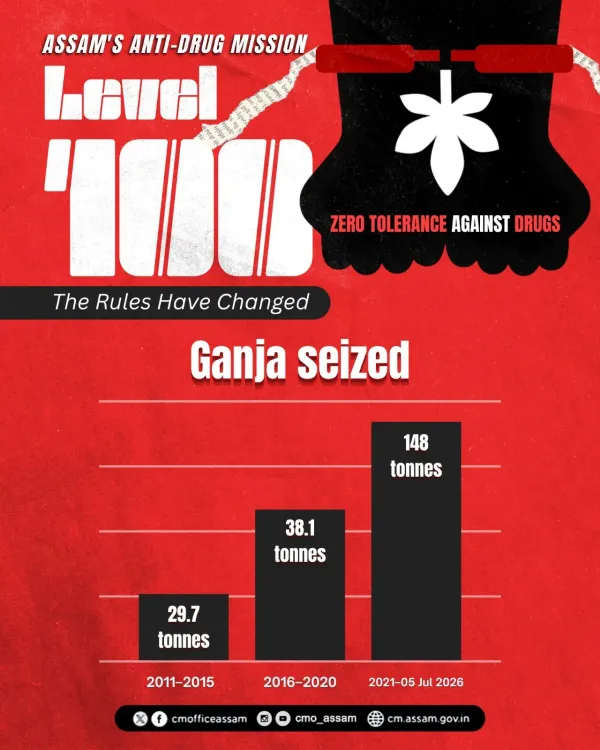
The Chief Minister's Office of Assam has marked five years of an intensified anti-narcotics campaign under CM Himanta Biswa Sarma, declaring zero tolerance for drug trafficking and citing the dismantling of trafficking networks across the state's international border corridors.
Key Takeaways
The Chief Minister's Office of Assam announced on 13 July 2026 that the state has sustained a five-year war on drugs under CM Dr.
Himanta Biswa Sarma .
Sarma declared zero tolerance for narcotics upon taking office in May 2021 and directed Assam Police to escalate enforcement under the NDPS Act .
Assam shares borders with Myanmar and Bangladesh , key transit corridors for Golden Triangle narcotics entering the northeast.
Similar anti-narcotics drives have been launched in neighbouring states Manipur and Arunachal Pradesh under a common central policy framework.
The primary beneficiaries are Assam's youth and residents of border districts most exposed to drug trafficking networks.
Annual Assam Police crime statistics and possible new legislative amendments are expected to provide the next formal assessment of the campaign's reach.
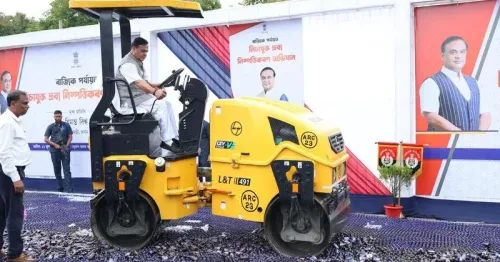
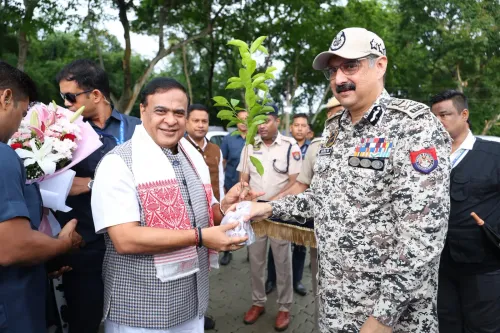
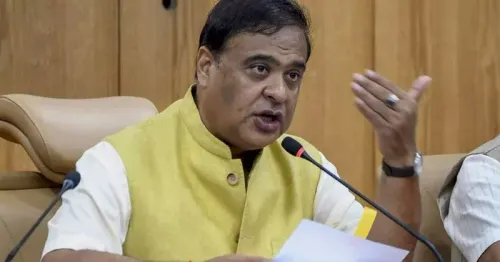
The Chief Minister's Office of Assam on Monday, 13 July 2026, declared that the state has sustained an unrelenting anti-narcotics campaign over the past five years under the leadership of Chief Minister Dr. Himanta Biswa Sarma, framing the drive as a war that 'never stops' against trafficking networks operating in the region.
Context
The official post from the Chief Minister's Office stated: 'The War Never Stops. For the last five years under the leadership of HCM Dr. Himanta Biswa Sarma, Assam has intensified its war against drugs through relentless action, dismantling trafficking networks and sending a clear message: there is zero tolerance for the narcotics trade.' The announcement marks a five-year milestone since Dr. Sarma assumed office in May 2021, when he publicly declared zero tolerance for drug trafficking as a central pillar of his administration's law-and-order agenda.
Assam Police has been the primary instrument of this campaign, conducting raids, seizures, and network interdictions across the state's borders. The state shares international frontiers with Myanmar and Bangladesh, both of which are transit corridors for narcotics originating from the Golden Triangle region of Southeast Asia.
Policy Backdrop
When Dr. Himanta Biswa Sarma took charge as Chief Minister in May 2021, he directed Assam Police to escalate enforcement under the Narcotic Drugs and Psychotropic Substances (NDPS) Act, signalling a departure from what his administration described as a permissive prior environment. State government reports from 2022 and 2023 documented multiple large-scale seizures of heroin and synthetic drugs, with the administration publicising arrests and network dismantling as evidence of operational progress.
Assam's campaign sits within a wider northeastern India enforcement push. Neighbouring states including Manipur and Arunachal Pradesh have announced parallel drives under the same central policy framework, reflecting a coordinated approach to the region's narcotics challenge. Rising seizures of methamphetamine and heroin have been reported across the northeast since the early 2020s, underscoring the scale of the problem that state forces are contending with.
Stakeholders and Impact
The most direct beneficiaries of sustained enforcement are Assam's youth and residents of border districts, who have historically borne the brunt of drug availability and addiction. Trafficking networks, when disrupted, reduce supply chains that feed local consumption, particularly of synthetic drugs and heroin in vulnerable communities.
Assam Police personnel engaged in anti-narcotics operations also remain central stakeholders, as the campaign's continuity depends on sustained institutional capacity, inter-agency coordination, and intelligence sharing with central agencies and border-management forces. Civil society groups working on drug rehabilitation in the state have long called for enforcement to be paired with treatment infrastructure.
What's Next
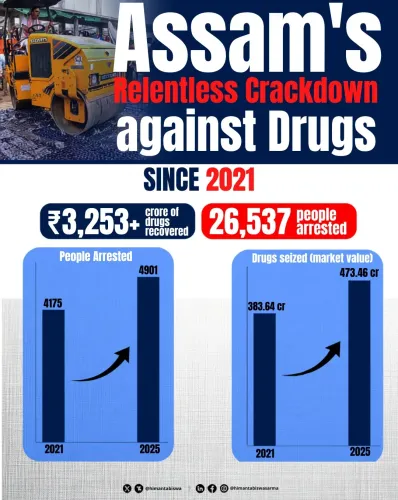
The five-year mark is likely to be accompanied by a formal accounting of the campaign's results, with Assam Police crime statistics on drug seizures expected to provide a quantitative picture of enforcement outcomes. Any new state-level amendments to narcotics enforcement rules may also be tabled in the next assembly session, potentially strengthening legal tools available to investigators.
The broader test for the administration will be whether sustained enforcement translates into measurable reductions in drug prevalence among Assam's youth — a metric that goes beyond seizure volumes and speaks to the campaign's long-term public-health impact.
Point of View
The Chief Minister's Office reinforces a governance brand built on muscular enforcement. The northeastern narcotics challenge is structurally deep, rooted in the Golden Triangle supply chain, which means seizure statistics alone are an incomplete metric of success. The real test — and the one opposition voices are likely to raise — is whether five years of intensified policing has produced verifiable declines in addiction rates and trafficking volumes at the community level.
NationPress
12 Oct 2026
Frequently Asked Questions
What is Assam's war on drugs about?
Assam's anti-narcotics campaign is a sustained enforcement drive launched under Chief Minister Dr. Himanta Biswa Sarma in May 2021, targeting drug trafficking networks operating through the state's borders with Myanmar and Bangladesh, with a stated policy of zero tolerance under the NDPS Act.
How long has CM Himanta Biswa Sarma's drug crackdown been running?
The campaign has been running for five years, since Dr. Sarma assumed office as Chief Minister of Assam in May 2021 and declared zero tolerance for the narcotics trade as a central law-and-order priority.
Which drugs are most seized in Assam?
State government reports from 2022 and 2023 highlighted seizures of heroin and synthetic drugs, including methamphetamine, which enter the northeast via trafficking routes linked to the Golden Triangle region of Southeast Asia.
Why is Assam a hub for drug trafficking in India?
Assam's geographic position — sharing international borders with Myanmar and Bangladesh — makes it a key transit corridor for narcotics originating from the Golden Triangle, placing it at the frontline of northeastern India's drug-trafficking challenge.
What other northeastern states have anti-drug campaigns?
Neighbouring states Manipur and Arunachal Pradesh have announced parallel enforcement drives under the same central policy framework, reflecting a coordinated northeastern India approach to the narcotics problem.