Nijut Moina scheme fights child marriage and school dropouts, says Assam CM Sarma
Synopsis
Assam CM Himanta Biswa Sarma used Navratri to spotlight the Nijut Moina scheme — framing ₹1,000–₹2,500 monthly grants for girl students as a direct weapon against child marriage. The scheme's reach from Class 11 through postgraduate study makes it one of the more comprehensive state-level efforts to keep girls in education across a state that has historically struggled with early marriage rates.
Key Takeaways
Assam CM Himanta Biswa Sarma highlighted the Mukhya Mantrir Nijut Moina scheme on 12 October 2026 via a post on X during Navratri .
The scheme provides monthly financial assistance for 10 months annually : ₹1,000 (Higher Secondary), ₹1,250 (undergraduate), and ₹2,500 (postgraduate).
Sarma called it 'a firm stand against child marriage and early dropout,' not merely a scholarship.
The scheme targets girls enrolled in government and government-aided institutions across Assam.
Sarma drew a parallel between Maa Brahmacharini's spirit and girls pursuing education instead of early marriage.
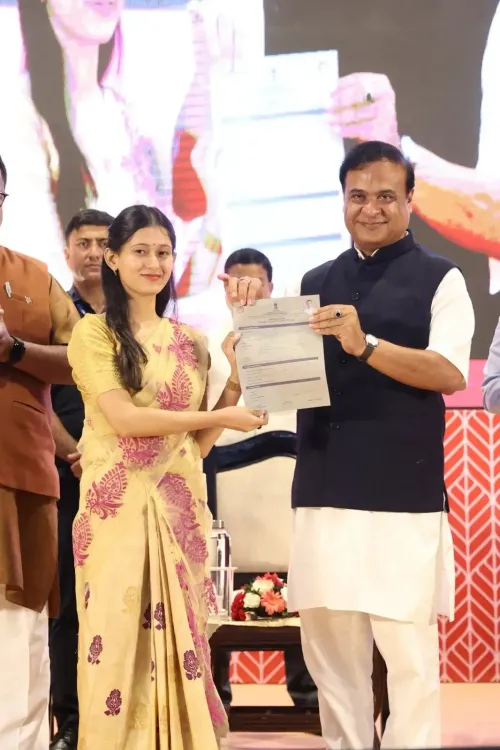
Assam Chief Minister Himanta Biswa Sarma on Monday, 12 October 2026, spotlighted the Mukhya Mantrir Nijut Moina scheme as a frontline instrument in the state's fight against child marriage and female educational dropout, framing the initiative as more than a financial aid programme. The remarks came via a post on X on the occasion of Navratri's second day, dedicated to Maa Brahmacharini.
What the Nijut Moina Scheme Offers
Under the scheme, girl students enrolled in government and government-aided institutions in Assam receive monthly financial assistance for 10 months a year. Students at the Higher Secondary School level receive ₹1,000 per month, those at the undergraduate level receive ₹1,250 per month, and postgraduate students are entitled to ₹2,500 per month. The support spans the educational ladder from Class 11 onwards through to postgraduate study.
Sarma's Key Message
'This is not just a scholarship. It is a firm stand against child marriage and early dropout,' Sarma wrote in his post. He argued that the scheme sends a direct signal to families that educating daughters is a worthwhile investment, and that state-backed financial assistance can help young women continue their studies rather than being pushed into early marriage. The Chief Minister drew a deliberate parallel between Maa Brahmacharini's spirit of devotion and perseverance and the determination of girls choosing academics over early matrimony, describing the pursuit of education as a form of tapasya — or penance — in the modern context.
Addressing a Deep-Rooted Social Challenge
Assam has historically recorded among the higher rates of child marriage in India, making targeted government intervention at the educational financing level especially consequential. The Nijut Moina scheme is designed to ease the cost burden on families, a factor researchers consistently identify as a driver of early marriage among girls. By tying financial support directly to enrolment at each academic level, the scheme attempts to create incremental incentives that keep girls in classrooms through higher education. Notably, the scheme covers postgraduate study — a rarer provision in state-level scholarship frameworks.
The Navratri Context and Broader Symbolism
Sarma's decision to invoke Navratri — a festival celebrating feminine divine power — to promote a girls' education scheme reflects a broader communication strategy by the Assam government of aligning social welfare messaging with cultural and religious occasions. The Chief Minister invoked Maa Brahmacharini's blessings for Nijut Moina beneficiaries, wishing them 'focus, wisdom and the courage to pursue their aspirations without limitations.' The framing positions educational empowerment as both a social priority and a culturally resonant value, potentially widening the scheme's acceptance among conservative households.
What Comes Next
The state government's continued emphasis on the Nijut Moina scheme suggests it will remain a flagship welfare initiative in Assam's policy calendar. As Navratri progresses, the Chief Minister's messaging is likely to keep girls' education in public discourse. Whether the scheme's disbursements are reaching the most marginalised girls in rural Assam — where child marriage rates are highest — will be the key measure of its real-world impact.
Point of View
Where child marriage pressure is strongest and banking access weakest. Sarma's Navratri framing is clever communication, but it sidesteps the harder question: does the scheme track outcomes like marriage rates and completion rates, not just enrolment numbers? A scholarship that funds enrolment without monitoring retention is only half a solution. Assam's child marriage challenge demands the second half too.
NationPress
12 Oct 2026
Frequently Asked Questions
What is the Mukhya Mantrir Nijut Moina scheme in Assam?
The Mukhya Mantrir Nijut Moina scheme is an Assam government initiative that provides monthly financial assistance to girl students enrolled in government and government-aided institutions at the Higher Secondary, undergraduate, and postgraduate levels. The aim is to reduce child marriage rates and prevent girls from dropping out of education by easing the cost burden on families.
How much financial assistance does the Nijut Moina scheme provide?
Under the scheme, Higher Secondary students receive ₹1,000 per month, undergraduate students receive ₹1,250 per month, and postgraduate students receive ₹2,500 per month. The assistance is provided for 10 months every year.
Why did CM Himanta Biswa Sarma highlight the Nijut Moina scheme on Navratri?
Sarma used the occasion of Navratri's second day — dedicated to Maa Brahmacharini, a deity symbolising knowledge and devotion — to draw a parallel between the goddess's teachings and girls choosing education over early marriage. The move aligns the state government's social welfare messaging with a culturally significant festival to broaden its resonance.
Who is eligible for the Nijut Moina scheme?
Girl students enrolled in government and government-aided institutions in Assam at the Higher Secondary, undergraduate, or postgraduate level are eligible. The scheme covers the academic journey from Class 11 onwards through to postgraduate study.
How does the Nijut Moina scheme help combat child marriage in Assam?
The scheme addresses one of the root causes of child marriage — financial pressure on families — by providing direct monthly stipends to girls who continue their education. By making staying in school financially viable, it aims to reduce the incentive for families to arrange early marriages for their daughters.