Chandrashekhar Azad: Parliament isn't BJP-Congress property, other parties' issues must be heard
Synopsis
Aazad Samaj Party-Kanshi Ram chief Chandrashekhar Azad used Parliament's corridors on 11 August to challenge the BJP-Congress duopoly on legislative airtime — spotlighting student crackdowns at BBAU Lucknow and pledging to personally join Jharkhand's JPSC-JSSC agitation if demands go unmet. Meanwhile, a BJP bandh and ABVP gherao in Ranchi drew police detentions but only mixed public response.
Key Takeaways
Chandrashekhar Azad on 11 August asserted Parliament must give floor time to parties beyond BJP and Congress .
He cited government cases and fines against BBAU Lucknow students who tried to mark Babasaheb Ambedkar's birth anniversary with a procession.
Azad pledged to personally support Jharkhand students protesting alleged irregularities in JPSC and JSSC recruitment exams if their demands are not met after the session.
BJP called a state-wide bandh in Jharkhand; ABVP organised an Assembly gherao in Ranchi — both over a police lathicharge on agitating students.
Police detained ABVP activists attempting to march to the Jharkhand Assembly ; normal life remained largely unaffected in Ranchi.
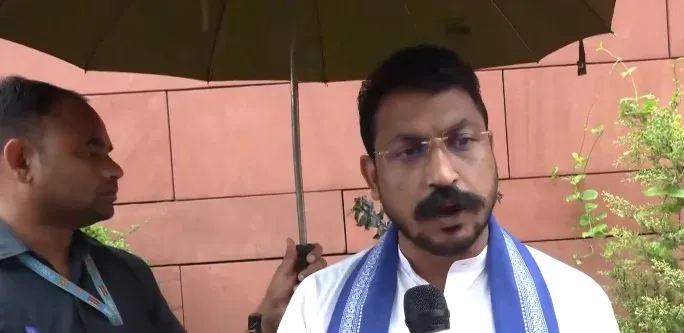
Aazad Samaj Party-Kanshi Ram president Chandrashekhar Azad on Tuesday, 11 August asserted that Parliament is not the exclusive domain of the Bharatiya Janata Party (BJP) and the Indian National Congress (INC), demanding that issues raised by smaller parties — including student grievances at a Lucknow university and recruitment exam irregularities in Jharkhand — receive floor time in the House.
Azad's Core Demand
Speaking to reporters, Azad said: 'The House does not belong only to the BJP and Congress; there are many other parties here, and they also have several issues.' He specifically cited the case of students at Babasaheb Bhimrao Ambedkar University (BBAU) in Lucknow, who had reportedly attempted to organise a procession to mark Babasaheb Ambedkar's birth anniversary. According to Azad, the government subsequently filed cases against those students and imposed fines.
Questioning the due-process implications, he added: 'How can action be taken without giving them a hearing?' Azad said he had reviewed videos in which students alleged they were not receiving adequate food in their hostel mess facilities — a welfare concern he argued deserved parliamentary attention alongside the legal action against them.
Jharkhand Student Protests: Azad Pledges Support
Azad also addressed the ongoing student agitation in Jharkhand over alleged irregularities in recruitment examinations conducted by the Jharkhand Public Service Commission (JPSC) and the Jharkhand Staff Selection Commission (JSSC). Expressing solidarity with the protesters, he said: 'Once the House concludes, if their demands are not met, I will go there and support them. I assure you of this.'
This comes amid a broader pattern of student-led protests over examination transparency that has surfaced across multiple states in recent months, reflecting what critics describe as systemic failures in public recruitment processes.
BJP Bandh and ABVP Gherao in Ranchi
Separately, the BJP called a state-wide bandh in Jharkhand on Tuesday, while the Akhil Bharatiya Vidyarthi Parishad (ABVP) organised an Assembly gherao programme in Ranchi — both in protest against a police lathicharge on students agitating over the alleged JPSC and JSSC irregularities. The bandh drew a mixed response across the state.
BJP workers staged demonstrations and blocked roads at several locations in the state capital. ABVP activists who attempted to march towards the Jharkhand Assembly were stopped and detained by police. Despite sporadic disruptions, normal life remained largely unaffected in many parts of Ranchi during the morning hours, with most commercial establishments staying open and vehicular movement remaining largely smooth.
Wider Context: Smaller Parties and Parliamentary Space
Azad's remarks reflect a recurring tension in Indian parliamentary politics — the perception among regional and smaller parties that legislative time and media attention are disproportionately absorbed by the two dominant national formations. Notably, this is not the first session in which smaller-party leaders have raised concerns about floor-time equity. With the monsoon session already marked by disruptions, Azad's call for broader issue inclusion underscores the challenge of balancing competing legislative priorities.
How the ruling dispensation and the Opposition respond to these demands — particularly on the Jharkhand student issue — will be closely watched as the session continues.
Point of View
A constitutional icon, is precisely the kind of issue that cuts across ideological lines and merits scrutiny. The Jharkhand recruitment controversy, meanwhile, is part of a wider pattern of exam-paper leaks and commission irregularities that have eroded trust in public hiring across states. That the BJP is simultaneously calling a bandh over the same student issue it arguably governs around at the Centre adds a layer of political contradiction that mainstream coverage has largely glossed over.
NationPress
25 Sept 2026
Frequently Asked Questions
What did Chandrashekhar Azad say about Parliament on 11 August?
Chandrashekhar Azad said Parliament does not belong only to the BJP and Congress, and that other parties also have important issues deserving discussion in the House. He specifically raised the case of BBAU Lucknow students penalised for organising an Ambedkar birth anniversary procession, and expressed support for Jharkhand students protesting JPSC and JSSC recruitment irregularities.
What happened to students at BBAU Lucknow?
Students at Babasaheb Bhimrao Ambedkar University (BBAU) in Lucknow reportedly attempted to organise a procession to celebrate Babasaheb Ambedkar's birth anniversary, after which the government filed cases against them and imposed fines. Azad questioned how action could be taken without giving the students a prior hearing.
Why are students protesting in Jharkhand?
Students in Jharkhand are agitating over alleged irregularities in recruitment examinations conducted by the Jharkhand Public Service Commission (JPSC) and the Jharkhand Staff Selection Commission (JSSC). The protests intensified after police carried out a lathicharge on demonstrators.
What was the BJP bandh and ABVP gherao in Ranchi about?
The BJP called a state-wide bandh in Jharkhand and the ABVP organised an Assembly gherao in Ranchi on 11 August to protest the police lathicharge on students agitating over alleged JPSC and JSSC exam irregularities. ABVP activists were detained by police before they could reach the Jharkhand Assembly; the bandh drew a mixed response with normal life largely unaffected.
Who is Chandrashekhar Azad?
Chandrashekhar Azad is the president of the Aazad Samaj Party-Kanshi Ram, a political party that positions itself as a champion of Dalit and marginalised communities. He is a Member of Parliament and has been vocal on issues related to Dalit rights, educational access, and government accountability.