Rajasthan CM Bhajan Lal Sharma's Second Meeting with PM Modi in March
Synopsis
In a significant second meeting within a month, Rajasthan's Chief Minister Bhajan Lal Sharma presented PM Modi with a sandalwood idol of Goddess Durga, highlighting the ongoing collaboration for Rajasthan's development amidst global challenges.
Key Takeaways
CM Bhajan Lal Sharma met PM Modi for the second time this month.
The meeting focused on Rajasthan's development and public welfare initiatives.
Sharma presented a sandalwood idol of Goddess Durga to the Prime Minister.
The craftsmanship of the idol highlights Rajasthan's rich artistic heritage.
The Jangid family, responsible for the idol's creation, has a notable history in sandalwood carving.
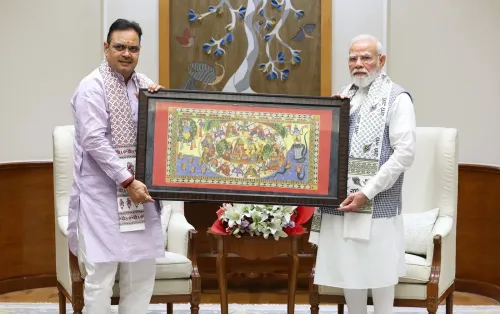
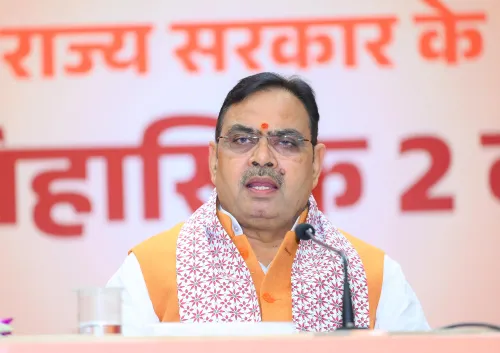
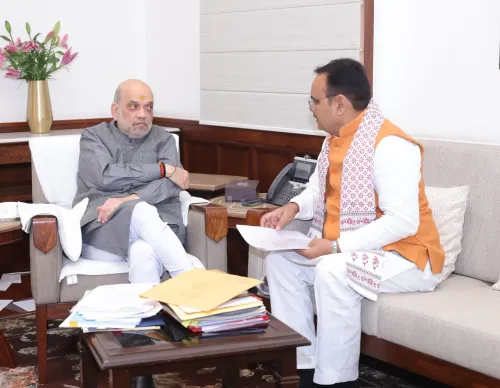
New Delhi, March 25 (NationPress) Chief Minister Bhajan Lal Sharma engaged in discussions with Prime Minister Narendra Modi at the Parliament House on Wednesday, marking their second encounter this month.
The Prime Minister's Office announced the meeting via a brief post on its X handle, stating, "The Chief Minister of Rajasthan, Shri Bhajan Lal Sharma, had an audience with the Prime Minister today."
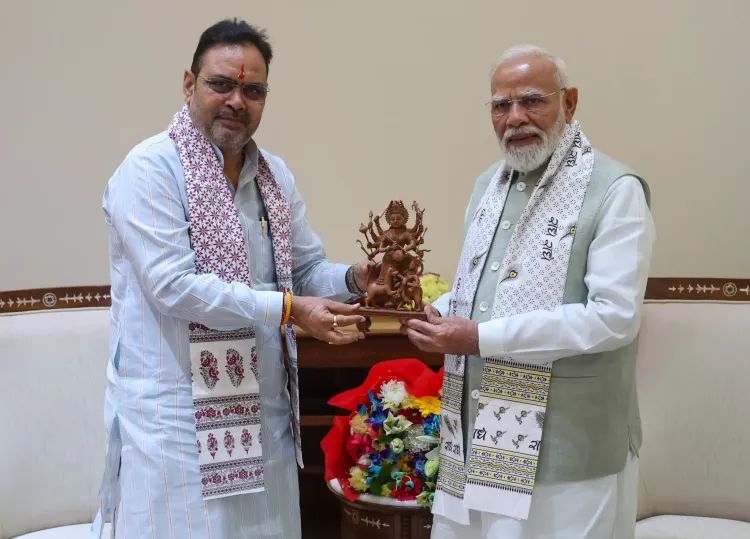
During this meeting, the Chief Minister presented a beautifully crafted idol of Goddess Durga made from sandalwood.
This meeting is considered pivotal against the backdrop of ongoing global events. It marked the second time the two leaders have interacted in a short span.
Previously, the Chief Minister met with the Prime Minister during his visit to Ajmer on February 28, where he sought the Prime Minister’s esteemed guidance for the comprehensive development of Rajasthan and the successful execution of several public welfare initiatives.
The Chief Minister expressed that the Prime Minister’s visionary leadership and precise directives light the way toward a prosperous Rajasthan.
He further highlighted that the Honourable Prime Minister’s steadfast dedication to the people of Rajasthan, combined with his forward-thinking vision, remains a tremendous asset for the state. With this support, Rajasthan is progressively achieving significant advancements in various development sectors. Motivated by this spirit, every citizen is determined to contribute to the shared goal of a “Developed Rajasthan.”
During the meeting, Chief Minister Sharma gifted Prime Minister Modi a sandalwood idol of Goddess Durga, intricately crafted by Jaipur artisan Mohit Jangid.
This stunning idol showcases exquisite craftsmanship, detailed artistry, and traditional embellishments.
The Jangid family has been involved in sandalwood carving for four generations, with 11 family members honored with National Awards. The idol not only holds religious significance but also symbolizes Rajasthan’s rich artistic legacy and enduring craftsmanship.
Point of View
The meeting between CM Bhajan Lal Sharma and PM Narendra Modi reflects the ongoing commitment to enhancing Rajasthan's developmental agenda. It underscores the importance of political collaboration in addressing regional needs and leveraging leadership for public welfare.
NationPress
23 Sept 2026
Frequently Asked Questions
What was the purpose of Bhajan Lal Sharma's meeting with PM Modi?
The meeting aimed to discuss the holistic development of Rajasthan and seek guidance on implementing public welfare schemes.
What gift did CM Sharma present to PM Modi?
CM Sharma gifted PM Modi a sandalwood idol of Goddess Durga, intricately carved by artisan Mohit Jangid.
How many times have Sharma and Modi met in March?
This was their second meeting in March, with the first occurring during Modi's visit to Ajmer on February 28.
What significance does the idol hold?
The idol represents both religious importance and the rich artistic heritage of Rajasthan, showcasing the craftsmanship of the Jangid family.
Who is Mohit Jangid?
Mohit Jangid is a Jaipur-based artisan known for his exquisite sandalwood carvings, with his family having a long-standing tradition in this craft.