CM Bhajan Lal urges Rajasthan to adopt cycling on World Bicycle Day
Synopsis
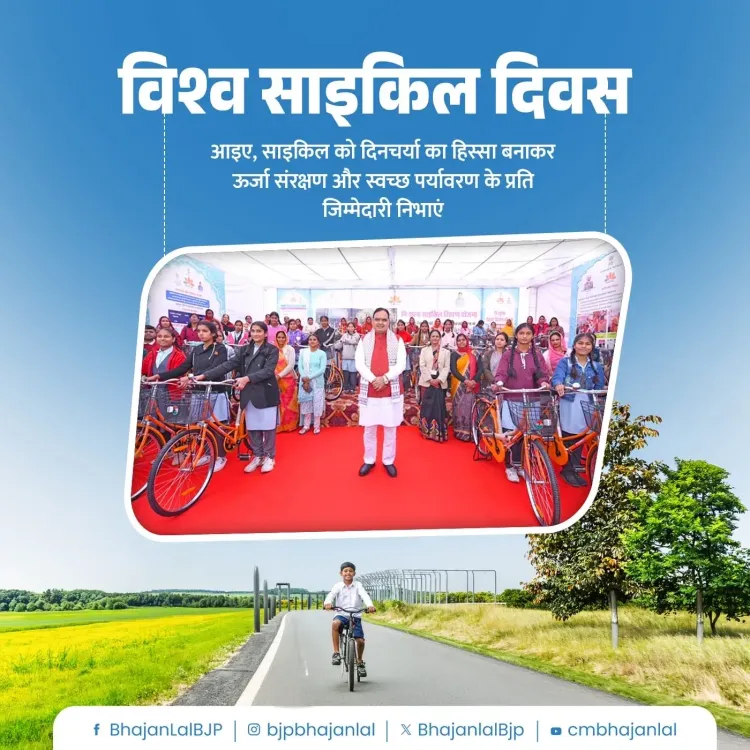
Rajasthan Chief Minister Bhajan Lal Sharma on World Bicycle Day urged residents to make cycling part of their daily routine, linking the appeal to Prime Minister Narendra Modi's Fit India movement and to broader goals of energy conservation, fuel savings, healthier lifestyles and a cleaner environment across the state.
Key Takeaways
Rajasthan CM Bhajan Lal Sharma issued a public appeal on World Bicycle Day, 3 June 2026 .
He urged citizens to make the bicycle part of their daily routine.
The message was framed around PM Narendra Modi 's Fit India and environment agenda.
Stated goals: energy conservation, fuel savings, healthier lifestyles and a cleaner environment.
World Bicycle Day was proclaimed by the UN General Assembly in 2018 .
No new state spending or scheme was announced alongside the appeal.
Rajasthan Chief Minister Bhajan Lal Sharma on 3 June 2026 appealed to citizens across the state to integrate cycling into their daily routine, marking World Bicycle Day with a message that linked personal fitness to fuel conservation and environmental protection. In a post on X, the Chief Minister framed the appeal as an extension of Prime Minister Narendra Modi's Fit India and environmental stewardship agenda.
'Heartfelt greetings to all residents of the state on the occasion of World Bicycle Day,' the Chief Minister wrote, adding that taking forward the Prime Minister's resolve on Fit India and environmental protection, citizens should 'make the bicycle a part of your daily routine and fulfil your responsibility towards energy conservation, fuel savings, a healthy lifestyle and a clean environment.'
Context
World Bicycle Day is observed every year on 3 June following a proclamation by the United Nations General Assembly in April 2018, which recognised the bicycle as a simple, affordable, reliable and environmentally fit means of transport. State leaders in India routinely use the day to issue public appeals that combine health messaging with climate-conscious mobility choices.
Sharma's message follows the established template of pairing a UN observance with a domestic policy hook — in this case the central government's flagship fitness campaign — without announcing fresh expenditure or programmatic commitments. The Chief Minister's invocation of oorja sanrakshan (energy conservation) and indhan bachat (fuel savings) places everyday transport choices within India's wider decarbonisation narrative.
Policy backdrop
The Fit India Movement was launched by Prime Minister Narendra Modi in August 2019 as a nationwide campaign to encourage physical activity, sports participation and healthier lifestyles, with the stated aim of reducing the burden of lifestyle diseases. Cycling has steadily emerged as one of its most cited examples, sitting at the intersection of preventive health and low-carbon mobility.
Successive central campaigns since 2014 — from Swachh Bharat on sanitation to Atmanirbhar Bharat on self-reliance — have consistently framed individual citizen action as integral to national outcomes. State governments, including Rajasthan, have routinely amplified these themes through official communications on designated observance days, embedding behavioural-change messaging within the broader political vocabulary of the ruling BJP.
Stakeholders and impact
The primary audience for the Chief Minister's appeal is the general public, particularly urban commuters in Rajasthan's larger cities such as Jaipur, Jodhpur, Kota and Udaipur, where short-distance car and two-wheeler trips dominate daily travel. Civic bodies, school networks and resident welfare associations are typically the implementing layer for any follow-up cycling drives.
For Rajasthan, a state with hot summers and uneven last-mile cycling infrastructure, the practical uptake of such appeals depends on dedicated lanes, safe parking and integration with public transport. The Chief Minister's framing — voluntary, aspirational and tied to a national campaign — leaves room for municipal authorities to design local interventions without binding the state exchequer to immediate new outlays.
What's next
Observers will watch whether the messaging is followed by concrete state-level steps, such as cycle-track expansion in Rajasthan's municipal corporations or Fit India-aligned events through the 2026-27 budget cycle. Any such moves would test how far rhetorical alignment with central campaigns translates into measurable shifts in mobility patterns and public-health outcomes on the ground.
Point of View
Sharma signals continuity with the BJP's wider behavioural-change politics without committing fresh fiscal resources. The real test lies in whether Rajasthan's municipal bodies translate such appeals into cycling infrastructure, safe lanes and last-mile integration. Until then, the gesture remains aspirational rather than transformative.
NationPress
23 Sept 2026
Frequently Asked Questions
What did Bhajan Lal Sharma say on World Bicycle Day 2026?
Rajasthan Chief Minister Bhajan Lal Sharma urged residents to make cycling a part of their daily routine to support energy conservation, fuel savings, healthier lifestyles and a cleaner environment. He linked the appeal to Prime Minister Narendra Modi's Fit India movement and environmental protection agenda.
When is World Bicycle Day observed and why?
World Bicycle Day is observed on 3 June every year. It was proclaimed by the United Nations General Assembly in April 2018 to recognise the bicycle as a simple, affordable, reliable and environmentally friendly means of transport.
What is the Fit India movement?
Fit India is a nationwide campaign launched by Prime Minister Narendra Modi in August 2019 to encourage physical activity, sports and healthier lifestyles across the country. Its goal is to reduce the burden of lifestyle diseases and embed fitness in daily routines.
Did the Rajasthan government announce any new cycling scheme?
No new cycling scheme or budgetary allocation was announced with the message. The Chief Minister's post was an appeal for voluntary citizen action rather than a programmatic policy announcement.
Who is Bhajan Lal Sharma?
Bhajan Lal Sharma is the Chief Minister of Rajasthan and a leader of the Bharatiya Janata Party. He regularly issues public messages aligning the state with central government priorities on health, environment and citizen engagement.