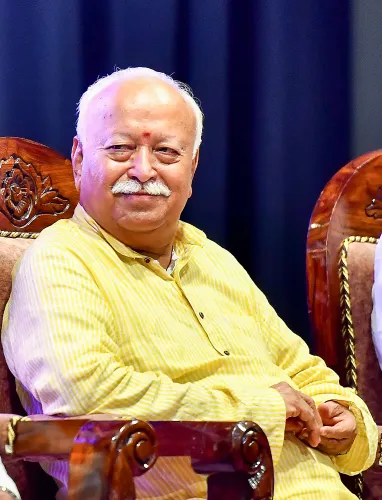
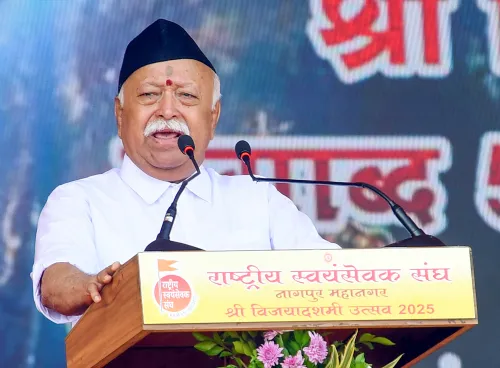
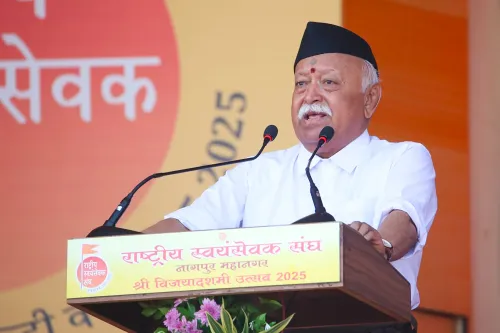
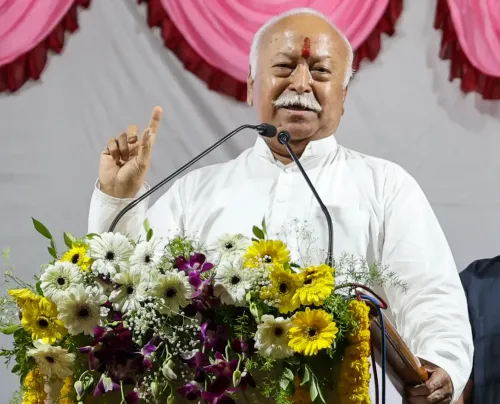
RSS chief Mohan Bhagwat urges Bharat to share civilisational vision for global welfare
Synopsis
RSS chief Mohan Bhagwat used the closing session of a 380-delegate national education conference in Bengaluru to argue that Bharat's integrated knowledge systems offer what modern global frameworks cannot — completeness. The address signals a concerted push to globalise India's civilisational worldview through the NEP 2020 framework.
Key Takeaways
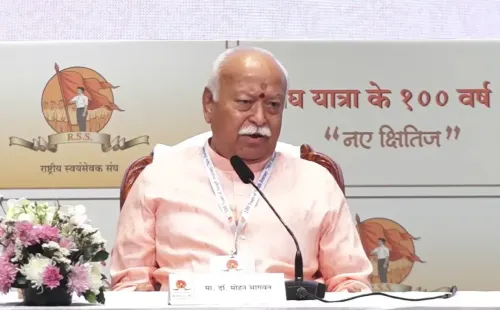
RSS chief Mohan Bhagwat addressed the valedictory session of the National Conference on NEP 2020 in Bengaluru on 28 June .
He called on Bharat to share its civilisational vision with the world, saying it provides 'completeness' where modern frameworks fall short.
Bhagwat elaborated on the principles of 'Anekata' (pluralism) and 'Shaastrartha' (respectful scholarly dialogue) as core Bharatiya values.
The conference was organised by Bharatiya Shikshan Mandal (BSM) and drew around 380 delegates from across India.
Karnataka Governor Thaawar Chand Gehlot inaugurated the three-day event; BSM also launched its new website at the conference.
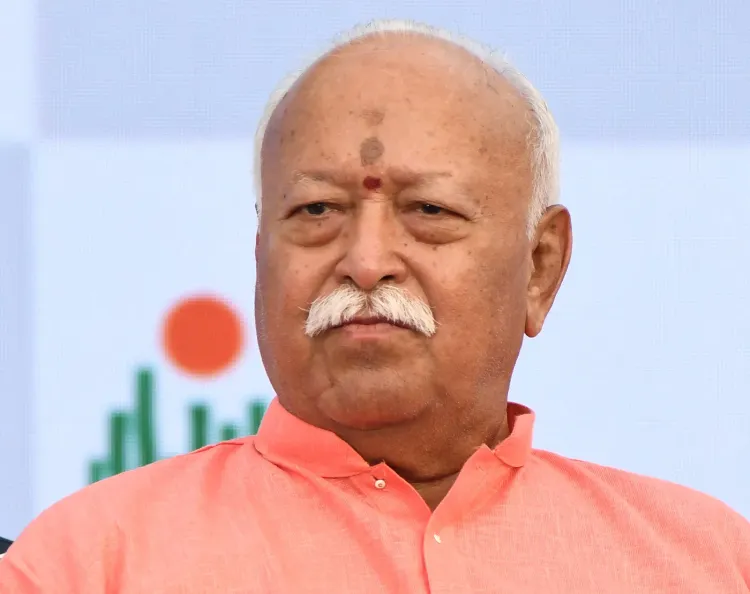
Rashtriya Swayamsevak Sangh (RSS) chief Mohan Bhagwat on Sunday, 28 June called on the nation to actively project its holistic civilisational worldview to the global community, arguing that Bharat's integrated knowledge systems carry the completeness required to address challenges that modern global frameworks only partially resolve. He was speaking at the valedictory session of a three-day national conference in Bengaluru.
Key Developments
Bhagwat delivered the closing address at the National Conference on 'Operationalising NEP 2020: Integrating Indian Knowledge Systems', organised by Bharatiya Shikshan Mandal (BSM) at the Art of Living International Centre from 26 to 28 June. The conference drew around 380 delegates — educators, academicians, and scholars from across the country.
The event was inaugurated by Karnataka Governor Thaawar Chand Gehlot. Senior BSM functionaries, including All-India President Sachchidanand Joshi and All-India General Secretary Bharatsharan Singh, were also present. The occasion also marked the launch of Bharatiya Shikshan Mandal's new website, aimed at expanding its reach among educators, scholars, and citizens.
What Bhagwat Said
'Our work is, in fact, to give completeness to the world,' Bhagwat declared, framing BSM's educational mission as part of a broader civilisational responsibility. He elaborated on the Bharatiya principle of 'Anekata' (pluralism), emphasising that it does not dismiss other perspectives as incorrect but recognises their validity rooted in diverse lived experiences.
He advocated 'Shaastrartha' — respectful scholarly dialogue — over confrontation, arguing that truth is expansive and no single viewpoint can fully encompass it. 'Bharatiya perspectives are complete where others remain incomplete,' he added.
On Education and BSM's Role
Bhagwat praised BSM's commitment to a holistic education model that nurtures the complete human being, moving beyond material success and monetary metrics. He reiterated the organisation's political independence, recalling that leaders of the freedom movement deliberately maintained separation between cultural-educational work and political organisations to preserve the purity and effectiveness of such efforts.
The conference deliberations centred on effectively implementing the National Education Policy (NEP), 2020, by deeply integrating India's classical knowledge traditions into contemporary curricula.
Broader Context
Bhagwat's address reflects a growing national conversation around reclaiming and internationalising India's knowledge heritage. The RSS has in recent years consistently pushed for greater integration of traditional Indian epistemologies — ranging from Ayurveda and Yoga to classical philosophy — into mainstream education and public discourse. The NEP 2020 framework, which mandates greater emphasis on Indian languages and knowledge systems, has provided institutional ground for such efforts. Notably, this conference is among the larger organised attempts to translate that policy mandate into an actionable academic framework.
How effectively these ideas translate into curriculum reform across India's vast and heterogeneous education system remains to be seen.
Point of View
Translating civilisational aspiration into classroom reality requires more than conferences and policy mandates. Whether BSM's growing organisational footprint can bridge that gap — without triggering legitimate concerns about ideological capture of educational institutions — is the accountability question mainstream coverage has largely avoided.
NationPress
29 Jun 2026
Frequently Asked Questions
What did RSS chief Mohan Bhagwat say at the Bengaluru conference?
Bhagwat urged India to actively share its civilisational and integrated knowledge vision with the world, arguing that Bharatiya knowledge systems offer completeness that modern global frameworks lack. He also advocated pluralism and respectful scholarly dialogue as core principles.
What was the National Conference on NEP 2020 about?
The three-day conference, organised by Bharatiya Shikshan Mandal at the Art of Living International Centre in Bengaluru from 26 to 28 June, focused on operationalising the National Education Policy 2020 by integrating Indian knowledge systems into contemporary education. It brought together around 380 delegates including educators and academicians.
Who attended the Bharatiya Shikshan Mandal conference in Bengaluru?
The conference was inaugurated by Karnataka Governor Thaawar Chand Gehlot and attended by around 380 delegates from across India. Senior BSM functionaries including All-India President Sachchidanand Joshi and All-India General Secretary Bharatsharan Singh were also present.
What is Bharatiya Shikshan Mandal and what is its role in NEP 2020?
Bharatiya Shikshan Mandal is a cultural-educational organisation that works to promote Indian knowledge systems and holistic education. It has been actively involved in efforts to implement the NEP 2020 framework, particularly its provisions for integrating classical Indian traditions into curricula.
What is the principle of 'Anekata' that Bhagwat referred to?
'Anekata' is a Bharatiya philosophical concept meaning pluralism — the recognition that diverse perspectives hold validity based on different lived experiences, without dismissing others as wrong. Bhagwat cited it as a distinguishing feature of India's civilisational worldview.