Vishwaguru Vision: RSS Chief Bhagwat Backed by Seers, Ex-Babri Litigant
Synopsis
RSS chief Mohan Bhagwat's Vishwaguru vision for India got a powerful multi-faith boost on Saturday — Hindu seers backed it while warning of brain drain, and former Babri Masjid litigant Iqbal Ansari declared India is already a world leader, contingent on religious brotherhood. A rare moment of convergence across ideological lines.
Key Takeaways
RSS chief Mohan Bhagwat declared at a Nagpur temple ceremony on April 25, 2025 that India will become a Vishwaguru , comparing the certainty to the Ram Mandir's construction.
Saint Varun Dasji Maharaj warned that brain drain is the single biggest obstacle to India achieving Vishwaguru status, urging the government to act urgently on talent retention.
Deveshacharyaji Maharaj of Siddha Peeth Hanumangarhi called those who doubt India's Vishwaguru trajectory "foolish," pointing to Indians holding top positions in countries worldwide.
Jagadguru Paramhans Acharya framed Bhagwat's message as a counter to 'anti-Sanatan' forces and concerns about Hindu safety in the country.
Former Babri Masjid litigant Iqbal Ansari declared India is already a Vishwaguru and stressed that interfaith brotherhood among Hindus, Muslims, Sikhs, and Christians is the key to sustaining that status.
The Vishwaguru debate reflects a growing convergence of cultural nationalism and geopolitical ambition in India's public discourse, particularly following the Ram Mandir consecration in January 2024.
Ayodhya, April 25: Hindu religious leaders on Saturday rallied behind Rashtriya Swayamsevak Sangh (RSS) chief Mohan Bhagwat's assertion that India is destined to become a 'Vishwaguru' — a global spiritual and intellectual leader — in the near future. While endorsing Bhagwat's conviction, several seers sounded a clear alarm over brain drain as a critical obstacle to that ambition. In a notable cross-community endorsement, former Babri Masjid litigant Iqbal Ansari declared that India has already earned the status of Vishwaguru, provided religious brotherhood continues to flourish.
Bhagwat's Vishwaguru Declaration at Nagpur Ceremony
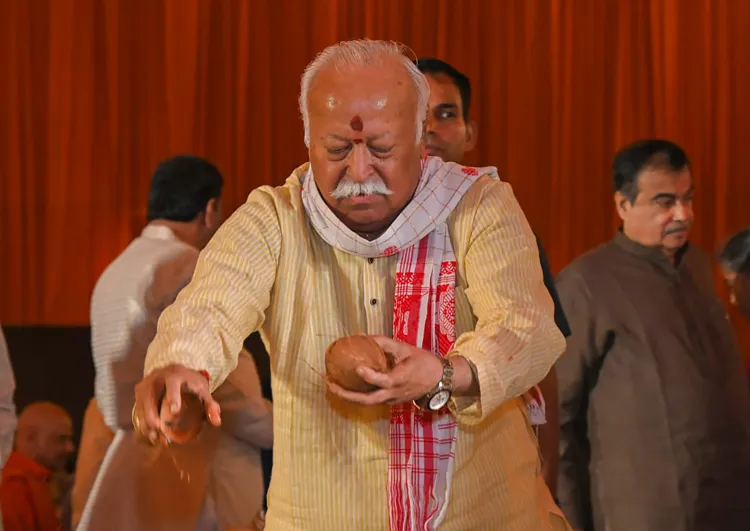
Mohan Bhagwat made the remarks during the foundation-stone laying ceremony of the 'Bharat Durga Shakti Sthal' temple in Nagpur. Drawing a parallel with the long-doubted construction of the Ram Mandir in Ayodhya, Bhagwat urged citizens to replace uncertainty with unwavering conviction.
"Do not harbour doubt, Bharat will become Vishwaguru," Bhagwat declared. "Earlier, people would ask me if Ram Mandir will ever be built. And I kept saying, 'I don't know how, but it will happen.'" He emphasized that the same faith must now be directed toward India's rise as a world leader.
This statement comes at a time when India is increasingly asserting itself on the global stage — from its G20 Presidency in 2023 to its growing influence in multilateral institutions, space exploration, and digital governance. Bhagwat's remarks are widely seen as a reaffirmation of the cultural nationalist vision that underpins the RSS's long-term civilizational outlook.
Seers Sound Brain Drain Warning
Saint Varun Dasji Maharaj offered a grounded, pragmatic perspective alongside his endorsement. He stressed that India's historic intellectual legacy must not be undermined by the ongoing exodus of its brightest minds to foreign nations.
"India was a Vishwaguru earlier as well, but in view of the current international scenario, technological advancements, and scientific progress, the country will also have to stop the brain drain of its talent," he told IANS. He further added, "India can become Vishwaguru only if development takes place at double the speed."
This concern is statistically significant. According to OECD data, India is among the top source countries for skilled emigration globally, with hundreds of thousands of engineers, doctors, and researchers settling abroad each year. The United States, Canada, the United Kingdom, and Australia remain top destinations, drawn by higher wages, better research infrastructure, and quality of life — factors that domestic policy has yet to fully counter.
Deveshacharyaji Maharaj of Siddha Peeth Hanumangarhi echoed this concern while also dismissing critics of India's Vishwaguru trajectory as "foolish." "Just as those who doubted the construction of the Ram Temple were foolish. Such people don't deserve to exist in the society," he said, in remarks that are likely to draw both support and criticism for their sharp tone.
He also highlighted India's growing global footprint: "Today in many countries, Indians have been appointed in some or the other highest position," referencing the rise of Indian-origin leaders in corporate boardrooms and governments across the world — from Sundar Pichai at Google to Rishi Sunak as former UK Prime Minister.
Jagadguru Paramhans Acharya on Anti-Sanatan Threats
Jagadguru Paramhans Acharya offered a more geopolitically charged reading of Bhagwat's message. He told IANS that the RSS chief's assurance was also a counter-narrative to what he described as 'anti-Sanatan' forces spreading fear through the concept of 'Ghazwa-e-Hind'.
"Because of this, people are concerned about the safety of Hindus in the country," Paramhans Acharya said. He added that Bhagwat's statement was a message of hope: "He has assured that the future of the country is bright. No one can stop the progress of the nation."
This framing reflects a broader ideological positioning — one that links India's civilizational rise with the protection and promotion of Sanatan Dharma, a theme that has grown more prominent in public discourse particularly since the consecration of the Ram Mandir in January 2024.
Iqbal Ansari: Brotherhood Is the Real Foundation of Vishwaguru
Perhaps the most symbolically significant voice in this chorus was that of Iqbal Ansari, the former Babri Masjid litigant who had accepted the Supreme Court's 2019 verdict on the Ayodhya dispute. His endorsement of India's Vishwaguru status carries weight precisely because of his identity and history.
"India has already been a Vishwaguru," Ansari stated, adding that as long as brotherhood prevails among Hindus, Muslims, Sikhs, and Christians, the country will continue to hold that stature. "Wherever we are lacking, that would be fulfilled as well," he said, urging the government and society to ensure equal respect for all religions.
Ansari's inclusive framing stands in deliberate contrast to more exclusionary articulations of the Vishwaguru concept. His voice adds a pluralist dimension to the debate — one that grounds India's global leadership potential not in religious dominance but in constitutional harmony and interfaith coexistence.
Broader Implications: Vishwaguru as Political and Cultural Narrative
The Vishwaguru discourse is not new — it has roots in Swami Vivekananda's address at the 1893 Parliament of World Religions in Chicago and has been periodically invoked by Indian leaders across the political spectrum. However, under the current political climate, it has taken on renewed urgency as a civilizational identity marker.
Critics argue that the Vishwaguru narrative risks becoming a rhetorical substitute for addressing pressing ground realities — including unemployment, malnutrition, healthcare gaps, and educational inequality. Supporters counter that restoring civilizational confidence is a prerequisite for sustained national development.
As India approaches the 2029 general elections and continues to assert itself in forums like the United Nations, BRICS, and the Quad, the Vishwaguru vision is likely to remain a central pillar of both cultural diplomacy and domestic political messaging. The challenge, as the seers themselves acknowledged, lies in translating conviction into concrete policy — especially on talent retention and equitable development.
Point of View
Consolidating a civilizational narrative that serves both cultural mobilization and diplomatic branding. But the seers' brain drain warning exposes a glaring contradiction: a nation aspiring to lead the world cannot afford to export its best minds to foreign universities and corporations. Most tellingly, Iqbal Ansari's inclusive framing — grounding Vishwaguru in interfaith brotherhood rather than religious supremacy — is the version of this vision that has the broadest constitutional legitimacy, and the one the mainstream political narrative consistently underplays.
NationPress
7 Oct 2026
Frequently Asked Questions
What is the Vishwaguru concept and why is RSS chief Bhagwat talking about it?
Vishwaguru means 'world teacher' or global leader, a concept rooted in India's ancient civilizational heritage. RSS chief Mohan Bhagwat invoked it at a Nagpur temple ceremony to assert India's destiny as a global leader, drawing parallels with the Ram Mandir construction to inspire national conviction.
What did former Babri Masjid litigant Iqbal Ansari say about India being a Vishwaguru?
Iqbal Ansari stated that India is already a Vishwaguru and will remain so as long as brotherhood among Hindus, Muslims, Sikhs, and Christians is maintained. He urged equal respect for all religions as the foundation of India's global leadership.
Why are Hindu seers warning about brain drain in the context of Vishwaguru?
Seers like Saint Varun Dasji Maharaj argued that India cannot become a true world leader if its top talent continues emigrating to foreign countries for better opportunities. They called on the Union government to implement policies that retain skilled professionals within India.
What is the significance of Bhagwat's Vishwaguru statement in 2025?
Bhagwat's statement in April 2025 comes after the historic Ram Mandir consecration in January 2024 and amid India's growing global influence through G20, BRICS, and space achievements. It reflects a broader RSS strategy to link civilizational identity with national development goals.
Who is Deveshacharyaji Maharaj and what did he say about Vishwaguru?
Deveshacharyaji Maharaj is a religious leader from Siddha Peeth Hanumangarhi in Ayodhya. He strongly backed Bhagwat's Vishwaguru vision, called doubters 'foolish,' and highlighted the global rise of Indian-origin leaders as evidence of India's intellectual and leadership potential.