Will Bharat Rise as Vishwaguru by Leading from Within?
Synopsis
In a compelling address, RSS chief Mohan Bhagwat highlights Bharat's path to becoming a superpower and a Vishwaguru. He emphasizes the importance of leading through example rather than domination, stressing the significance of Dharma in guiding society and fostering unity. This insightful discussion draws attention to India's unique role in global balance.
Key Takeaways
Bharat's rise as Vishwaguru is rooted in leading by example.
Dharma is a guiding force for all existence.
Unity in diversity is essential for national strength.
The RSS aims to reclaim indigenous heritage for social harmony.
The Hindu identity is fundamentally indigenous.
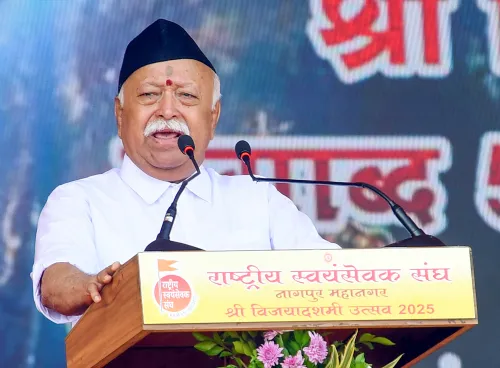
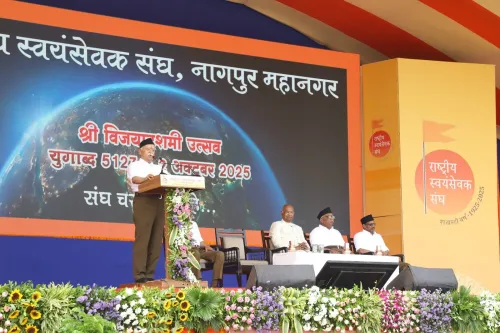
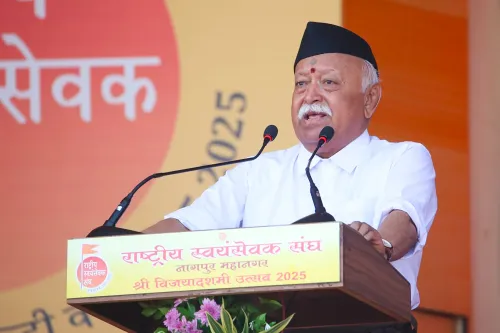
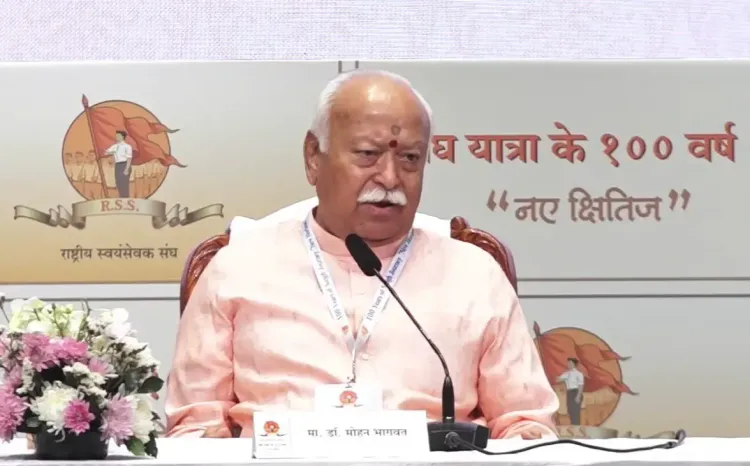
Mumbai, Feb 7 (NationPress) The chief of the RSS, Mohan Bhagwat, stated on Saturday that Bharat is on the path to becoming a superpower, but its journey to become Vishwaguru is equally essential.
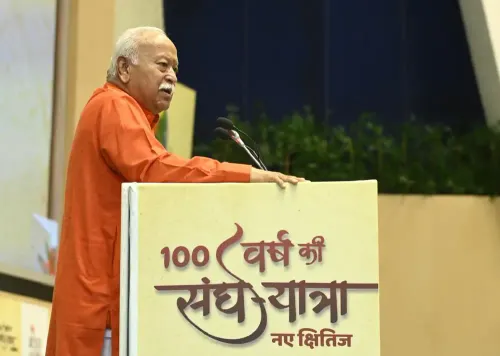
During his address at the two-day "New Horizons" lecture series commemorating the RSS centenary, Bhagwat emphasized that Bharat's ascension to Vishwaguru should not be through domination but rather by leading from within and by setting an example.
He remarked, "Achieving Vishwaguru status demands significant effort, such as character development and societal organization, rather than exerting dominance. As long as Dharma serves as the sustaining force for all existence in Bharat, it will maintain this position and elevate the world," he affirmed.
The event celebrating the RSS Centenary Year was graced by over 900 distinguished guests, including actor Salman Khan, as well as notable scientists, industrialists, and artists.
Bhagwat clarified that Dharma is not merely a "religion" but a "force governing the universe" and an obligation towards all living beings. He described Dharma as a framework of "Universal Discipline" that sustains all forms of life. He posited that India uniquely offers a "third path" for the world, striking a balance between the extremes of capitalism and communism through spiritual materialism.
He stated that the label "Hindu" is not an imposed foreign term but an inclusive descriptor for those aligned with Bharat's ethos, which includes pride in the land, respect for its culture, and a shared legacy of ancestors. He noted that divisions arise from outside influences or internal forgetfulness, rather than from the Hindu identity itself.
Bhagwat articulated that the RSS's vision fosters the reclamation of this shared indigenous heritage to promote social harmony (samajik samrasta) and national strength. He asserted that the Hindu identity is indigenous and not something that "originated from elsewhere." He reiterated that the "Hindu" identity serves as a cultural and civilizational umbrella.
He declared that there is no "Ahindu" (non-Hindu) in India, as all citizens share the same ancestry and cultural heritage, irrespective of their current religion.
The RSS chief critiqued the prevalent use of the term dharmanirpekshata, often equated with secularism, arguing that it is technically inaccurate. He proposed that the more appropriate term is panthnirpekshata (neutrality towards various sects/ways of worship), as Dharma itself is a universal moral code that cannot be treated with neutrality.
Bhagwat reflected on the RSS's journey through significant challenges, noting that despite difficulties, the Sangh has thrived through dedication, perseverance, and selfless service without seeking power or returns. These trials have strengthened the organization without altering its mission.
He remarked, "The RSS is characterized by Sanatan—timeless values derived from Bharat's civilizational ethos. It is not reactive or temporary but represents the unfolding of the Hindu nation's life mission."
He emphasized that while external forms may gradually evolve—much like a banyan seed growing—the intrinsic nature (swabhav) remains unchanged. Perceptions of change may arise from new expressions, but these are merely manifestations of growth, not deviations. "By adhering to Sanatan principles, the RSS navigates challenges without compromising its ideals," he concluded.
Point of View
Mohan Bhagwat's address offers a profound vision for Bharat's future. His emphasis on leading with Dharma rather than domination resonates with the need for unity and strength in diversity. This approach reflects a broader understanding of India's cultural heritage and its potential impact on global dynamics. It is a call for introspection and collective growth, urging citizens to embrace their shared identity.
NationPress
19 Sept 2026
Frequently Asked Questions
What does Vishwaguru mean?
Vishwaguru refers to a global leader or teacher, embodying wisdom and guidance for the world.
How does Dharma play a role in Bharat's future?
Dharma serves as a guiding principle that fosters unity and moral responsibility among individuals and communities.
What is the significance of the RSS centenary?
The RSS centenary marks a hundred years of the organization's contributions to India's social and cultural fabric.
What is the RSS's vision for India?
The RSS envisions a strong and harmonious India that celebrates its indigenous heritage while uniting diverse communities.
Why is the term dharmanirpekshata criticized?
Bhagwat argues that dharmanirpekshata inaccurately equates secularism with neutrality towards Dharma , which is a universal moral code.