Democrats accuse Trump of illegal Iran war, cite $32bn fuel cost surge
Synopsis
Five senior House Democrats have formally accused President Trump of waging an illegal war with Iran that has cost American consumers at least $32 billion in extra fuel costs, pushed gasoline to nearly $4.50 a gallon, and spiked jet fuel by 85%. Separately, Congressman Jason Crow has introduced legislation to cut off federal funding for the conflict entirely — the sharpest congressional pushback yet.
Key Takeaways
Five senior House Democrats sent a formal letter to President Trump on 7 May demanding documents on economic planning before military action against Iran .
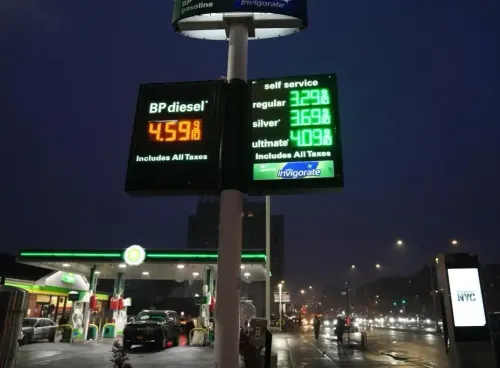
Crude oil prices have reportedly surged nearly 50 per cent since the conflict intensified; US gasoline prices have climbed to nearly $4.50 a gallon .
American consumers have absorbed an estimated $32 billion in additional fuel costs, according to the letter.
Jet fuel costs have risen 85 per cent since the war began, driving up airline, shipping, and electricity costs.
Congressman Jason Crow introduced the "No Funds for Iran War Act" to block federal funding for continued operations without congressional authorisation.
The war has, according to Crow, killed 13 American servicemembers and cost tens of billions in taxpayer dollars; the White House has until 20 May to respond to the Democrats' document request.
Congressional Democrats on Wednesday, 7 May sharply escalated their offensive against President Donald Trump's handling of the US-Iran conflict, accusing the administration of dragging the United States into an "illegal war" that has fuelled inflation, pushed gasoline prices to nearly $4.50 a gallon, and imposed an estimated $32 billion in additional fuel costs on American households.
The Democrats' Letter and Key Demands
Five senior House Democrats sent a sharply worded letter to President Trump demanding documents and answers on whether the administration adequately assessed the economic fallout before launching military operations against Iran. The letter was signed by Rep. Jared Huffman, Ranking Member of the House Committee on Natural Resources; Rep. Robert Garcia, Ranking Member of the House Committee on Oversight and Government Reform; Rep. Frank Pallone Jr., Ranking Member of the House Committee on Energy and Commerce; Rep. Angie Craig, Ranking Member of the House Committee on Agriculture; and Rep. Don Beyer Jr., senior House Democrat on the Joint Economic Committee. The White House has been asked to respond by 20 May.
"As your illegal war with Iran continues into its third month with on-and-off again negotiations and naval blockade, you have unleashed chaos, undermined our national security, and escalated the conflict," the lawmakers wrote.
Economic Fallout: Fuel, Food, and Freight
The Democrats argued that disruptions around the Strait of Hormuz — a critical global oil chokepoint — have driven costs sharply higher across the US economy. According to the letter, crude oil prices surged by nearly 50 per cent after the conflict intensified, while average US gasoline prices climbed to nearly $4.50 a gallon, more than $1 higher than before the attacks on Iran began.
The lawmakers cited reports estimating that American consumers have absorbed at least $32 billion in additional fuel costs. Jet fuel costs, they noted, have risen 85 per cent since the war began, feeding into higher airline ticket prices, increased shipping charges, and elevated electricity bills. "The rising fuel costs are not felt only at the gas pump," the letter stated.
The conflict has also disrupted fertiliser supplies and global liquefied natural gas shipments through Iran's blockade of the Strait of Hormuz, the letter said, warning that food prices were likely to climb further in the coming months as fertiliser, diesel, and transportation costs mount — compounding pressure on farmers already stretched thin.
Allegation of Inadequate Planning
The Democrats further accused the administration of failing to prepare for predictable economic consequences, alleging that key Cabinet officials were not consulted before military action was taken. "You reportedly did not consult with Treasury Secretary Scott Bessent, Energy Secretary Chris Wright, or Director of National Intelligence Tulsi Gabbard to gauge the likely impact on global oil markets before attacking Iran," the letter stated. The lawmakers requested all documents and communications related to the administration's planning on oil markets, fertiliser supplies, transportation costs, electricity prices, and food inflation.
No Funds for Iran War Act
Congressman Jason Crow, a former Army Ranger and member of the House Armed Services and Intelligence Committees, introduced legislation titled the "No Funds for Iran War Act", aimed at blocking federal funding for continued military operations against Iran without congressional authorisation. "I won't vote for a dime to continue this illegal war with Iran. It's clear that President Trump has no endgame and no strategy," Crow said.
Crow stated the war had already "killed 13 American servicemembers, cost us tens of billions in taxpayer dollars, and raised gas prices at home." Congresswoman Maggie Goodlander joined other Democratic lawmakers and veterans in backing the legislation, arguing that Congress should not provide "blank checks for unauthorised wars."
War Powers and What Comes Next
The legislative push comes as an increasing number of lawmakers invoke the War Powers Act and constitutional concerns over the administration's military campaign, now entering its third month. The combination of a formal document demand — with a 20 May deadline — and new funding-block legislation signals a coordinated Democratic effort to force accountability on both the economic and legal fronts. Whether the White House responds substantively will likely shape the next phase of congressional scrutiny.
Point of View
If accurate, are damaging. A 50% crude surge and $32 billion in consumer fuel costs are not abstractions; they are kitchen-table numbers in an election cycle. The more revealing allegation is that Treasury Secretary Bessent, Energy Secretary Wright, and DNI Gabbard were reportedly not consulted before strikes on Iran — a claim that, if substantiated, would suggest a significant breakdown in pre-war economic risk assessment. The 'No Funds for Iran War Act' is unlikely to pass a Republican-controlled chamber, but it forces every member on record. That is the real play.
NationPress
23 Sept 2026
Frequently Asked Questions
Why are Democrats accusing Trump of an illegal war with Iran?
Congressional Democrats argue that the administration launched military operations against Iran without proper congressional authorisation, violating the War Powers Act and constitutional requirements. They also allege the White House failed to assess the economic consequences before acting, citing surging fuel and food costs as evidence of inadequate planning.
How much have US fuel costs risen because of the Iran conflict?
According to the Democratic letter, American consumers have absorbed at least $32 billion in additional fuel costs since the conflict began. Crude oil prices have surged nearly 50 per cent, average US gasoline prices have climbed to nearly $4.50 a gallon — over $1 higher than pre-conflict levels — and jet fuel costs have risen 85 per cent.
What is the 'No Funds for Iran War Act'?
It is legislation introduced by Congressman Jason Crow that would block federal funding for continued US military operations against Iran unless Congress explicitly authorises them. Crow, a former Army Ranger, said the war has killed 13 American servicemembers and cost tens of billions in taxpayer dollars with no clear strategy or endgame.
Who signed the Democratic letter to President Trump?
The letter was signed by five senior House Democrats: Rep. Jared Huffman, Rep. Robert Garcia, Rep. Frank Pallone Jr., Rep. Angie Craig, and Rep. Don Beyer Jr., representing ranking members of key House committees covering natural resources, oversight, energy, agriculture, and the economy.
What deadline have Democrats set for the White House to respond?
The Democrats have asked the White House to provide the requested documents and communications related to economic planning before the Iran strikes by 20 May 2025.