Bhupender Yadav Addresses India–SIDS Coast Partnership at COP31
Synopsis
Union Environment Minister Bhupender Yadav inaugurated the India–SIDS Partnership for Resilient Coasts and Oceans at COP31 in Antalya, spotlighting mangrove conservation, early warning systems, and institutional capacity-building as India deepens its South-South climate cooperation with the world's most sea-level-vulnerable nations.
Key Takeaways
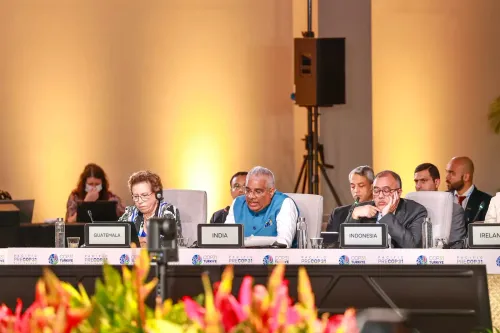
Union Environment Minister Bhupender Yadav delivered the inaugural address at the India–Small Island Developing States Partnership for Resilient Coasts and Oceans on the sidelines of COP31 in Antalya, Türkiye on 17 November 2026 .
India proposed six cooperation areas: coastal risk assessment, shoreline monitoring, early warning systems, mangrove conservation, technology partnerships for island contexts, and government capacity-building.
The partnership builds on India's domestic MISHTI (Mangrove Initiative for Shoreline Habitats and Tangible Incomes) scheme, launched in Union Budget 2023 .
India has prior institutional frameworks in this space, including the Coalition for Disaster Resilient Infrastructure (2019) and the International Solar Alliance , both of which extend tools to SIDS-class vulnerable nations.
The 39 Small Island Developing States face existential risks from sea-level rise and intensifying storms, making the partnership's coastal and oceanic focus directly consequential for affected communities.
Concrete follow-through — joint projects, MoUs, and budgeted programmes — will determine the partnership's real-world impact beyond the COP announcement.
On the sidelines of COP31 in Antalya, Türkiye, Union Environment Minister Bhupender Yadav delivered the inaugural address at the India–Small Island Developing States Partnership for Resilient Coasts and Oceans on Tuesday, 17 November 2026 — placing India at the centre of a conversation that is, for millions of people, an existential one.
For the 39 Small Island Developing States grouped under the SIDS banner, rising seas and intensifying storms are not future scenarios — they are present-tense realities eroding shorelines, livelihoods, and in some cases, entire landmasses. India's decision to anchor a dedicated partnership around their coastal and oceanic challenges signals both strategic intent and a people-first philosophy that Yadav framed explicitly as flowing from Prime Minister Narendra Modi's guidance.
What India put on the table in Antalya
Yadav outlined six concrete areas of cooperation: coastal risk assessment, shoreline monitoring, early warning systems, ecosystem-based approaches — with a specific call-out for mangrove conservation — technology partnerships tailored to island contexts, and institutional capacity-building between governments. The list is notably operational, steering clear of the pledge-and-forget mode that has drawn criticism at previous COPs.
The ecosystem focus has domestic precedent. India launched the Mangrove Initiative for Shoreline Habitats and Tangible Incomes (MISHTI) in the Union Budget 2023, designed to expand mangrove cover along India's own coastline while generating income for coastal communities. Exporting that model — the technology, the institutional know-how — to island nations is a logical extension of what India has already road-tested at home.
India's South-South climate playbook
This partnership fits into a recognisable strategic pattern. India's climate diplomacy has long tried to pair domestic adaptation programmes with practical technology and capacity support for developing nations, rather than simply channelling finance. The Coalition for Disaster Resilient Infrastructure, launched in 2019, already extends adaptation tools to vulnerable countries including SIDS. The International Solar Alliance and the Forum for India-Pacific Islands Cooperation are earlier nodes in the same network.
What distinguishes the Antalya partnership is its coastal specificity. Early warning systems for cyclones and storm surges, shoreline monitoring dashboards, mangrove restoration blueprints — these are the granular instruments that determine whether a fishing village survives a category-four season or is displaced entirely. That granularity is a deliberate choice.
What to watch after Antalya
The partnership is newly inaugurated, which means the real test lies ahead: whether joint projects on coastal risk assessment and mangrove conservation move from ministerial addresses to signed MoUs and budgeted programmes. India's credibility as a South-South climate leader — and SIDS nations' trust in New Delhi as a genuine partner rather than a photo-opportunity — will be measured in the follow-through.
At a COP where the gap between ambition and action remains the central tension, India just made a specific, operationally-framed promise to some of the world's most climate-exposed communities. The clock on delivery has started.
Point of View
New Delhi positions domestic schemes such as MISHTI as exportable models, reinforcing soft power without committing large financial transfers. The timing matters: as COP negotiations strain under the ambition-action gap, India's specificity offers a contrast narrative. The unanswered question is whether the partnership produces binding deliverables or remains a diplomatic statement — and that answer will shape India's credibility with SIDS heading into the next climate cycle.
NationPress
17 Nov 2026
Frequently Asked Questions
What is the India–SIDS Partnership for Resilient Coasts and Oceans?
It is a new cooperation framework launched at COP31 in Antalya, Türkiye, through which India and Small Island Developing States will work together on coastal risk assessment, shoreline monitoring, early warning systems, mangrove conservation, and institutional capacity-building.
What did Bhupender Yadav announce at COP31?
Union Environment Minister Bhupender Yadav delivered the inaugural address at the India–SIDS Partnership for Resilient Coasts and Oceans on 17 November 2026, outlining six areas of practical cooperation between India and island nations highly vulnerable to climate change.
What is India's MISHTI scheme and how does it relate to the SIDS partnership?
MISHTI — the Mangrove Initiative for Shoreline Habitats and Tangible Incomes — was launched in India's Union Budget 2023 to expand mangrove cover along India's coastline while supporting coastal livelihoods. India is now offering to extend this ecosystem-based approach as a model of cooperation to Small Island Developing States.
What are Small Island Developing States and why do they need climate help?
Small Island Developing States (SIDS) are a group of 39 low-lying coastal nations that are among the most vulnerable to sea-level rise, intensifying cyclones, and storm surges driven by climate change, threatening entire communities and in some cases national territories.
What is India's broader approach to climate diplomacy with developing countries?
India pursues South-South climate cooperation through practical technology transfer and capacity-building rather than primarily financial pledges. Platforms include the Coalition for Disaster Resilient Infrastructure (2019), the International Solar Alliance, and the Forum for India-Pacific Islands Cooperation.