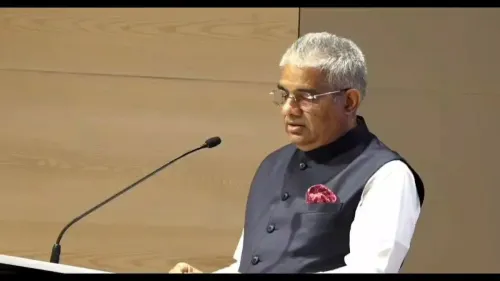
Bhupender Yadav Lists India's Global Green Initiatives
Synopsis
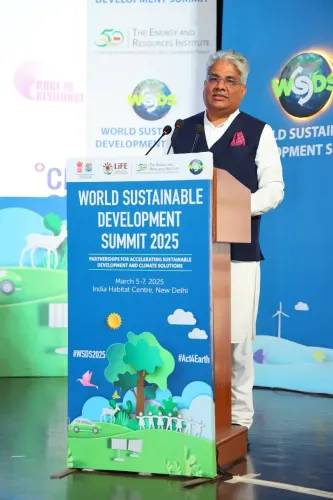
Union Environment Minister Bhupender Yadav highlighted six global platforms India has led — including the International Solar Alliance, CDRI, Global Biofuel Alliance, IMEC, and Mission LiFE — framing them as India's contributions to the welfare of all nations and every form of life.
Key Takeaways
Bhupender Yadav listed six global initiatives on October 13, 2026 , anchored by the rhetorical question 'हमने क्या दिया?' ('What have we given?').
The International Solar Alliance was co-launched by India and France at COP21 in 2015 to expand solar energy among tropical nations.
The Coalition for Disaster Resilient Infrastructure was announced by India at the UN Climate Action Summit in 2019 .
Mission LiFE was unveiled in 2022 to promote sustainable lifestyles globally.
The Global Biofuel Alliance and IMEC both emerged from India's G20 presidency in 2023 .
The list deliberately mixes climate platforms with an economic corridor, projecting India as a comprehensive development leader for the Global South .
From the sun-drenched corridors of COP21 in Paris to the summit halls of New Delhi's G20 presidency, India has quietly assembled a portfolio of global initiatives that its government argues speak louder than any speech. Union Environment Minister Bhupender Yadav drove that point home on Tuesday, October 13, 2026, listing six landmark platforms India has either launched or championed on the world stage.
Six Platforms, One Argument
Yadav's post posed a single rhetorical question — 'हमने क्या दिया?' ('What have we given?') — and answered it not once but four times, each answer a named, treaty-backed initiative. The roll-call: the International Solar Alliance (ISA), the Coalition for Disaster Resilient Infrastructure (CDRI), the International Big Cat Alliance, the Global Biofuel Alliance, the India-Middle East-Europe Economic Corridor (IMEC), and Mission LiFE — Lifestyle for Environment. His closing line framed all six under a single moral umbrella: 'initiatives that benefit everyone, that benefit every life.'
From Paris 2015 to the G20 Stage
The ISA — co-launched by India and France at COP21 in 2015 — was among the earliest of these moves, designed to accelerate solar deployment across tropical and developing nations. Four years later, India announced the CDRI at the UN Climate Action Summit in 2019, building a global partnership around climate-resilient infrastructure standards — a direct response to the infrastructure devastation that extreme weather events routinely inflict on the Global South.
Mission LiFE, unveiled in 2022, shifted the lens inward, asking ordinary citizens and communities worldwide to adopt sustainable daily habits. Then, during India's landmark G20 presidency in 2023, the Global Biofuel Alliance was born — aimed at scaling sustainable biofuels as a credible energy transition tool — alongside the announcement of IMEC, a sweeping connectivity corridor linking India, the Middle East, and Europe.
Why Mixing IMEC With Green Alliances Is a Signal
The list is deliberately eclectic. Placing an economic connectivity corridor like IMEC alongside climate-focused platforms is a studied choice — it frames India's global footprint not as purely environmental, but as comprehensively developmental. Analysts watching India's multilateral diplomacy have noted this pattern: New Delhi consistently bundles clean-energy and climate-resilience initiatives with economic infrastructure projects to project a 'whole-of-planet' leadership image, particularly to Global South partners who need both green standards and hard connectivity.
India's Paris Agreement commitments and its G20 stewardship have provided the diplomatic runway for all six platforms. Whether they translate into expanded membership rolls or new funding pledges at upcoming UNFCCC COP sessions will be the real measure of their momentum.
Six initiatives. One country. The Minister's post is essentially a report card — and it is asking the world to grade it.
Point of View
But as an architect of its institutions, from the ISA to the Global Biofuel Alliance. The deliberate inclusion of IMEC alongside green alliances signals that New Delhi views economic connectivity and environmental leadership as inseparable pillars of its Global South credentials. With UNFCCC COP cycles and G20 summits continuing to be high-visibility stages, this kind of public inventory-taking sets up future diplomatic positioning.
NationPress
13 Oct 2026
Frequently Asked Questions
What is the International Solar Alliance and who started it?
The International Solar Alliance is a treaty-based intergovernmental organisation co-launched by India and France at COP21 in 2015 to accelerate solar energy deployment, especially among tropical and developing nations.
What is the Coalition for Disaster Resilient Infrastructure?
The Coalition for Disaster Resilient Infrastructure is a global partnership announced by India in 2019 at the UN Climate Action Summit, focused on promoting climate-resilient infrastructure standards worldwide.
What is Mission LiFE?
Mission LiFE, or Lifestyle for Environment, is an Indian government programme unveiled in 2022 that encourages individuals and communities globally to adopt sustainable and environmentally responsible daily habits.
What is the Global Biofuel Alliance?
The Global Biofuel Alliance was launched during India's G20 presidency in 2023 to promote the development and use of sustainable biofuels as part of the global energy transition.
Why did Bhupender Yadav include IMEC in a list of environmental initiatives?
By including the India-Middle East-Europe Economic Corridor alongside climate platforms, Yadav framed India's global contributions as spanning both environmental resilience and economic development, projecting a comprehensive leadership role for the Global South.