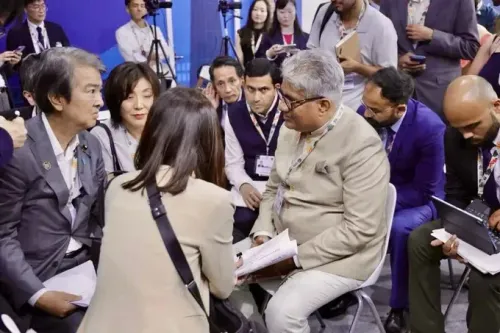
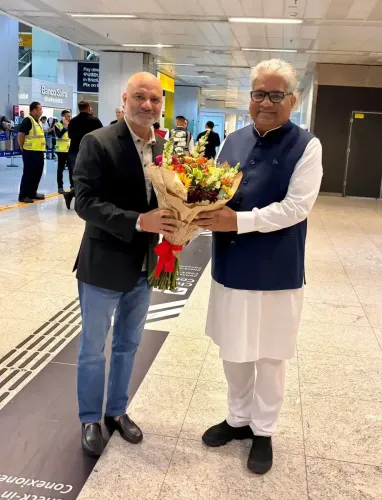
Bhupender Yadav meets UNFCCC chief Stiell in New Delhi
Synopsis
Union Environment Minister Bhupender Yadav held talks with UNFCCC Executive Secretary Simon Stiell in New Delhi on 20 July 2026, covering climate finance, adaptation, technology transfer, and India's early achievement of its enhanced NDC targets under PM Modi's leadership.
Key Takeaways
Bhupender Yadav met UNFCCC Executive Secretary Simon Stiell in New Delhi on 20 July 2026 .
Talks covered adaptation, technology transfer, climate finance, the global stocktake, and just transition.
Yadav highlighted that India has achieved its enhanced NDC targets ahead of the stipulated timeline under PM Narendra Modi .
India had already crossed the 40 per cent non-fossil power capacity milestone before the 2030 deadline.
The meeting reinforces India's strategy of showcasing domestic climate delivery to strengthen its negotiating position on finance and technology access.
Follow-up action is expected ahead of COP29 and COP30 on adaptation finance and technology transfer frameworks.
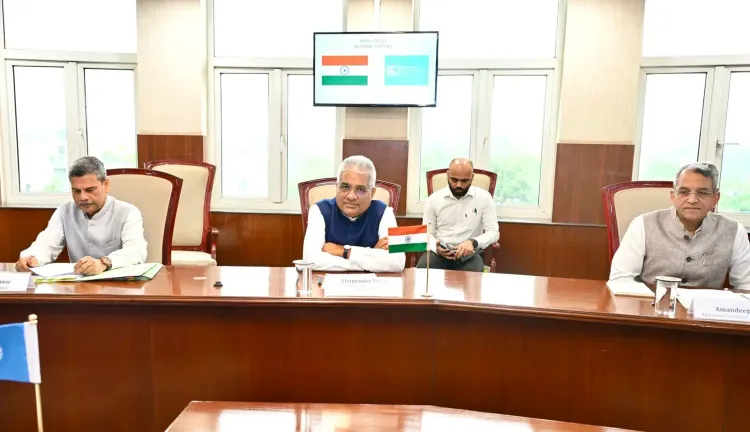
Union Environment Minister Bhupender Yadav met UNFCCC Executive Secretary Simon Stiell in New Delhi on Monday, 20 July 2026, holding wide-ranging talks on the global climate agenda including adaptation, technology transfer, climate finance, the global stocktake, and just transition.
Context
Yadav described the meeting as 'engaging' and said he elaborated on how India, under the leadership of Prime Minister Narendra Modi, had not only submitted its enhanced Nationally Determined Contributions (NDCs) but had also achieved the targets 'way earlier than the stipulated timeline.' The minister added that India is 'taking strides in other allied sectors to combat the climate change crisis.'
The bilateral meeting signals India's continued engagement with the UN climate machinery ahead of upcoming Conference of Parties negotiations, using direct dialogue with UNFCCC leadership to press its priorities on equity, finance, and technology.
Policy Backdrop
India's climate diplomacy received a major boost at COP26 in 2021, when PM Modi unveiled the Panchamrit strategy — five commitments covering renewable energy capacity, emission intensity reduction, non-fossil electricity share, net-zero by 2070, and carbon sink expansion. Building on that, India submitted enhanced NDCs in August 2022, raising its non-fossil electricity capacity target to 50 per cent by 2030.
India had already crossed the earlier benchmark of 40 per cent non-fossil power capacity ahead of its 2030 deadline — a milestone the government has repeatedly cited in multilateral forums to demonstrate domestic delivery on international commitments. Yadav's conversation with Stiell appears to follow this established pattern of showcasing early achievement to reinforce India's credibility in negotiations over climate finance and just transition support.
Stakeholders and Impact
Simon Stiell, who has led the UNFCCC secretariat since 2022, oversees the machinery that governs the Paris Agreement, including the global stocktake process that assesses collective progress. For developing countries and the BASIC grouping — Brazil, South Africa, India, and China — meetings such as this are opportunities to shape the agenda on adaptation finance and technology transfer, which remain contested in global negotiations.
India's renewable energy sector and communities vulnerable to climate impacts stand to benefit most if New Delhi's push for enhanced adaptation finance and technology access translates into concrete commitments at future COP sessions. The discussion on 'just transition' also reflects India's insistence that the shift away from fossil fuels must be financed and supported by developed nations, not simply mandated.
What's Next
Attention will now turn to follow-up on the global stocktake decisions and new climate finance pledges expected at COP29 and COP30. Possible India-UNFCCC joint initiatives on adaptation frameworks and technology transfer mechanisms could emerge from the groundwork laid in today's New Delhi meeting.
India's ability to demonstrate early NDC achievement while simultaneously pressing for greater financial and technological support from the developed world will remain central to its negotiating posture as the international community moves toward the next round of global climate commitments.
Point of View
Not merely a courtesy call. By demonstrating that it has delivered on its Paris Agreement commitments ahead of schedule, New Delhi strengthens its moral authority to demand reciprocal action from developed nations on climate finance and technology transfer. This bilateral engagement fits a well-worn Indian playbook: lead with domestic credibility, then press hard on equity. With COP30 on the horizon, the timing suggests India is positioning itself early to shape the narrative around just transition and adaptation finance for the Global South.
NationPress
21 Jul 2026
Frequently Asked Questions
Why did Bhupender Yadav meet Simon Stiell in New Delhi?
Union Environment Minister Bhupender Yadav met UNFCCC Executive Secretary Simon Stiell on 20 July 2026 to discuss key climate agenda items including adaptation, technology transfer, climate finance, the global stocktake, and just transition, and to brief Stiell on India's early achievement of its enhanced NDC targets.
What are India's NDCs and has India met them?
India's Nationally Determined Contributions (NDCs) are its climate commitments under the Paris Agreement. India submitted enhanced NDCs in August 2022, targeting 50 per cent non-fossil electricity capacity by 2030, and had already crossed the earlier 40 per cent non-fossil power target ahead of the 2030 deadline.
What is the UNFCCC and who is Simon Stiell?
The UNFCCC (United Nations Framework Convention on Climate Change) is the UN body overseeing the Paris Agreement and global climate negotiations. Simon Stiell has served as its Executive Secretary since 2022, leading the secretariat that supports international climate talks.
What is India's Panchamrit climate strategy?
Panchamrit is India's five-point climate commitment announced by PM Narendra Modi at COP26 in 2021, covering targets on renewable energy capacity, emission intensity reduction, non-fossil electricity share, net-zero by 2070, and expansion of carbon sinks.
What is just transition and why does India raise it in climate talks?
Just transition refers to ensuring that the shift away from fossil fuels is fair and supported, particularly for developing economies. India raises it in climate talks to argue that developed nations must provide finance and technology to help poorer countries transition without sacrificing economic growth or jobs.